What to Do When Poplar Trees Get Canker Disease? A Detailed Guide to Prevention and Control Methods
Poplar is the general term for deciduous trees of the genus Populus in the willow family (Salicaceae). The genus contains more than 100 species, mainly distributed in the temperate and cold zones of Europe, Asia, and North America, as well as the Mediterranean coastal countries and the Middle East. China has more than 50 species. The wood is used for civil construction materials, furniture production, matchsticks, sawn timber, papermaking, and is also used for...
Poplar is the general term for deciduous trees of the genus Populus in the willow family (Salicaceae). The genus contains more than 100 species, mainly distributed in the temperate and cold zones of Europe, Asia, and North America, as well as the Mediterranean coastal countries and the Middle East. China has more than 50 species. The wood is used for civil construction materials, furniture production, matchsticks, sawn timber, papermaking, and is also used for particleboard and fiber materials. The leaves are good fodder. Poplar is also a major tree species for timber forests, shelterbelts, and greening around homes, villages, roads, and water.
Over the years, China has made considerable achievements in poplar scientific research, successfully introducing and breeding a number of superior poplar clone varieties. After large-scale promotion, these have formed tremendous productivity with remarkable economic benefits. High-yield cultivation techniques have been combined into high-yield cultivation models and supporting technologies, shortening the rotation period and improving yield and wood quality. In poplar pest and disease control, some truly effective methods and integrated control techniques have been proposed. Due to the adoption of superior poplar varieties and high-yield cultivation measures, over the past decade or more, the newly planted poplar plantations in China have achieved higher yields per unit area than before, and the rotation period has also been shortened.
In recent years, due to the implementation of the national Grain for Green project and the fourth-phase afforestation project of the "Three-North" Shelterbelt Program, many provinces and cities have established large areas of high-yield poplar plantations in these projects. Currently, the total area of poplar plantations in China is about 6 million hectares, accounting for 19% of the national total plantation area and 4 times the world's poplar plantation area. Because poplars are susceptible to pests and diseases, project achievements are difficult to consolidate and may even fail.
In recent years, canker disease (also called bark rot) has been the main cause of poplar death. Most poplars, especially fast-growing varieties, may be infected.
I. Symptoms of poplar canker disease. The trunk and branches of poplars are the sites where bark rot occurs. It manifests as two types: trunk rot and (dieback) dead branches.
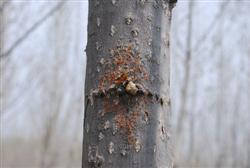
1. Trunk rot: Mainly occurs on the main trunk, large branches, and branch forks. In the early stage, it appears as dark brown, water-soaked lesions, slightly swollen, with the cortical tissue rotting and softening, a distillers' grain smell beneath the bark, and water seeping out when pressed by hand. Later it loses water and sinks, sometimes the bark in the diseased area cracks and even becomes filamentous, and the lesions sometimes have obvious dark brown margins. Under suitable conditions, it expands longitudinally faster than laterally. When the diseased area encircles the trunk completely, the parts above it die, the cortex rots, and the fibers separate like hemp, easily peeling from the xylem, and the sapwood also discolors. In the later stage, many pinhead-sized protrusions appear on the lesions, which are the fungal pycnidia. In wet weather, yellow, orange, or red tendril-like cirrhi of conidia are extruded from the ostioles of the pycnidia.
2. Dieback disease: Mainly occurs on seedlings, young trees, and branches of large trees. In the early stage, it appears dark gray, the diseased area expands rapidly, and after encircling the branch, the upper part of the branch dies.
II. Pathogen and disease patterns of poplar canker disease
The disease is mainly caused by Valsa sordida in the Ascomycota subdivision, whose asexual form is Cytospora chrysosperma in the Deuteromycota subdivision. It overwinters as mycelium and immature fruiting bodies in diseased tissues. Pycnidia and mature conidia are produced in the overwintering lesions and become the main source of infection that year. The disease begins in April of the following year, with the first peak of incidence from late May to June. In July-August, when temperatures rise, the disease slows down, and a second peak of incidence appears in September, at which time the pathogen comes from conidia formed in the lesions of that spring, and it stops after October. When the spring temperature reaches above 10°C and the relative humidity is above 60%, the disease begins to occur; 24-28°C is most suitable for disease development. The pathogen enters through wounds or lenticels, with an incubation period of about 1 month. From disease onset to conidia formation takes 2-3 months, and in autumn, locules and ascospores form on the lesions. Latent infection is an important characteristic of poplar canker disease. Ascospores are spread by wind to the host cortex, invade through wounds, and show symptoms after overwintering. When tree vigor is weak, the disease is more likely to occur. Some lesions that develop on healthy trees in the current year may heal naturally the following year. On the same diseased tree, there are more lesions on the sunny side than on the shady side. Seedlings that have not been transplanted generally do not develop the disease or have very mild disease. Once transplanted, water balance is lost, tree vigor declines, and the disease is prone to occur. The spring disease peak is the result of infection from the previous autumn, not from infection in the current spring. When spring afforestation is carried out, new lesions on newly planted young trees are also caused by infection in the nursery the previous year. Therefore, the number of pathogen-carrying seedlings is closely related to the degree of disease in young trees in new forest land. Arid and infertile site conditions are important predisposing factors for the disease and are also the main reason why canker disease is particularly common and severe in China's arid and semi-arid "Three-North" regions. Extensive root damage during seedling lifting and substantial water loss of seedlings during planting are the internal reasons why newly planted young trees are prone to the disease. Different poplar species and strains differ significantly in resistance to canker disease. Species of the section Populus (white poplars) are resistant, species of the section Aigeiros (black poplars) have moderate resistance, while species of the section Tacamahaca are mostly susceptible. Most hybrid strains between Tacamahaca and Aigeiros species are also relatively susceptible. Populus cathayana, Populus pseudo-simonii, Qunzhong poplar, and Beijing poplar are all highly susceptible poplars. Among resistant sections, some strains are susceptible; for example, Populus tomentosa is a relatively resistant tree species, but some of its strains (triploid Populus tomentosa) are very susceptible. Among susceptible types, there are also resistant strains. At the same time, the susceptibility of tree species is also very closely related to their environmental conditions.
III. Prevention and control measures for poplar canker disease. Improving tree growth vigor and increasing tree resistance is the fundamental approach to controlling this disease.
(1) Choose suitable soil and varieties when planting, and match species to the site. Strictly follow technical regulations to improve disease resistance. (2) Cultivate strong seedlings. Cuttings should be stored in a cool, dark place below 2.7°C to avoid reducing the vitality of the cuttings, avoid long-distance transport of seedlings, carefully heel in, and soak roots for more than 24 hours before afforestation or dip them in mud slurry. (3) Post-planting tending and management, control of wood-boring pests, and rational pruning without leaving stubs. Pruning should be done in winter, and pruning during the rainy season should be avoided as much as possible. Avoid heavy pruning; cut and saw wounds should be disinfected by applying lime sulfur mixture, or coated with wuningmycin or sprayed at high concentration. (4) Severely diseased poplars should be removed and burned promptly to prevent the spread of the pathogen. Stands with severe infection should be completely cleared to avoid forming new sources of infection and infecting larger areas of stands. (5) Strengthen forest tending and management to promote vigorous tree growth. Before winter or in early spring before the pathogen reproduces and spreads, spray high-concentration fungicide on the trunks of young plantations, and for middle-aged forests, brush fungicide, lime sulfur mixture, or Bordeaux mixture on the trunks to prevent disease. For treating diseased trees, scraping off the lesions before applying the agent gives better results. Practice has proven that applying fungicide to the diseased area results in obvious new tissue regeneration and wound healing after 15 days. (6) For lightly diseased plants or stands, while strengthening management and improving forest growth vigor, scrape off the lesions with a knife, scraping down to healthy tissue, then spray or brush the trunk. Optional chemical agents include 10-fold edible alkaline water, or 10-fold dilution of 20% Nongkang 120 aqueous solution, 50-fold 40% asomate, 100-fold 50% Tuzet, 5% thiophanate, carbendazim, etc., applied 2-3 times consecutively.