What are the harms and control measures of poplar canker?
Poplar canker is a common and frequently occurring disease, extremely harmful to Populus species as well as willow, elm and other tree species. The disease is a latent infection disease. When adverse conditions such as drought, waterlogging, sunscald, freezing damage occur, or when tree vigor is difficult to restore after seedling transplanting or heavy pruning, the disease develops rapidly, and in mild cases affects tree growth...
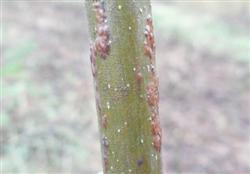
Poplar canker is a common and frequently occurring disease, extremely harmful to Populus species as well as willow, elm and other tree species. The disease is a latent infection disease. When adverse conditions such as drought, waterlogging, sunscald, freezing damage occur, or when tree vigor is difficult to restore after seedling transplanting or heavy pruning, the disease develops rapidly. In mild cases it affects tree growth, causing symptoms such as delayed leaf flushing, smaller leaves, dead branches and dead trunks; in severe cases it causes trees to die in patches.
Disease symptoms
The disease occurs on the bark of branches and trunks of poplar, willow and other trees. In the early stage, irregular swellings appear on the bark, which feel relatively soft to the touch and give off a faint alcohol smell when the bark is peeled. The swollen patches gradually lose water, then shrink and sink, and may even crack. When the bark is peeled back, the subcortical cambium can be seen to be decayed, and brown areas appear on the surface of the xylem. The diseased bark continues to expand, spreading fastest in spring and autumn, and developing faster longitudinally than transversely. On the sunken diseased bark, dense small black pimple-like bodies appear, which are the conidiomatal stromata of the pathogen.
When rain occurs or humidity is too high, a milky white paste-like substance is squeezed out from the top of the black spots and gradually turns orange-yellow; this is the spore horn of the pathogen. The spore horns dry as they are extruded, forming slender tendrils. The conidiomatal stromata are sometimes arranged in concentric rings. After drying, the diseased bark is very easy to peel off, and the cortex can be seen to have rotted into tangled, hemp-like fibrous strands. If the diseased bark girdles the trunk for one full circle, the branches and trunk above that point will dry up and form dead branches.
When twigs are affected, there are no obvious canker spots; when the rough bark is affected, there are also no obvious canker spots and no tendril-like spore horns, but there are amber-colored conidial masses.
Disease occurrence pattern
The pathogen survives and grows in the diseased bark year after year, forming conidia in April, with the highest production in May. Spore horns are more abundant after rain or in wet weather. After rainwater dissolves the spore horns, the spores are spread by wind, rain, insects and birds, and invade, colonize and remain latent through unwounded dead bark. In northern regions, the disease begins in mid-March, peaks in May, eases in July, and stops developing in September.
Poplar canker is positively correlated with freezing damage, sunscald injury, insect damage, salt damage and drought damage. Regarding tree species, white poplar (Populus alba) and Euphrates poplar (Populus euphratica) are the most resistant to the disease, Simon poplar (Populus simonii), Canadian poplar (Populus canadensis) and Lombardy poplar (Populus nigra var. italica) are next, and the Cathay poplar group (Populus cathayana) is the most susceptible.
Using overly large seedlings for planting, damaging the root system during transplanting, transplanting too many times, or large seedlings or young trees that have been heeled in too long are all prone to disease because their vigor is difficult to restore after transplanting. For urban and rural landscaping trees, poor pruning technique, excessive pruning and frequent mechanical injury all favor disease occurrence. In shelterbelts and block plantations, the windward side is also prone to disease because it is often hit by wind-blown sand. When density is too low or pruning is excessive, causing excessive light exposure and sunscald injury, the trees are also prone to disease.
Control measures
1. Maintaining vigorous tree growth is the main approach to controlling this disease. When planting, choose suitable soil conditions, select tree species and varieties resistant to freezing, insects and sunscald, and protect the root system. After planting, strengthen tending and management, control trunk-boring pests, prune reasonably without leaving stubs, and protect wounds. In early winter, whitewash the trunks to prevent freezing damage and sunscald. After the stand is established, improve stand sanitation and remove weakened branches and entire trees. Shelterbelts should be designed and established with a semi-permeable structure, and small shrubs should be planted on the windward side.
2. For chemical control, the following can be used: 10% alkaline water, 2% Kangfuji 843 (1:3 dilution), 10% Shuangxiaoling (1:10 dilution), pine tar diesel oil (1:1), 10% sodium carbonate solution, carbendazim (1:25), thiophanate (1:25), and lime sulfur mixture, but Shuangxiaoling (1:10 dilution) is the preferred agent. This is because it has good efficacy, low cost, abundant supply, is easy to promote and causes no phytotoxicity, and the best methods of use are trunk painting and trunk spraying. When using the above agents, if 50-1oo ppm gibberellin is applied around the disease spot 5 days after application, it can promote the formation of callus tissue and make the disease spot less likely to recur.