Detailed Explanation of Key Cultivation Techniques for Fast-growing and High-yield Poplar Plantations
In order to achieve fast growth, high yield, and high quality and efficiency in poplar, scientific cultivation techniques must be applied. Based on the research results and practical experience of poplar cultivation techniques in our province, the following key technical points should mainly be mastered: 1. Site selection. Selecting afforestation land suitable for poplar growth is the basic condition for achieving fast-growing and high-yield poplar...
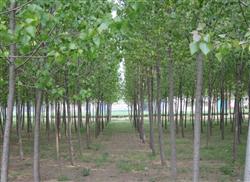
In order to achieve fast growth, high yield, and high quality and efficiency in poplar, scientific cultivation techniques must be applied. Based on the research results and practical experience of poplar cultivation techniques in our province, the following key technical points should mainly be mastered:
1. Site selection. Selecting afforestation land suitable for poplar growth is the basic condition for achieving fast-growing and high-yield poplar. Poplar is a fast-growing species among deciduous broadleaf trees, and grows best on alluvial soil that is deep, loose, fertile, moist, and well-drained. Poplar afforestation land in our province is mainly in plain areas and river beach land. The afforestation land should meet the following conditions:
1. Deep soil layer, with effective soil layer thickness greater than 1.0 m.
2. Relatively light soil texture. For species of the Aigeiros section (such as Euramerican poplar and eastern cottonwood varieties), light loam and sandy loam are best, followed by medium loam and tight sand; species of the Populus section (such as Chinese white poplar) can grow on relatively light or heavy soil.
3. Suitable groundwater level. The suitable groundwater level for poplar growth should be around 1.5 m; during the growing season, the groundwater level should be below 1 m and not lower than 2.5-3 m.
4. Relatively high soil nutrient content. Minimum requirements: organic matter content greater than 0.4%, nitrogen content greater than 0.03%. Available nitrogen greater than 15 mg/L, available phosphorus greater than 2 mg/L, available potassium greater than 40 mg/L.
5. Soil with no salinity-alkalinity or slight salinity-alkalinity. Soil salt content should preferably be below 0.1%, and groundwater mineralization should be lower than 1 g/L.
2. Careful land preparation. After the afforestation land is leveled and the drainage and irrigation ditch system is repaired, carry out overall deep plowing (or deep turning) of more than 30 cm, then dig large planting holes with a diameter of 0.8-1.0 m and a depth of 0.8-1 m.
3. Selection of improved varieties and strong seedlings
1. Selection of improved varieties. According to different cultivation objectives, select suitable improved varieties that have already passed provincial-level forest tree improved variety approval.
(1) Plywood timber. Plywood requires large-diameter timber, with a straight and full trunk form, no scars or knots, moderate wood hardness, and good rotary cutting, drying, and gluing performance. The main improved varieties suitable for cultivating plywood timber are those of the Aigeiros section, such as I-69, I-72, L323, L324, Zhonghe No. 1, T26, T66, Zhonglin 46 poplar, etc.
(2) Pulpwood. Pulpwood requires poplar varieties with fast growth, light wood color, relatively high wood density, high cellulose content, long fibers (should reach more than 0.9 mm), fiber length-to-width ratio greater than 35, wall-to-lumen ratio less than 1, and low impurity content. Poplar varieties suitable for cultivating pulpwood include: I-69 poplar, I-72 poplar, L323, L324, L35, Zhonghe No. 1, Zhonglin 46, I-107, Zhonglin 23 poplar, etc.
(3) Furniture timber. It requires a straight and full trunk, few scars and knots, relatively high wood density, fine structure, low heartwood content, relatively high mechanical strength and hardness, easy drying, small swelling and shrinkage, easy processing, and good gluing and painting performance. The main varieties include Lumaо 50, Yixian female plant, I-69, I-107, L35, I-102, T26, T66, Zhonglin 23 poplar, etc.
2. Selection of strong seedlings. Experiments have proved that using black poplar seedlings with 2-year roots and 1-year stems or 2-year roots and 2-year stems, height above 4.5 m, and diameter at breast height above 3.5 cm for afforestation not only shortens the seedling recovery period and strengthens resistance to natural disasters, but also results in fast growth, early maturity, and high timber yield. The requirements for strong seedlings are a well-developed and complete root system, thick and strong seedlings, a high degree of lignification of branches and shoots, plump and full terminal buds, no mechanical damage, and no pests or diseases.
4. Afforestation density. Designing a reasonable afforestation density should be determined according to factors such as the characteristics of the poplar variety, site conditions of the afforestation land, cultivation objectives, and rotation period. For afforestation land with good site conditions, fast-growing varieties with larger crowns, and cultivation of large-diameter timber, the density should be lower; when site conditions are relatively poor, varieties with straight trunk form and narrower crowns are selected, and short-rotation stands are cultivated, the density can be higher.
According to the relevant provisions of the national wood standards for poplar wood, combined with the research results on afforestation density of poplar high-yield plantations in Shandong, it is considered that the afforestation density for short-rotation pulpwood plantations is 2 x 3 m, 3 x 3 m, 3 x 4 m, and the afforestation density for plywood timber is 5 x 6 m, 6 x 6 m, 4 x 8 m, so as to facilitate the cultivation of large-diameter timber.