Detailed Explanation of the Key Cultivation Techniques for Roselle
Roselle (Hibiscus sabdariffa) belongs to the Malvaceae family, genus Hibiscus, and is an annual herbaceous plant native to Sudan in Africa. It has purple stems, green leaves, yellow flowers and red fruits, with brilliant colors. It is currently the world's most ideal natural plant health beverage; its seeds can be pressed for oil and have high medicinal value, and are also edible; the lower stems can be used as feed and fuel, so it may be said to be a treasure from top to bottom. In order to...
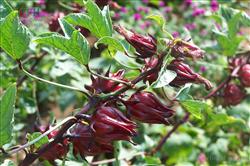
Roselle (Hibiscus sabdariffa) belongs to the Malvaceae family, genus Hibiscus, and is an annual herbaceous plant native to Sudan in Africa. It has purple stems, green leaves, yellow flowers and red fruits, with brilliant colors. It is currently the world's most ideal natural plant health beverage; its seeds can be pressed for oil and have high medicinal value, and are also edible; the lower stems can be used as feed and fuel, so it may be said to be a treasure from top to bottom. In order to study this technique, the Hongta District Agricultural Technology Station introduced roselle for planting in 2011 and achieved success. The techniques are now introduced as follows:
I. Soil requirements: Roselle is a plant that fears waterlogging but not drought. It is best to choose a sunny site with deep soil and good drainage, and sandy loam for planting. Apply 1000-1500 kg of farmyard manure per mu.
II. Planting density: According to soil fertility, the plant-to-row spacing is (0.6 x 0.8) cm, and it is best to sow 1300-1500 hills per mu.
III. Sowing time: Soak the seeds for 12 hours before sowing. Sowing from mid-to-late April to early May is more suitable. For dibbling, sow 3-4 seeds per hill; for raising seedlings in nutrient pots and transplanting, transplant promptly when the seedlings are 12-15 cm tall.
IV. Field management:
1. Timely pest control: Seedlings emerge 5-7 days after sowing. Spray 50 ml of 2.5% lambda-cyhalothrin per mu to control pests. Control of root and crown rot: when it occurs, use 5 g of 5% Baodingning and 30 ml of 2% kasugamycin mixed with 15 kg of water to drench the roots twice. Pesticides must be sprayed before flowering. Spraying pesticides is strictly prohibited during the flowering period, so as to avoid pesticide residues remaining in the calyx and affecting product quantity.
2. Timely thinning, final singling and pinching: When the seedlings grow to 10-15 cm, thinning should be carried out, removing weak and diseased seedlings, keeping only one healthy seedling per hill, and removing the rest to fill gaps. Thinning should not be too late, otherwise it will affect seedling growth. When the seedlings are 80 cm tall, pinching should be carried out to promote strong branches, more flowers and plump calyces.
3. Fertilization and irrigation: Roselle does not need large amounts of water and fertilizer, but for land with poor fertility and seedlings with poor growth, additional fertilizer should be applied appropriately. Apply 20 kg of compound fertilizer, 8 kg of urea and 5 kg of zinc fertilizer per mu to promote seedling growth; before flowering, apply 30 kg of compound fertilizer and 20 kg of potassium sulfate per mu to meet the needs of flowering.
4. Cultivation and weeding, drainage: When the plants are 30 cm tall, combine with topdressing and earthing up, and carry out 2-3 timely cultivations. In summer, due to abundant rain, weeds grow densely, so manual weeding is necessary to avoid competing with roselle for fertilizer and water. During the rainy season, attention should be paid to digging ditches for drainage to prevent seedling death and the occurrence of root rot.
IV. Harvesting and drying
Roselle is mainly harvested for its calyces. In mid-to-late October, when the seeds inside the flower buds become hard or brown, choose a sunny day and use scissors to cut off the fruiting branches, remove the calyx together with the fruit, and sun-dry for one day first. After shrinkage, remove the calyx. When removing the calyx, use a metal tube with a diameter the size of a water pen cap, press it against the base of the fruit, and push the round fruit out to separate the calyx from the fruit. The calyx must be kept intact and must not be split or peeled off. Then place it on a clean site and with clean tools to dry in the shade, or dry it at 40°C. Roselle is acidic and very prone to mold, so it must be dried in time.