Detailed Explanation of the Seven Steps in Rose Cultivation and Management
1. Site selection and garden establishment: In mountainous areas, make full use of field ridges and earthen slopes, which not only increases economic returns but also fixes the soil and protects the ridges, preventing soil erosion. On plains, dedicated rose gardens should be established in contiguous blocks. However, whether in mountainous areas or on plains, never plant on heavy, sticky, waterlogged ground. 2. Soil treatment: Before planting, carry out soil disinfection, mainly by steam sterilization; if conditions do not permit, chloropicrin fumigation may be used. After chloropicrin fumigation, deep plowing should be done several times to avoid phytotoxicity affecting the development of the plant root system. Then apply 20 cm of farmyard manure and plow it in. On plains, form high beds with a bed surface width of 200 cm and a bed height of 15-20 cm.
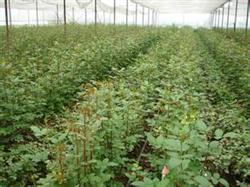
1. Site selection and garden establishment: In mountainous areas, make full use of field ridges and earthen slopes, which not only increases economic returns but also fixes the soil and protects the ridges, preventing soil erosion. On plains, dedicated rose gardens should be established in contiguous blocks. However, whether in mountainous areas or on plains, never plant on heavy, sticky, waterlogged ground.
2. Soil treatment: Before planting, carry out soil disinfection, mainly by steam sterilization; if conditions do not permit, chloropicrin fumigation may be used. After chloropicrin fumigation, deep plowing should be done several times to avoid phytotoxicity affecting the development of the plant root system. Then apply 20 cm of farmyard manure and plow it in. On plains, form high beds with a bed surface width of 200 cm and a bed height of 15-20 cm.
3. Planting: Set row spacing at 2-2.5 m and plant spacing at 1-1.5 m; on plains, the row and plant spacing may be appropriately increased. Dig planting holes (60 cm long, wide and deep), place the seedlings in, fill with soil, firm it down and water.
4. Fertilization: Fertilization can be carried out in 2 applications. One is in late autumn, combined with deep plowing, applying 3000-3300 kg of farmyard manure per mu; the other is after flowering, combined with loosening the soil, applying 5-25 kg of diammonium phosphate or other compound fertilizer per mu.
5. Pruning: Roses have strong sprouting ability. If not pruned in time, the branches often grow weak and die because the plant clump becomes too dense. Pruning should be based on plant age, growth condition, and fertilizer, water and management conditions, following the principle of thinning as the main method and heading back as a supplement, so as to keep old plants with young branches, many branches but not dense, and good ventilation and light penetration. Old branches more than 5 years old should be thinned out in time to support the growth of new branches. For roses that are weak in growth and have basically lost the ability to bloom, heavy pruning can be done to promote new branch growth.
6. Pest and disease control: The main diseases of roses are rust, powdery mildew and brown spot. To control rust, diseased buds can be removed and buried deeply. Before and during the onset of rust, powdery mildew and brown spot, spray triadimefon, thiophanate or chlorothalonil once every half month, which has a good effect on preventing disease infection and spread. The main pests of roses include scarab beetles, bagworms, red spider mites, aphids, scale insects, longhorn beetles, and others. Scarab beetles and bagworms mainly damage the tender shoots and leaves of roses; during their occurrence, phoxim or deltamethrin can be sprayed. Red spider mites, aphids and scale insects mainly suck the sap of roses, causing weak growth; systemic insecticides such as dimethoate and monocrotophos can be sprayed for control. Longhorn beetles are destructive pests; their adults should be captured and killed and the nectar plants they feed on should be removed to suppress their occurrence.
7. Harvesting: Different harvesting times for roses lead to considerable differences in yield and quality. Usually rose buds should be harvested before they open, that is, when the longitudinal diameter of the bud is 3 times that of the calyx, which is the best time to harvest. Harvesting too early reduces yield, while harvesting too late means the flowers have already opened and quality is affected. During the concentrated flowering period, pick robust and plump buds, and leave other thin, weak buds to be picked as petals after they fully open. Flowers that open sporadically at other times should also be picked as petals after they fully open.