What are the care and management methods for colored calla lilies?
How should colored calla lilies be managed when planting? 1 Current production status of colored calla lilies. Colored calla lily is a perennial bulbous flower of the genus Zantedeschia in the Araceae family, and is an excellent cut flower and potted flower. In recent years, because of its bright colors, elegant form and wide range of applications, colored calla lily has occupied an increasingly important...
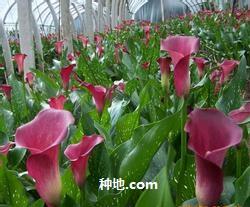
How should colored calla lilies be managed when planting?
1 Current production status of colored calla lilies. Colored calla lily is a perennial bulbous flower of the genus Zantedeschia in the Araceae family, and is an excellent cut flower and potted flower. In recent years, because of its bright colors, elegant form and wide range of applications, colored calla lily has occupied an increasingly important position in the international flower market, and is recognized as the star of the century's flowers. Colored calla lily originated in the rivers and swamps of southern Africa. It was introduced to Europe for artificial cultivation several hundred years ago, and breeding by interspecific or intergeneric hybridization of calla lily began one hundred years ago. Many countries in the world produce colored calla lilies, especially New Zealand, the Netherlands and other countries, where production and consumption are more extensive. China's introduction, production and application of colored calla lilies has not been long, and large-scale production is in its initial stage, but the momentum of development is good. Heilongjiang Province has several decades of history in cultivating white calla lilies, and in recent years there has already been large-scale production. Heilongjiang Shuangxin Horticulture Company has basically achieved year-round production of white calla lily cut flowers, and cut flowers and seedlings have been successively promoted to Daqing, Qiqihar, Hegang, Mudanjiang and other cities in the province, but the introduction of colored calla lilies in the province is only a matter of recent years, with varieties mainly including light yellow, purple-red, pink and so on.
2 Ecological habits of colored calla lilies
2.1 Temperature: Because colored calla lilies grow in the rivers and swamps of southern Africa, they like warmth and are not cold-tolerant. Their suitable growth temperature is about 23°C, the growth temperature is 18-20°C, and normal flowering can occur when the night temperature is kept above 10°C, but it is best not lower than 16°C. If the temperature is low, flowering is delayed. Colored calla lilies can tolerate a low temperature of 4°C. Above 25°C or below 5°C easily causes colored calla lilies to go dormant, and at 0°C the corms will freeze and die.
2.2 Light: Colored calla lilies prefer sunlight, especially in winter when sufficient light is needed. Colored calla lilies are slightly shade-tolerant. In summer, direct sunlight can cause leaf withering and sunscald, so appropriate shading is needed. Generally, 30% shading is more suitable. Too much shading will affect bract coloring and cause flower colors to be insufficiently vivid. Day length has little effect on flowering, and they can grow well under full sun or half sun.
2.3 Water: Colored calla lilies have relatively strict water requirements. Soil drought should be avoided, while excessive water will cause root rot. Water supply should follow the principle of "frequent small amounts," and the frequency and intensity of watering should vary with the season. Colored calla lilies do not have high requirements for air humidity, but excessively dry air humidity will cause physiological diseases such as leaf curling, wilting, scorched edges and poor spathe development. It is worth noting that air humidity should not suddenly become wet or dry, and a relatively balanced humidity environment should be maintained.
2.4 pH: Colored calla lilies are acid-loving flowers, and their pH adaptation range is between pH 5.0 and 7.5. In actual production, in order to prevent bacterial soft rot, soil acidity is usually maintained between pH 6.0 and 7.0.
2.5 Nutrition: Colored calla lilies require a fertilizer-rich, fertile soil environment. They need sandy loam soil with good drainage and aeration, slightly acidic and rich in humus.
2.6 Dormancy period: The dormancy of colored calla lilies varies by region. In the Cape of Good Hope region of South Africa, they are dormant in summer, while in subtropical regions they do not go dormant. In the temperate regions north of the Yangtze River in China, they are mostly potted, flowering indoors in winter and going dormant in summer due to high temperatures. When cultivated indoors in Heilongjiang Province for cut flower production, year-round production of colored calla lilies can be achieved by heating in winter and shading and cooling in summer. Overall, the main limiting factor for dormancy in colored calla lilies is temperature. In addition, humidity and light will both affect the growth of colored calla lilies. Dormancy in colored calla lilies is a passive adaptation to adverse environments. Temperatures that are too high or too low will cause calla lilies to go dormant.
2.7 Flowering period: Colored calla lilies have a relatively long flowering period, but due to differences in varieties and cultivation regions, the flowering period also varies. Generally, in temperate regions north of the Yangtze River, when potted indoors, the flowering period is mostly from the end of December to May of the following year, with February to March being the full bloom period. In subtropical regions south of the Yangtze River, the flowering period is from December to March of the following year. In areas above 1000 m in altitude, the flowering period can be extended to August to October. By controlling the temperature, light and planting time of colored calla lilies, their flowering period can be effectively controlled.
3 Propagation methods of colored calla lilies. The main propagation methods of colored calla lilies are division of corms and seed propagation. The division method is mostly carried out during the dormant period. Small corms are taken and planted, and they can bloom the following year. Because of its long cycle and great variation, seed propagation is mainly used in the breeding of colored calla lilies and is mostly not used in production. Generally, sowing is done around October, and the suitable germination temperature is about 20°C. With the development of modern biotechnology, large-scale rapid propagation of colored calla lilies by tissue culture will gradually replace traditional propagation methods, because tissue culture is not only fast, but by using shoot tip culture, it can also greatly reduce the chance of viral infection and obtain a large number of healthy seedlings.
4 Key cultivation points of colored calla lilies. Potted colored calla lilies are generally planted in early September. Because of their well-developed root system, flower pots at least 15 cm high should be selected, using well-drained sandy loam rich in humus, and it is best to apply some organic fertilizer as base fertilizer. After emergence, place them in a place with relatively strong light and keep the potting soil moist. In winter, give full light; in summer, shade is needed. The suitable temperature is 20-25°C, and in winter it should be kept above 10°C. During the growing season, apply liquid fertilizer once every 2 weeks, and be careful not to pour liquid fertilizer into the leaf petioles, so as to avoid petiole rot. During the growth period, colored calla lilies should maintain sufficient moisture, but not be too wet. A high-temperature and high-humidity environment will cause colored calla lilies to be infected with bacterial soft rot. Before flowering, if there are too many leaves, some old leaves can be removed to help the flower stems emerge. During the flowering period, fertilizers mainly based on phosphorus fertilizer should be applied. After late June, when the weather becomes hotter and the leaves of colored calla lilies gradually turn yellow, watering should be controlled to promote dormancy. After all the leaves have turned yellow and withered, take out the corms and store them in a ventilated and cool place. In autumn, grade the large and small corms and plant them separately. Large corms bloom, and small corms are used to grow seedlings. When cultivating colored calla lilies in the Heilongjiang region, ventilation and cooling measures can be taken so that they can continue to grow after flowering, achieving year-round growth and even year-round flower production.
5 Pest and disease control of colored calla lilies
5.1 Diseases: Common diseases of colored calla lilies include soft rot, viral disease, gray mold, root rot, etc. The main control methods are: 1) drying and disinfecting corms. 2) soil disinfection. 3) strengthening cultivation management. 4) doing a good job of environmental sanitation, and promptly concentrating and destroying diseased plants and infected corms. 5) appropriate crop rotation. 6) chemical control.
5.2 Insect pests: Common pests of colored calla lilies include aphids, scale insects, red spiders, etc. The main control methods are: 1) increasing plant planting density. 2) strengthening ventilation. 3) applying corresponding chemical agents for control.
Click to get more calla lily planting techniques
Click to get a large amount of flower and tree planting techniques