Where can I find soilless cultivation techniques for calla lilies?
How do you force calla lilies to bloom when growing them? Are there any tips? Calla lilies are not very cold-tolerant, so potted plants should be kept warm in winter. The suitable temperature is 15-25°C, 13-17°C in winter, and the minimum temperature must not be lower than 5°C. At home, you can put a double-layer plastic cover over them, place them on the balcony to get sunlight during the day, and move them indoors at night. If the temperature cannot reach...
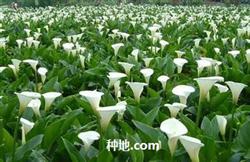 Request: soilless cultivation techniques for calla lilies, the more detailed the better
For soilless cultivation of calla lilies, you can refer to the following:
1. Variety selection. Common horticultural varieties of calla lilies include the white-stem type, green-stem type, and red-stem type. The white-stem type has smaller tubers, a white-green leaf stalk base, slow growth, white spathes, an early flowering period, and many flowers; tubers only 1-2 cm in diameter can bloom. The green-stem type has thick large tubers, a green leaf stalk base, vigorous growth, tall plants, and yellow-white flowers; it flowers late, and tubers must reach 5-6 cm or more in diameter before they can bloom. The red-stem type has moderate growth vigor, a reddish leaf stalk base, and white spathes; its flowering period falls between that of the white-stem type and the green-stem type.
In addition, there are some common horticultural cultivated species in the same genus as calla lilies, such as Zantedeschia albomaculata, Zantedeschia rehmannii, and Zantedeschia elliottiana.
The main forms of soilless cultivation for calla lilies are pot cultivation and trough cultivation. For pot cultivation, the short, compact white-stem type, Zantedeschia rehmannii, and Zantedeschia albomaculata are generally chosen. If large plants are the goal, the tall green-stem type or Zantedeschia elliottiana can be chosen. Calla lilies grown to harvest spathes as cut flowers are suitable for trough cultivation.
2. Soilless cultivation system. The soilless cultivation system for calla lilies mainly consists of growing troughs, a drip irrigation system, a nutrient solution tank, a water pump, and a liquid supply timer. The growing troughs can be built with bricks, with a trough frame width of 80 cm and height of 20 cm. The length of the growing troughs depends on the actual length of the greenhouse, and generally should not exceed 30-40 cm. First lay a layer of plastic film inside the trough to isolate the soil, then add 15-18 cm of substrate. Substrates suitable for soilless cultivation of cut-flower calla lilies include rice husk ash and sawdust at a 3:1 volume ratio, or a mixed substrate of perlite and sawdust at a 2:1 volume ratio. For the drip irrigation system, embedded drip tapes can be used, with emitter spacing of 10 cm or 20 cm, and 2 tapes laid in each growing trough. The volume of the nutrient solution tank is generally preferably 1-2 cubic meters. The selection of the water pump depends on the working pressure and number of drip tapes. Generally, 3 greenhouses can use 1 submersible pump with a power of 450 watts for liquid supply.
3. Planting. Soilless-cultivated calla lilies can be planted in late August. Select healthy, disease-free seed bulbs of uniform size and plant them in the growing troughs at a plant spacing of 15 cm. For seed bulbs of uniform size, the row spacing is 40 cm, and the planting depth of the seed bulbs is 3-4 cm. After planting, lay 2 drip tapes on the outer side of the seed bulbs for liquid supply.
4. Nutrient solution management. For soilless cultivation of calla lilies, the following nutrient solution formula can be used: calcium nitrate 800 g, monopotassium phosphate 210 g, magnesium sulfate 250 g, potassium nitrate 500 g, ammonium nitrate 30 g, ethylenediaminetetraacetic acid iron salt 10 g, manganese sulfate 2 g, zinc sulfate 1 g, boric acid 1.3 g, copper sulfate 0.15 g, ammonium molybdate 0.1 g. In the early growth stage of calla lilies, the nutrient solution concentration can be controlled at 1.2 ms/cm; in the middle and late growth stages, it can be appropriately increased to 1.5 ms/cm. Throughout the entire growth period, the pH value of the nutrient solution must be adjusted to 5.6-6.5. The nutrient solution supply amount is mainly determined according to weather conditions and plant size. Generally, liquid is supplied 2-3 times a day to ensure that the cultivation substrate layer is moist and that there is a shallow water layer at the bottom of the trough.
5. Plant management and pest and disease control. Plant management for calla lilies is relatively simple, mainly removing yellow leaves and some outer leaves. The purpose of removing outer leaves is to avoid leaf crowding that affects light and ventilation, and to allow flower stalks to extend out. The main pests and diseases of calla lilies include bacterial soft rot, aphids, red spider mites, and so on. Bacterial soft rot can damage leaves, leaf stalks, and tubers, and is mainly spread by bacteria carried on tubers. At the early stage of the disease, Bordeaux mixture at 500 times dilution can be sprayed for control.
Click to get more calla lily cultivation techniques
Click to get a massive amount of flower and tree cultivation techniques