What should be noted when transplanting an osmanthus tree?
What common pests and diseases affect osmanthus trees, and how are they controlled? The common pests and diseases of osmanthus trees are: 1. Leaf spot disease: it mainly damages the leaves, initially appearing as small brown spots, with the lesions round or irregular in shape, later gray to grayish-white in the center with reddish-brown edges, and blackish-gray mold-like growth on the lesions. High temperature and high humidity are often...
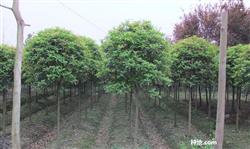 What should be noted when transplanting an osmanthus tree? Please advise.
I. Preparation before transplanting
At a certain time before transplanting, root pruning should be carried out according to the size of the canopy to determine the root range to be kept when transplanting; the root pruning circle should be no smaller than 1/3 to 1/2 of the canopy.
II. Digging up the tree
When transplanting a large osmanthus tree, it must be kept with a soil ball. The size of the soil ball for transplanting is crucial: if too large, it wastes labor and cost; if too small, it affects survival. The diameter of the soil ball is generally about 8 to 10 times the trunk diameter. After a tree with a soil ball is dug out from its original growing site, the soil ball with the root system should be wrapped on site with straw rope and cattail bags, wrapped together with the root collar area, and tied off on the trunk. For a large tree without a soil ball, the wounds should be trimmed smooth, and a slurry should be applied to protect the root system. After completion, cover with topsoil to restore the original level and water thoroughly. Lift it starting from the third year.
III. Hoisting and transport
During hoisting, the load-bearing points of the tree being lifted should be wrapped with hemp bark or cloth, and the outer part should be bound with wooden strips for protection so that the hook does not come into direct contact with the tree, avoiding damage to the bark. The load-bearing points should be chosen at the middle-lower part of the tree. During hoisting and transport, try to avoid swinging back and forth, reduce abrasion of branches and leaves, and avoid loosening of the soil ball. For trees with large canopies, rope should be used to tie them up to tighten the canopy and prevent damage.
Before a large tree is transported, spray the branches and leaves with water to keep them moist. If transport is over a long distance, cover with felt cloth to minimize evaporation of water from the trunk and leaf surfaces during transport. The truck bed should be lined with padding material, and the tree should be placed gently on the padding, arranged as neatly as possible, with the roots forward and the canopy facing backward, to avoid the branch tips being lifted and broken by headwinds during transport. Secure with ropes to reduce swaying during transport, and pay attention to safety at the same time.
When unloading the tree, keep it as close as possible to the planting hole. If it can be lifted and delivered into the planting hole in one go, that is best.
IV. Planting and maintenance
The planting hole dug before planting a large osmanthus tree should be larger than the root system or soil ball range, so that there is a certain distance between the soil ball and the sides of the planting hole, allowing more loose, fertile soil to be filled in after planting, which helps rooting.
1) Position the tree upright: after planting a large osmanthus tree, be sure to place the tree upright so that the trunk is vertical to the ground. This is especially important for trees with large canopies, because moving and adjusting them later is relatively difficult, so it must be done right the first time.
2) Wrap the trunk: to reduce water evaporation from the trunk and maintain trunk moisture, wrap the trunk tightly from the base upward with moist straw rope, then coat the straw rope fully with clay slurry, and thereafter frequently spray water with a sprayer to keep it moist.
3) Install support posts: large trees must have support posts, generally mainly triangular supports. The support posts should be buried in the soil, and large stones should be buried at the foot of the support posts to prevent sinking. For large trees, setting up the support posts before mounding soil can prevent the tree from leaning when soil is mounded. Where the upper part of the support posts is tied to the trunk, soft material should be used as padding. At the same time, the upper parts of the 3 support posts should be tied firmly, and if necessary, waist bands can also be added. The support posts can be made of fir wood or steel pipes; for trees with large canopies, steel pipes are best.
4) Build a shade shed: after planting a large tree, build a shade shed above the canopy to provide shade. The shed can use bamboo, wood, or steel pipes to build scaffolding, and the scaffolding can be covered with shade netting. Choose shade netting of different densities according to the shade tolerance of the tree species; for broadleaf trees, choose shade netting with better shading.
5) Watering and fertilizing: watering should follow the principle of not watering when not dry, and watering thoroughly when watering. Especially in summer, spray water on the ground and canopy, and if necessary, add potassium dihydrogen phosphate or 0.3% urea solution along with the spraying for foliar fertilization. To promote rooting of large trees, add apt rooting agent when watering in the early stage after planting. To restore tree vigor as soon as possible, apply a base fertilizer once in the autumn of the first year after transplanting. In the second year, fertilize 2 to 3 times in early spring and autumn, and apply foliar topdressing if necessary.
Click to get more osmanthus cultivation techniques
Click to get more flower cultivation techniques