Detailed Explanation of Osmanthus Tree Grafting Methods and Technical Key Points
Osmanthus is also known as "Yuegui", "Muxi", "Yangui", "Jiulixiang", and "Qilixiang". The leaves are opposite, mostly elliptical or long-elliptical, with smooth, leathery surfaces and serrated edges. The tree crown is round-spherical. The trunk is rough and grayish-white. Flowers cluster together, 3 to 5 growing in the leaf axils, blooming from September to October, mostly bearing...
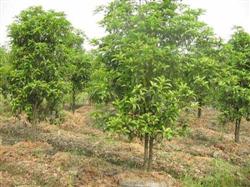 How do you graft an osmanthus tree? Please guide me.
There are many methods for grafting osmanthus. Among them, approach grafting is a commonly used one, and in China, potted osmanthus mostly uses approach grafting. Its advantages are: a long suitable grafting period, easy survival, quick shaping, and early flowering. The key points of osmanthus approach grafting are introduced as follows:
1. Cultivating rootstock. The rootstock tree species used for grafting osmanthus include privet (Ligustrum) and fringetree (Chionanthus retusus). The rootstock used for grafting needs to be a robustly growing 2-3 year old sapling or a 2-3 year old branch on a multi-year-old tree, free of pests and diseases, with a thickness of over 1 cm.
2. Selecting scions. Osmanthus has varieties such as Jingu (golden osmanthus), Yingu (silver osmanthus), Dangui (orange osmanthus), and Sijigui (four-season osmanthus). First, you can choose the osmanthus variety according to your preferences, needs, and available resources, then from the selected osmanthus tree choose robustly growing, well-developed, pest-free, medium-sized 2-3 year old branches as scions.
3. Grafting method. (1) Move the scion close to the rootstock. You can use methods such as propping, padding, framing, hanging, and tying to bring the selected osmanthus branch scion and the rootstock branch close together in the same direction. Then specifically determine the suitable grafting position on the rootstock and scion, and fix the position well. (2) Cut the interface slant. Cut interface slants at the determined grafting positions on the rootstock and scion respectively. The slant is oval-shaped, with a length of 3 cm to 5 cm, and the depth of the slant generally does not exceed half the thickness of the branch. (3) Cut the rootstock. After the grafting and tying is completed, cut off the rootstock branch 1 cm above the interface. (4) Remove sprouts. After grafting, if branches sprout from the part below the rootstock interface, they should be removed promptly. 31 days to 35 days after grafting, cut off the scion from below the interface to separate it from the parent plant. (5) Check survival. 3 days to 5 days after cutting the scion, if the scion's branches and leaves grow normally, it is surviving; if the leaves appear wilted and curled, it has not survived, and grafting should be redone. After successful grafting, the branches grow quickly, and the tying rope easily embeds into the bark and affects growth, so the tying rope should be loosened promptly.
Click to get more osmanthus cultivation techniques
Click to get more flower cultivation techniques