What are the asexual propagation methods for four-season osmanthus?
How do you propagate osmanthus trees by cuttings? The method is as follows: 1. Cutting bed preparation. Select light loamy arable land for deep plowing and bed making. For osmanthus trees, the bed width should be 120 cm, the bed height 25 cm, and the ditch width 40 cm. The soil should be fine and crumbly, the bed surface flat, and the ditches unobstructed. Build a cover above the cutting bed at a distance of...
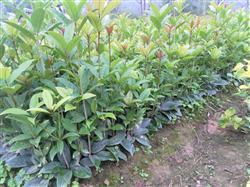 How is four-season osmanthus propagated asexually? Please advise.
Four-season osmanthus is an evergreen small tree of the Oleaceae family. Although its flowers are small, their fragrance is rich. Except in severe cold and extreme heat, it can bloom continuously and has high ornamental and economic value. Four-season osmanthus is produced in southwestern and central China and is suitable for cultivation in various places; in the north it is best grown in pots. Four-season osmanthus is mostly propagated asexually, and the methods are as follows:
(1) Cuttings. Carry this out in spring just before budbreak. Collect 1-year-old stout branches as cuttings, cut each section to about 10 cm long, and keep 2 green leaves at the upper part. Dip the base of the cuttings in a vitamin B12 solution, or soak them for 1 hour in a solution containing 50 mg of ABT No. 2 rooting powder per kilogram, then insert them into a sand tray, with the insertion depth being 1/2 the length of the cutting. Place the tray in a shaded place, avoid direct sunlight, and spray water to keep the sand moist. After 15 days the cuttings will root, and after 40--50 days they can be transplanted or potted.
(2) Grafting. Grafted seedlings grow quickly, have a high survival rate, and bloom early. Use 1--2-year-old seedlings of glossy privet or Chinese privet as rootstock, and commonly use cleft grafting and bud grafting.
(1) Cleft grafting: This is best done in early spring before budbreak. Use 1-year-old strong branches as scions, cut each section to about 10 cm long, keep 2--3 buds at the upper end, cut off 0.5 cm above the buds, and make a cut starting 4 cm from the lowest bud and extending to the end, cutting deep enough to remove the xylem, and on the opposite side of the cut surface make a 0.5 cm long slant at the end. Cut off the rootstock at 6 cm above the ground, smooth the cut surface, and on one side of the cut surface make a vertical downward cut as deep as the length of the long cut surface of the scion. Insert the scion with its long cut surface facing inward into the rootstock cut, align the cambium on one side of both, and finally tie the joint firmly with plastic film tape. After the joint heals and new shoots emerge, remove the tying tape and wipe off the rootstock suckers.
(2) Bud grafting: Carry this out in summer. Use 1-year-old strong branches with plump buds as scions, cut off the leaves but keep the petioles; make a cut 1.5 cm above the bud on the scion and slice upward horizontally, with the cutting depth slightly into the xylem. Make a horizontal cut on the rootstock at 10 cm above the ground, then from the middle of the cut make a vertical downward cut the same length as the bud piece, so that the cut forms a "T" shape, with the depth reaching the cambium. Then open the rootstock cut, insert the bud piece into the "T" opening, and use a plastic film bag to wrap it with the bud exposed. After the grafted bud sprouts, remove the tying tape and cut off the rootstock above the grafted bud.
(3) Air layering. This can be done in spring, summer, and autumn. On superior plants, select 2--3-year-old vigorous branches as layering branches, and make the layering position about 15 cm from the point of attachment of the layering branch. At the layering position, make a ring-shaped peel about 6 cm wide, or tap the bark with a small stick, with the tapping intensity such that the bark is crushed but does not fall off, and after 3--4 days of exposure it can be wrapped with nutrient soil. Use plastic film to wrap 2--3 turns around the layering position, making a film tube 25 cm long and 10 cm thick, then tie the lower end of the film tube tightly with string 5 cm below the layering position, fill the film tube with potting soil (humus soil plus 20% decomposed human manure and urine), and press it firm, and finally tie the upper end of the film tube tightly with string so that it forms a ball shape. Every week use a syringe to inject clean water into the potting soil to keep it moist. After 1--2 months the wound on the layering branch will heal and root, after which it can be cut from the mother tree, the film removed, and transplanted or potted.
Click to get more osmanthus cultivation techniques
Click to get more flower cultivation techniques