What symptoms does tobacco show when it is deficient in nutrients?
How is tobacco curly leaf virus disease prevented and controlled? Tobacco curly leaf disease is also called leaf curl disease. Curly leaf disease is widely distributed in many tropical regions, and it occurs in the tobacco-growing areas of Yunnan, Guangdong, Fujian and Taiwan, China. In 2006, the incidence rate in some tobacco-growing areas of Yunnan was 7-11%. Curly leaf disease has a wide host range, including plants from 14 families and 45 genera...
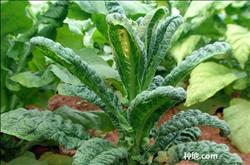 What conditions occur when tobacco is deficient in nutrients? How is it prevented and controlled?
During its growth and development, tobacco needs to absorb a variety of nutrient elements.
With nitrogen deficiency, the lower leaves of the tobacco plant gradually turn yellow and dry up; the leaves are small, whitish in color, lack luster, and the tissue lacks elasticity and is brittle. Preventive and remedial measures: it is recommended to apply compost fermented with enzyme bacteria or fully decomposed organic fertilizer, and if necessary mix in cake fertilizer, and combine with watering to reduce the degree of damage. Ammonium nitrate can also be applied at 10-13 kg per mu.
With phosphorus deficiency, the tobacco plant grows slowly, the aboveground part takes on a rosette shape, the leaves are small, narrow and elongated, the leaves have a rust color, and brown spots appear on the lower leaves, which in severe cases spread to the upper leaves. When phosphorus is deficient, the leaves generally do not mature, and their color is not fresh. Remedial measures: when phosphorus deficiency is found, apply phosphate fertilizer as a base fertilizer before transplanting by mixing it between the rows or by broadcasting it in one application; for phosphorus deficiency in the middle and late stages, spray the leaf surface with a 1%-2% superphosphate extract.
With potassium deficiency, the leaf tips of the lower leaves turn yellow first, then this spreads to the leaf margins and between the veins, and death begins from the leaf margins. Although the tissues around the leaf edge stop growing, the interior is still growing, causing the leaves to curl downward. Preventive and remedial measures: according to actual needs, apply 200 kg of plant ash or 10 kg of potassium sulfate per mu, and if necessary spray the leaf surface with a 2% potassium dihydrogen phosphate solution or a 2.5% potassium sulfate solution.
With calcium deficiency, the plant is dark green at first, then the growing point stops growing, the terminal bud dies, the young buds growing from the sides are deformed, the unfolded leaves become brittle, the leaf margins lose their green color, the roots turn black, and the growth of fibrous roots stagnates. Remedial measures: when calcium deficiency is found, spray the leaf surface with 0.2%-0.5% tobacco-specific compound fertilizer or a 1%-2% superphosphate extract. With magnesium deficiency, the tip of the lower leaf and the areas between the veins around it begin to lose green and turn yellow, then turn white; the parts close to the veins almost all turn white, but the rest remains green. Remedial measures: when magnesium deficiency is found, spray the leaf surface with a 0.2%-0.5% magnesium sulfate solution.
With sulfur deficiency, the symptoms are similar to those of nitrogen deficiency, and the tobacco plant shows yellowing. However, when the sulfur content in the tobacco plant is less than 0.1%, growth is slow, the whole plant is light green, the young leaves are the lightest in color, and the old leaves do not dry up; these symptoms differ from nitrogen deficiency. Preventive and remedial measures: when sulfur is deficient, apply 6-9 kg of gypsum or 2 kg of sulfur per mu. In addition, applying superphosphate can also meet its sulfur needs.
With iron deficiency, the young leaves lose their green color first, and the areas between the veins of the top young leaves turn light green to nearly white. When iron deficiency is severe, the veins lose their green color and the entire leaf turns white. Remedial measures: when iron deficiency is found, promptly spray the leaf surface with a 0.1%-0.2% ferrous sulfate solution.
With boron deficiency, in the early stage the terminal buds, leaves and growing points are abnormal, the young leaves are light green, and the base turns grayish white; in the later stage the terminal buds and leaves die, and even if they do not die, the leaves that grow out are mostly deformed. Remedial measures: when boron deficiency is found, promptly spray the leaf surface with a 0.1% borax solution.
With manganese deficiency, the young leaves lose their green color at first, the areas between the veins change from light green to white, and some leaves develop necrotic spots. Remedial measures: when manganese deficiency is found, promptly spray the leaf surface with a 0.05%-0.1% manganese sulfate solution.
With copper deficiency, the upper leaves are dark green, curl, or become permanently wilted and cannot recover. Remedial measures: when copper deficiency is found, promptly spray the leaf surface with a 0.1%-0.2% copper sulfate solution.
With zinc deficiency, light yellow stripes appear between the veins of the lower leaves at first, then gradually whiten and become necrotic, and the upper new
leaves are light to white in color after unfolding, the internodes of the tobacco plant shorten and it becomes shorter, and the dead parts are water-soaked in appearance. Preventive and remedial measures: in zinc-deficient plots, apply 1.2 kg of zinc sulfate per mu as a base application; if zinc deficiency occurs during the growing period, use 0.5% zinc diamine tetraacetate
solution for leaf surface spraying. If zinc sulfate is chosen for spraying, it is best to add a small amount of 20% slaked lime to adjust the pH value, so as to avoid phytotoxicity.
With molybdenum deficiency, the leaves of the whole plant wilt or curl, with wavy wrinkles, the leaves lose their green color and turn grayish white, and irregular necrotic spots appear on the lower leaves; the spots are grayish white at first, then turn brownish red. Remedial measures:
when molybdenum deficiency is found, promptly spray the leaf surface with a 0.02%-0.1% ammonium molybdate solution.
Click to get more tobacco cultivation techniques
Click to get more flower cultivation techniques