How to Grow Roses? A Complete Guide to Scientific Cultivation Methods
How to grow roses scientifically? Please provide guidance. Rose cultivation can follow the methods below: 1. Variety arrangement: Use Meilan Lipstick and Bellamy as the main summer varieties, and American Pink can serve as a companion variety for summer or autumn and winter. Cardinal and Red 90 serve as the main autumn and winter varieties. 2. Planting period and...
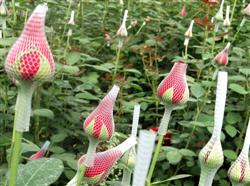
How to grow roses scientifically? Please provide guidance
Rose cultivation can follow the methods below:
1. Variety arrangement: Use Meilan Lipstick and Bellamy as the main summer varieties, and American Pink can serve as a companion variety for summer or autumn and winter. Cardinal and Red 90 serve as the main autumn and winter varieties.
2. Planting period and dense planting specifications: The suitable period for spring planting is from mid-April to early June, and for autumn from late October to mid-November. For dense planting specifications, use a bed width of 1.5 m (bed ditch 60 cm), bed height 30 cm, plant 2 rows per bed, with in-bed row spacing and plant spacing of 30 x 25 cm, and plant enough for 2500 plants per mu.
3. Fertilization: When cultivating in medium soil fertility, apply 35-40 kg of pure n, 31.5-36 kg of p2o5, and 35-40 kg of k2o per mu. The ratio of n, p, and k is about 1:0.9:1. Among these, organic fertilizer should account for more than 60%. The Cardinal variety, which has a high fertilizer requirement, should be given more, while other varieties should be given less as appropriate. Use 3000-3500 kg per mu of decomposed poultry and livestock manure, human urine, mushroom material, mountain soil ash, rotten rice straw, etc. as base fertilizer. After heavy pruning, apply topdressing by opening furrows on both sides of the bed far from the roots, deeply applying organic fertilizer properly combined with chemical fertilizer, and after fertilization combine with intertillage and earthing up. After normal cutting of flowers, topdressing can be applied by mixing with water according to the plant's growth condition.
4. Pruning: For the main summer varieties, prune heavily in winter; for the main autumn and winter varieties, prune heavily in summer. When pruning, for plants with fewer branches and weak growth, the branch-bending method can be used instead of branch cutting. To regulate the flowering period, the suitable pruning period can be estimated by referring to the accumulated temperature of the variety. Routine pruning: mainly, when cutting flowers, cut at 1-2 bud points above the base of the branch, and do not cut high, to prevent the formation of a hollow state.
5. Field management
(1) Intertillage and weeding: Choose clear weather for intertillage and weeding. Intertillage can be combined with fertilization, and do a good job of earthing up and repairing the beds.
(2) Drainage and irrigation: During the rainy season or heavy rain, clear the ditches and drain water in time. In dry seasons, appropriately divert water for irrigation. For the first irrigation, stop watering when the water level reaches one third of the bed height. After that, stop watering when the water level is slightly higher than the previous time, and let it dry naturally.
6. Winter insulation: In mid-to-late November, when the nighttime temperature is around 13°C, cover with film for insulation. On clear and warm days, when the daytime temperature reaches 27°C, open the ventilation layer to cool down, and around 4 p.m. close the ventilation layer for insulation.
7. Prevention and control of major diseases
(1) Black spot disease: Also known as brown spot disease, the pathogen is a fungus of the genus Actinospore. It can occur throughout the production period, and generally the disease is severe in the plum rain season and typhoon season. Prevention and control methods: Sweep up fallen leaves at any time and remove diseased leaves to reduce sources of infection. In winter, carry out heavy pruning on severely diseased plants to remove overwintering pathogens on diseased stems. When new leaves have just unfolded in summer, spray once every 7-10 days with 50% duojuling 500-1000 times solution, or 75% chlorothalonil 500 times solution, or 80% zineb 500 times solution.
(2) Gray mold: The pathogen is a fungus of the class Hyphomycetes, order Hyphomycetales. High temperature and poor ventilation make it prone to occur. Prevention and control methods: Remove diseased parts in time to reduce sources of infection, and also promptly cut off faded rose flowers. Spray with 50% sumilex 2000 times solution, or 50% iprodione 1000-1500 times solution, or 50% thiophanate-methyl 500 times solution, once every 7-10 days, for 2-3 consecutive sprays. Also pay attention to alternating the use of chemicals to prevent resistance.
(3) Powdery mildew: The pathogen is a fungus of the genus Sphaerotheca. It develops rapidly in warm and humid seasons. When there is excessive nitrogen fertilizer and insufficient potassium fertilizer in the soil, the disease is more severe. Prevention and control methods: Prune and destroy all dead infected branches and tips to reduce sources of infection. Diseased leaves in the early stage should be removed as soon as possible. Spray with 20% triadimefon emulsifiable concentrate 2000 times solution, or 50% sulfur suspension 300 times solution, or 75% chlorothalonil 600 times solution, once every 7-10 days, for 2-3 consecutive sprays.
Click to get more rose cultivation techniques
Click to get more flower cultivation techniques