What are the key points of cherry blossom autumn management techniques?
How should cherry blossoms be managed in autumn? Please introduce the methods. Autumn tree management for cherry blossoms. 1. Disease prevention and leaf protection. Cherry blossom leaves are susceptible to infection by diseases such as powdery mildew, brown spot, and sooty mold. If not controlled in time, it can cause premature leaf drop, affecting nutrient accumulation, which is unfavorable for flowering next year. You can use 70% thiophanate-methyl 1000x solution, 65% zineb wettable powder 500x solution, sprayed once every 15 days. Try to avoid using dichlorvos to prevent leaf drop. Water appropriately, and increase foliar fertilizer spraying (0.3% to 0.5% urea, 0.3% potassium dihydrogen phosphate) to ensure the leaves remain intact, thick, and dark green.
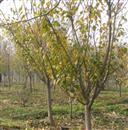
How should cherry blossoms be managed in autumn? Please introduce the methods.
Autumn tree management for cherry blossoms
1. Disease prevention and leaf protection. Cherry blossom leaves are susceptible to infection by diseases such as powdery mildew, brown spot, and sooty mold. If not controlled in time, it can cause premature leaf drop, affecting nutrient accumulation, which is unfavorable for flowering next year. You can use 70% thiophanate-methyl 1000x solution, 65% zineb wettable powder 500x solution, sprayed once every 15 days. Try to avoid using dichlorvos to prevent leaf drop. Water appropriately, and increase foliar fertilizer spraying (0.3% to 0.5% urea, 0.3% potassium dihydrogen phosphate) to ensure the leaves remain intact, thick, and dark green.
2. Autumn base fertilizer application. Base fertilizer is generally applied in early September, when the fertilizer has enough time to decompose, allowing the tree to absorb and utilize it before dormancy. At this time, the roots cut during fertilization can quickly heal and sprout a large number of absorbing roots, improving the tree's absorption and utilization rate of fertilizer. The fertilizer type is mainly decomposed farmyard manure, combined with a small amount of chemical fertilizer. Generally, 50 to 75 kg of compost manure is applied per young tree. Autumn base fertilizer should not be applied too deep, with 40 to 50 cm being appropriate. Young trees can use the trench application method, while robust trees can use the broadcast application method. If nutrient deficiency symptoms are found in the tree, a small amount of trace elements can be appropriately mixed in.
3. Deep plowing of the tree disk. Before the arrival of the autumn root growth peak of cherry blossoms, combined with the application of base fertilizer, deep plowing of the tree disk can increase the amount of deep roots, store water and preserve moisture, and raise soil temperature. Clean up dead branches, fallen leaves, weeds, etc. in the tree disk, and burn them in a centralized manner to eliminate overwintering pests and fungal sources.
4. Autumn pruning. According to the growth status of the tree, promptly thin out dense branches, crossing branches, overlapping branches, and diseased and pest-infested branches to improve ventilation and light penetration in the canopy and enhance tree vigor. Use a sharp knife to smooth and scrape clean the wounds, apply lime sulfur 5-degree solution for disinfection, then apply tung oil or other protective agents to prevent wound rot.
Click to get more cherry blossom planting techniques
Click to get more flower planting techniques