A Detailed Guide to Cherry Blossom Cultivation Techniques and Management Methods
How are cherry blossoms cultivated and managed? Please give an introduction. For cherry blossom planting and management, you can refer to the following: 1. Soil requirements and improvement measures. Cherry blossoms can grow well in sandy loam and clay loam rich in humus (pH 5.5 to 6.5). In places in the south where the soil is heavy clay, generally mix in homemade leaf mold (soil made by composting collected leaves, acidic soil, chicken manure, and charcoal powder). Note that before mixing, all existing clay clods must be broken up, otherwise it will not improve the soil. In places where the groundwater level is less than 1 m, use the raised planting method, that is, level the entire planting hole first, then pile soil on top and plant the seedling. For alkaline soil in the north, sulfur powder or ferrous sulfate, etc. needs to be applied to adjust the pH value to about 6. Apply 2 grams of sulfur powder per sq m, with a validity period of 1 to 2 years, and measure it every year so that the pH value does not exceed 7. Varieties such as mountain cherry and Somei Yoshino have straight trunks and larger tree bodies. They are strongly heliophilous tree species and require shelter from wind and a sunny location, with ventilation and light transmission. When planting in groups, every tree must be able to receive sunlight.
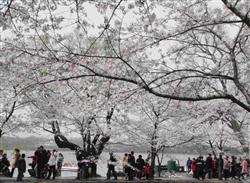
How are cherry blossoms cultivated and managed? Please give an introduction.
For cherry blossom planting and management, you can refer to the following:
1. Soil requirements and improvement measures
Cherry blossoms can grow well in sandy loam and clay loam rich in humus (pH 5.5 to 6.5). In places in the south where the soil is heavy clay, generally mix in homemade leaf mold (soil made by composting collected leaves, acidic soil, chicken manure, and charcoal powder). Note that before mixing, all existing clay clods must be broken up, otherwise it will not improve the soil. In places where the groundwater level is less than 1 m, use the raised planting method, that is, level the entire planting hole first, then pile soil on top and plant the seedling. For alkaline soil in the north, sulfur powder or ferrous sulfate, etc. needs to be applied to adjust the pH value to about 6. Apply 2 grams of sulfur powder per sq m, with a validity period of 1 to 2 years, and measure it every year so that the pH value does not exceed 7. Varieties such as mountain cherry and Somei Yoshino have straight trunks and larger tree bodies. They are strongly heliophilous tree species and require shelter from wind and a sunny location, with ventilation and light transmission. When planting in groups, every tree must be able to receive sunlight.
2. Planting measures
The planting time is immediately after the soil thaws in early spring, generally February or March. Carefully prepare the soil before planting. For planting on flat ground, dig a hole with a diameter of 1 m and a depth of 0.8 m. First fill about half the depth of the hole with improved soil, place the seedling in the center of the hole, and spread the seedling roots in all directions. After filling in a small amount of soil, lift the seedling slightly upward so the root system spreads fully, then press lightly. The planting depth should make the uppermost seedling roots 5 cm from the ground. After planting, make a water-catching basin and water thoroughly, finally using bamboo strips about as tall as the seedling for support to prevent it from being blown over by wind.
3. Management measures
Drought prevention: After planting, seedlings are prone to drought damage. In addition to thorough watering at planting, water once every 8 to 10 days thereafter, keeping the soil moist but without standing water. Loosen the soil promptly after watering, and it is best to cover the ground surface thinly with grass to reduce water evaporation. Within 2 to 3 years after planting, to prevent the trunk from drying out, it can be wrapped with rice straw. However, after 2 to 3 years, once the sapling grows new roots and its adaptability to the environment gradually increases, it no longer needs to be wrapped with straw.
Growing season management: Cherry blossoms are fertilized twice a year, preferably with acidic fertilizer. One is winter fertilizer, applied in winter or early spring with organic fertilizers such as bean cake, chicken manure, and decomposed fertilizer; the other is after flowering, applying quick-acting fertilizers such as ammonium sulfate, ferrous sulfate, and superphosphate. Generally, for fertilizing large cherry blossom trees, the hole application method can be used, that is, dig a ring-shaped ditch about 10 cm deep at the edge of the vertical projection line of the tree crown, and apply the fertilizer into it. This method is both simple and conducive to root absorption. Later, as the tree grows, the diameter and depth of the fertilizing ring ditch also increase accordingly. Cherry blossom roots are shallowly distributed and require good drainage and aeration, so around the tree, especially within the root distribution range, people, livestock, and vehicles must never compact the soil. Trampling by pedestrians will weaken the tree's vigor, shorten its lifespan, and even cause root rot and death.
Pruning and maintenance: Pruning mainly involves cutting off withered branches, water sprouts, overlapping branches, and diseased and pest-infested branches. In addition, when many branches grow on the trunk of a large cherry blossom tree, several robustly growing branches should be retained, and all the rest should be cut off from the base to facilitate ventilation and light transmission. After pruning, disinfect the wounds on the branches promptly with medicine to prevent pathogens from invading after rain and causing rot. After long periods of exposure to the sun, cherry blossom bark is prone to aging and damage, causing rot, and it should be removed and disinfected promptly. After that, wrap the rotted area with leaf mold and charcoal powder to promote the restoration of normal physiological functions.
4. Issues to note when planting cherry blossoms
① Soil requirements of cherry blossoms
Cherry blossoms can grow in sandy soil and clay soil. In places where the water level is less than 1 m, raised planting is needed; rather than that, level the planting hole first, then pile soil on top and plant the seedling. Cherry blossom trees are large, like sunlight, and fear wind. The planting time for cherry blossoms is in early spring, generally February to March.
② Planting method for cherry blossoms
Before planting, level the ground, and dig a hole with a diameter of 0.8 m and a depth of 0.6 m. First fill the hole with 10 cm of organic fertilizer, put the seedling into the hole, and spread the seedling roots in all directions. After filling with soil around the cherry blossom, lift the seedling upward once so the roots spread deeply, then firm it. The planting depth should be about 5 cm from the upper layer of the seedling roots. After planting, water thoroughly, set up support with sticks to prevent it from being blown over by strong wind.
Click to get more cherry blossom planting techniques
Click to get more flower planting techniques