How do you grow jasmine to get a high yield?
How can jasmine cultivation achieve a high yield? Please advise. For high-yield jasmine cultivation, you can refer to the following methods: 1. Reasonable close planting. It is best to choose fertile sandy loam with convenient drainage and irrigation. Deeply plow and prepare the soil, and make turtle-back-shaped beds 1.3 m wide. The planting row spacing is 65 cm, the hole spacing is 33 cm, and the hole depth is 25 cm. Apply 3000 kg of farmyard manure and 25 kg of superphosphate per 667 sq m as base fertilizer at the bottom of the holes. Plant 3 plants per hole, with a plant spacing of 10 cm, in a triangular arrangement. Plant about 10,000 plants per 667 sq m. After planting, cover with soil and press firm, level the bed surface, and water thoroughly to settle the seedlings.
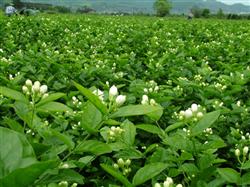
How can jasmine cultivation achieve a high yield? Please advise.
For high-yield jasmine cultivation, you can refer to the following methods:
1. Reasonable close planting. It is best to choose fertile sandy loam with convenient drainage and irrigation. Deeply plow and prepare the soil, and make turtle-back-shaped beds 1.3 m wide. The planting row spacing is 65 cm, the hole spacing is 33 cm, and the hole depth is 25 cm. Apply 3000 kg of farmyard manure and 25 kg of superphosphate per 667 sq m as base fertilizer at the bottom of the holes. Plant 3 plants per hole, with a plant spacing of 10 cm, in a triangular arrangement. Plant about 10,000 plants per 667 sq m. After planting, cover with soil and press firm, level the bed surface, and water thoroughly to settle the seedlings.
2. Timely intertillage. Carry out intertillage in March, May, and July each year, to a depth of 7-8 cm, trying not to damage the root system, and bank the soil from the bed furrows around the base of the stems to a thickness of 3 cm.
3. Fertilize frequently. During the first intertillage in late March, remove dead branches and apply 600 kg of diluted human manure and urine per 667 sq m to promote rooting and new shoot growth so that the plants flower earlier. June to July is the full blooming period of jasmine, when it needs the most fertilizer. After harvesting flowers in June, carry out the second intertillage, and at the same time apply a topdressing of 10 kg of urea per 667 sq m, and remove leaves to improve ventilation, reduce pests and diseases, concentrate nutrients for the flower buds, and encourage more blooming in July. After the peak blooming period of jasmine in July, apply topdressing once a month, each time with 5 kg of urea per 667 sq m, to increase bud formation and improve flower quality, and in the evening apply a 0.5% urea solution as a foliar topdressing 3-4 times.
4. Timely drainage and irrigation. After jasmine plants are established, the soil should be kept moist. Standing water in the field should be drained promptly. During continuous drought, irrigate in the furrows or by watering in the evening, and drain the water immediately once the bed surface is moist. If jasmine plants are soaked in water for too long, it will affect flower quality and reduce yield.
5. Pinch the tops and thin the leaves. After entering the full blooming period, for lush clumps with dense branches and leaves, pinch the tops and thin the leaves several times to promote the formation of more flower buds. When pinching the tops, try not to leave stubs, so as not to affect the sprouting of the second round of new shoots. For clumps with many branches and luxuriant leaves, thin the leaves heavily, generally keeping 1/2 of the leaves; for those with sparse branches and leaves, thin less, and promptly remove dead branches and diseased leaves. When thinning leaves, be careful to protect the petioles and axillary buds. Through pinching the tops and thinning the leaves, yield can be increased by 10%.
6. Prevent and control pests and diseases. Jasmine is mainly harmed by brown spot, southern blight, and scale insects. Brown spot occurs from May to October, mainly harming young branches and leaves, causing branches to die. When the disease occurs, promptly prune off diseased branches and burn them, then spray the branches and leaves with 800-times carbendazim or thiophanate-methyl. Southern blight often occurs in June to July, generally starting at the stem base near the ground and then gradually spreading, forming a white silky film. Affected leaves often wither and fall off, and in severe cases the entire branch dies. When the disease occurs, apply 2-2.5 kg of 75% chloronitrobenzene per 667 sq m, mixed evenly with fine sand and broadcast. When scale insects occur, spray the branches and leaves with 60-times petroleum oil emulsion or control them by hand.
7. Harvest at the right time. Jasmine has a very long flowering period, from June all the way to October. It is generally divided into 3 stages: the 1st stage is in June, commonly known as "mist flowers." During this period, the temperature is not high and the light is poor, so the flower quality is relatively poor and the yield is not high. These flowers should be picked and removed promptly, which is the key to ensuring more flowering and better quality later. The method is to pick the young shoots together with the flowers, so that the axillary buds below sprout into flowering branches, and after 3-4 weeks the 2nd stage flowers can be harvested. The 2nd stage flowers are in July to August, commonly known as "summer flowers." These flowers are large, with a lasting fragrance, and are numerous. The 3rd stage is in September to October, commonly known as "autumn flowers." During this period, the temperature is high and the flower quality is also relatively good.
Click to get more jasmine cultivation techniques
Click to get more flower cultivation techniques