What causes southern magnolia trees to topple over?
Why do southern magnolia trees topple over? What methods can prevent it? Please give guidance. The southern magnolia tree is an excellent urban street tree, with pure white and large flowers, a tall and straight trunk, a beautiful crown, dark green leaves, and a strong ability to resist pollution and absorb dust. But nothing excellent is ever without its shortcomings, and the southern magnolia tree's poor resistance to toppling is one of its weaknesses...
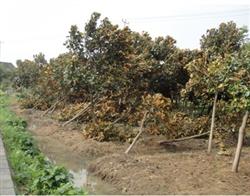
Why do southern magnolia trees topple over? What methods can prevent it? Please give guidance
The southern magnolia tree is an excellent urban street tree, with pure white and large flowers, a tall and straight trunk, a beautiful crown, dark green leaves, and a strong ability to resist pollution and absorb dust. But nothing excellent is ever without its shortcomings, and the southern magnolia tree's poor resistance to toppling is one of its weaknesses. Observation has revealed three main reasons that cause southern magnolia trees to topple over.
First, the head is heavy and the branches and leaves are dense. The leaves of the southern magnolia are leathery, large and thick, and among trees they stand out for the weight per unit area of their large leaves. Because the southern magnolia has wide adaptability, likes fertilizer, and has strong shade tolerance, it produces many branches and many leaves, with leaves overlapping, making the crown of the southern magnolia large and heavy.
Second, the roots are shallow and the base is light. Generally, southern magnolia is grafted onto Manglietia as rootstock. When the root area of a southern magnolia tree is dug open, its root system is found to be underdeveloped, with few and thin branches growing from the main root, and also few lateral roots branching further. In particular, its root system resembles a fleshy root, and its ability to push through the soil is poor. When it encounters compacted soil, the root system cannot spread out, resulting in "shallow roots and a light base."
Third, damage from strong winds. Because of the "heavy head" caused by dense branches and heavy leaves and the "light base" caused by an underdeveloped root system, when strong winds strike, some southern magnolia trees located in windy spots along the street will topple over.
For this, the following measures can be taken.
First, when purchasing southern magnolia trees, choose seedlings with well-developed root systems that have been transplanted several times.
Second, prune branches and cut leaves to solve the "heavy head" problem. Since the crown of the southern magnolia can be beautiful and attractive without pruning, in the past the trees were not pruned. So to solve the "heavy head" problem, the branches and leaves must be pruned before the rainy season and the windy season arrive, so that they allow wind and light through and reduce resistance.
Third, loosen the soil, apply fertilizer, strengthen the roots, and improve management. Improve the compacted soil around the trees so that the soil is airy and loose, then apply an appropriate amount of phosphorus fertilizer to strengthen the roots, which is more conducive to the extension and development of the root system.
Click to get more magnolia cultivation techniques
Click to get more flower cultivation techniques