Detailed Explanation of Camellia Cutting Propagation Methods and Steps
How to propagate camellias by cuttings? Please provide an introduction to the method. Camellia is one of the ten traditional famous flowers of our country. It likes a warm environment, with an optimum growth temperature of 18-25 degrees. It prefers semi-shade, environments with relatively high air humidity, and deep, fertile, loose, well-drained soil. It dislikes strong sunlight and dryness. Cuttings...
How to propagate camellias by cuttings? Please provide an introduction to the method
Camellia is one of the ten traditional famous flowers of our country. It likes a warm environment, with an optimum growth temperature of 18-25 degrees. It prefers semi-shade, environments with relatively high air humidity, and deep, fertile, loose, well-drained soil. It dislikes strong sunlight and dryness.
When propagating camellias by cuttings, the following steps can generally be followed.
1. Preparation of the cutting medium
The cutting medium is required to have characteristics such as heat retention, moisture retention, looseness, and air permeability. Generally, sandy soil or soil rich in humus can be selected as the cutting medium. When conditions do not allow it or when propagating in large quantities, clean loess of superior quality and free of impurities can also be used. About one week before cutting, the cutting medium should be placed under the sun to be exposed or disinfected with potassium permanganate solution. One to two days before cutting, water should be used to moisten the cutting medium.
2. Collection of scions and treatment of cuttings
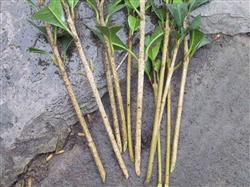
As cuttings, branches from young trees root more easily than branches from old trees, and semi-lignified young shoots root more easily than fully lignified old branches. Therefore, from healthy camellia mother plants with excellent quality, stable traits, robust growth, no pests or diseases, and a relatively short age, select current-year, fully developed, semi-lignified branches as cuttings, and cut them into 8-10 cm long cuttings, retaining the upper 2 leaves, while removing the remaining leaves from the base of the petiole. The upper end of the cutting should be cut flat about 0.5-1 cm from the bud, and the lower end should be cut diagonally near the node.
3. Cutting
When cutting, the principle of cutting immediately after collection should be followed. Insert 1/3 of the treated cutting branch into the moist medium (generally about 3 cm; in arid areas, it can be inserted somewhat deeper). To avoid damaging the cortex at the base of the cutting, first make a hole with a small wooden stick slightly thicker than the branch, then insert the cutting, and afterward gently press the soil firm with your fingers so that the soil is in close contact with the cutting. The cutting density should be such that the leaves slightly overlap.
4. Management after cutting
The 4 factors affecting rooting of cuttings are humidity, temperature, air, and light. Immediately after cutting, the seedbed should be watered thoroughly once, and an arched frame should be set up and covered with plastic film so that the air humidity is maintained at about 95% and the temperature is controlled between 18-27 degrees. At first, the seedbed should be shaded, and the degree of shading needs to be relatively greater. If high-temperature weather occurs, the temperature can be lowered by spraying water on the leaves or by misting in the air. After 15-20 days, callus tissue begins to form, and at this time the amount of watering can be gradually reduced, maintaining humidity at about 85%. About 20 days after callus tissue forms, rooting begins. After that, the amount of watering can be further reduced, and it is enough to keep the soil moist. While avoiding direct strong light, gradually increase the light duration so that the cuttings can carry out photosynthesis. At the same time, the two ends of the film can also be appropriately opened to allow ventilation.
After the cuttings have fully rooted, they can be transplanted with soil into the open field. To improve the survival rate of transplanting, transplanting is generally carried out in the spring of the second year. After the cutting seedlings survive transplanting, a thin application of human feces and urine can be applied once to promote their growth.
Click to get more camellia cultivation techniques
Click to get more flower and tree cultivation techniques