Detailed Explanation of Edible Lily Planting Methods and Technical Points
How do you plant edible lilies? How do you fertilize lilies and control pests and diseases? Please provide guidance. Edible lily planting can be carried out by referring to the following methods: 1. Site selection and land preparation: Choose fertile soil, high and well-drained terrain, and loose sandy loam for cultivation. While preparing the land, apply 2000 kg of organic fertilizer per mu plus Yangfeng...
How do you plant edible lilies? How do you fertilize lilies and control pests and diseases? Please provide guidance.
Edible lily planting can be carried out by referring to the following methods:
1. Site selection and land preparation: Choose fertile soil, high and well-drained terrain, and loose sandy loam for cultivation. While preparing the land, apply 2000 kg of organic fertilizer per mu plus 40-50 kg of Yangfeng compound fertilizer as base fertilizer. Apply 50-60 kg of lime per mu (or 0.6 kg of 50% diazinon) for soil disinfection. Then break up the soil finely and level it into beds 1.3 m wide, either raised beds or flat beds, with a furrow width of 30 cm, and open relatively deep drainage ditches around the perimeter for good drainage.
2. Planting method
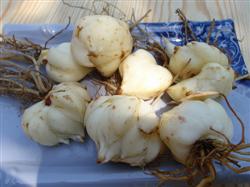
Bulbil propagation is mainly used. Select small bulbs with tightly overlapping scales, white color, regular shape, no damage, and no pests or diseases as seed bulbs. Soak the seed bulbs in a solution of 70% thiophanate-methyl, or carbendazim, or agricultural streptomycin for 15-30 minutes for disinfection, then dry them and plant. The suitable time is late September to October. On the prepared bed surface, open horizontal furrows at a row spacing of 25 cm and a depth of 12 cm, then place one small bulb every 15 cm (plant spacing), with the tip pointing upward, cover with fine soil and press firmly, then cover with soil. Where conditions permit, add a layer of fallen leaves or rice straw to prevent freezing and preserve moisture, gently press the leaves and straw firmly, and remove them when sprouting begins. Plant 10,000-15,000 plants per mu, with a seeding rate of 150-200/kg per mu.
3. Field management
(1) Early-stage management. In winter, carry out intertillage on sunny days, expose the surface soil to the sun, and preserve soil moisture and temperature. Before emergence in spring, loosen the soil and hoe weeds to raise soil temperature and promote early seedling growth; cover with straw to preserve moisture. In summer, prevent rot caused by high temperatures; when the weather turns cool, keep warm again, prevent frost damage, and apply seedling-promoting fertilizer to promote lily growth.
(2) Mid- and late-stage management. First, clear the ditches and drain water. Second, top the plants at the right time. The most suitable time is: when the flower buds turn from upright to drooping, and the color changes from all green to pinkish red on the side facing the sun. The time is June. Third, control nitrogen fertilizer application after topping. This promotes rapid swelling of the young bulbs. Around the summer solstice, remove bulbils and clear the furrows and beds in time to reduce field temperature and humidity.
(3) Topdressing. The first application is a stable winter fertilizer. In January, before lily shoots emerge, apply about 5-10 kg of urea per mu together with intertillage to promote new root growth. The second application is a heavy seedling-strengthening fertilizer. In early April, when lily shoots are 10-20 cm tall, apply 10-15 kg of Yangfeng compound fertilizer plus 5-10 kg of urea per mu to promote strong seedlings. The third application is an appropriate bulb-expanding fertilizer. In early to mid-June, after flowering and topping, apply 30-40 kg of Yangfeng 48% urea-based compound fertilizer per mu to promote bulb swelling. At the same time, spray 0.2% potassium dihydrogen phosphate on the leaves. This topdressing must be completed 40-50 days before harvest.
4. Pest and disease control
(1) Lily Phytophthora blight
One of the common diseases of lilies. It occurs severely in rainy years, causing stem and leaf rot and seriously affecting bulb yield. The pathogen can infect stems, leaves, flowers, and scales. After the stem base is infected, it becomes water-soaked and constricted, causing the entire plant to wither and die rapidly. When leaves are affected, the lesions are water-soaked, light brown, and form irregular large spots. In severe cases, flowers, pedicels, and scales can all be affected, causing discoloration and rot of the diseased parts.
Control methods: 1) Practice crop rotation; 2) Choose plots with good drainage and loose soil for cultivation; 3) Disinfect seed bulbs; 4) Strengthen field management, pay attention to opening ditches for drainage; increase phosphorus and potassium fertilizer application to make seedlings grow robustly; 5) Spray 1:2:200 Bordeaux mixture once before emergence, and spray 50% carbendazim 800-fold solution 2-3 times after emergence to protect seedlings; after disease onset, remove diseased plants promptly and treat with 50% quicklime.
(2) Viral disease
Affected plants show yellowing leaves or yellow spots, yellow streaks, acute leaf drop, poor growth, and stunting. Flower buds turn yellow and cannot open, and in severe cases the plants wither and die.
Control methods: 1) Breed disease-resistant varieties or propagate with disease-free bulbs; 2) Strengthen field management, appropriately increase phosphorus and potassium fertilizer application to make plants grow robustly and enhance disease resistance; 3) Remove severely affected plants, and control aphids early to reduce reinfection by virus-carrying aphids.
(3) Leaf blight and soft rot
These are the main diseases during the growing season and storage period, respectively.
Control methods: Select robust, disease-free seed bulbs for propagation. Before sowing, soak the seeds in 50% benomyl 500-600-fold solution for 20-30 minutes, then dry and plant. During harvest and transport, avoid bruising the bulbs as much as possible, and during storage pay attention to ventilation and cooling.
(4) Common pests include: aphids, scarab larvae, and mites.
Aphid damage: they often gather on tender leaves and flower buds to suck sap, causing plants to stunt, grow poorly, and be affected in flowering and fruiting. Control methods: 1) Clean the field, remove weeds in the field, and reduce overwintering pest populations; 2) During occurrence, spray 2000-fold fenvalerate solution, or 1500-fold 40% omethoate solution, or 1000-fold 50% malathion solution, aphid-mite net, or Dagongchen.
For scarab larvae, malathion or phoxim can be used. For mites, acaricides can be used.
Click to get more lily planting techniques
Click to get more flower planting techniques