How to prevent and control chrysanthemum powdery mildew? Detailed planting techniques
How to prevent and control powdery mildew when growing chrysanthemums? Please introduce the following methods for reference to prevent and control chrysanthemum powdery mildew: 1. Orchard cleaning: during cultivation, pay attention to pruning overly dense and withered yellow plant leaves, pull out diseased plants, sweep up diseased fallen leaves, and burn or deeply bury them in a centralized manner, which can greatly reduce the sources of pathogen infection. 2. Strengthen production...
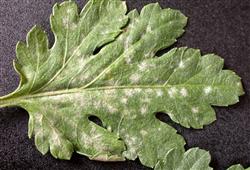
How to prevent and control powdery mildew when growing chrysanthemums? Please introduce
Chrysanthemum powdery mildew can be prevented and controlled by referring to the following methods:
1. Orchard cleaning: during cultivation, pay attention to pruning overly dense and withered yellow plant leaves, pull out diseased plants, sweep up diseased fallen leaves, and burn or deeply bury them in a centralized manner, which can greatly reduce the sources of pathogen infection.
2. Strengthen production management. Do not plant too densely, control soil moisture, and increase ventilation and light penetration. Avoid excessive application of nitrogen fertilizer; instead, increase the application of phosphorus and potassium fertilizers to enhance the disease resistance of plant leaves. When watering, pay attention to keeping the leaves dry to prevent the spread of water droplets splashing during watering, or high temperature and humidity allowing entry into the host, causing reinfection and disease occurrence.
3. Chemical control. For sterilization of potting soil, seedbeds, or soil with chemicals, a mixed agent of 50% thiophanate-methyl and 50% thiuram (1:1) can be used, sprayed at 600-700 times dilution on potting soil, seedbeds, or soil to achieve a sterilization effect. In the early stage of disease, spray with agricultural antibiotic 120 or antibacterial B0-10 emulsion at 100 times dilution, or 50% kasugamycin-copper wettable powder or 75% tridemorph emulsion at 1000 times dilution, once every 10 days, spraying 3 times continuously to control disease occurrence and spread. In particular, using 25% propiconazole emulsifiable concentrate 20 ml added to 100 kg of water for spraying, once every 10-15 days, spraying 2-3 times continuously, gives a relatively good control effect. In addition, during the disease period, 70% thiophanate-methyl wettable powder 32-48 g, or 50% thiophanate-methyl wettable powder 45-67.5 g, can be added to 70 kg of water, stirred evenly and sprayed, once every 7-10 days, spraying 2-3 times continuously; 15% triadimefon emulsion at 1500 times dilution, or 70% thiophanate-methyl wettable powder at 800-1000 times dilution, 50% sulfur-multi suspension at 300 times dilution, or 20% triadimefon emulsifiable concentrate at 2000 times dilution, or 75% chlorothalonil wettable powder at 600 times dilution, 50% tebuconazole at 1000 times dilution can also be used, spraying once every 7-10 days, spraying 3-4 times continuously, which can produce a good control effect.
Click to get more chrysanthemum planting techniques
Click to get more flower planting techniques