What is peony purple root rot? Introduction to peony care methods
What is peony purple root rot? What harm does purple root rot do to peonies? We ask friends to help explain the harm of peony purple root rot: commonly known as purple or black root rot, it is a common fungal disease of peonies. The incidence rate is higher in old plants and in fields with years of continuous cropping. Besides peonies, it also harms forest trees, fruit trees and...
 What is peony purple root rot? What harm does purple root rot do to peonies? We ask friends to help explain
The harm of peony purple root rot:
Commonly known as purple or black root rot, it is a common fungal disease of peonies. The incidence rate is higher in old plants and in fields with years of continuous cropping. Besides peonies, it also harms forest trees, fruit trees and crops.
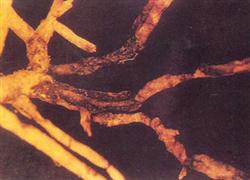
The source of infection is the mycelium surviving in the soil, which spreads through contact. The course of damage is that young tender roots are infected first, and it gradually spreads to the lateral roots, main roots and the root crown. The diseased roots are initially yellow-brown, and in severe cases turn dark purple or black with wet rot. The surface of the diseased roots has a layer of cotton-like mycelium. In the later stage the surface layer of the diseased roots completely rots, but still fits intact around the outside of the xylem and can be moved up and down.
The characteristic of this disease is a long damage period. An affected peony will not die immediately; it takes three to five years or longer. Affected plants show weakened growth, yellowing, and smaller leaves, with alternating on-year and off-year flowering. In severe cases, some branches or the whole plant die. The reason is that the old roots rot, no new roots grow, and growth is blocked. Once cotton-like mycelium appears at the root crown, it means that most of the underground root system has already rotted, and the plant will soon die.
Control methods for peony purple root rot:
1. Strictly disinfect seedlings and soil
Soak the roots of seedlings in 20% lime water for half an hour, or in 100-fold Bordeaux mixture for 1 hour, then soak the roots in 1% copper sulfate solution for 3 hours. Then wash clean with water before planting.
For soil disinfection, before plowing, apply 5-7.5 kg of 2.5% Ceresan powder or 2.5-5 kg of pentachloronitrobenzene powder, or 10?20 kg of sulfur powder per mu, and plow it into the soil. For small-area planting, disinfect the seedbed or tree pit by spraying 500-fold 30% liquid "Tachigaren", using 3 liters per square meter.
2. Strengthen soil, water and fertilizer management
The main cause of root rot is mostly soil infection caused by applying organic fertilizers such as human feces and urine that have not been fully composted and fermented. Therefore, to strengthen soil, water and fertilizer management, the main measures are:
1. Apply more potassium fertilizer to promote new root growth. During the growing period, 0.1-0.2% potassium dihydrogen phosphate can be used for foliar spraying, or potassium sulfate or potassium chloride (do not use in saline-alkali land) can be added when fertilizing, at 5-7.5 kg per mu.
2. Carry out reasonable intertillage and winter plowing to keep the cultivated soil layer of the peony garden at about 25 to 30 cm, prevent soil compaction, keep the soil loose, and maintain good water and air permeability.
3. Avoid raw fertilizer and heavy fertilizer. Use less or try not to use human feces and urine. If organic fertilizers such as human feces and urine are applied, they must be fully composted and fermented.
4. Control underground pests in time. Root crowns bitten open by white grubs are prone to root rot infection. Therefore, in early spring each year, promptly spray 800-fold trichlorfon solution or 1000-fold phoxim solution.
5. Properly control the frequency and amount of watering for peonies. Especially in early spring and late summer during the active period of the mycelium, when the soil moisture content is not less than 60%, water as little as possible or not at all to reduce infection.
3. Carry out root irrigation treatment
For severely affected plants, they can be dug out and burned, or the diseased roots can be cut off, disinfected and replanted. For newly affected plants or those with mild symptoms, root irrigation treatment can be carried out by digging trenches.
The following agents have a certain effect on root rot and can be selected for use: 1 degree Baume lime sulfur mixture (2.5-7.5 kg/plant); 200-500-fold copper sulfate solution (5-7.5 kg/plant); 500-800-fold Tuzet wettable powder (1.5-2.5 kg/plant); 1000-fold 70% thiophanate-methyl solution (1.5-2.5 kg/plant). In early spring or late summer, dig 3-5 radial trenches around the trunk, as long as the crown, 20-30 cm wide and about 30 cm deep. It is better to expose the roots, then seal the soil after irrigation.
4. Root drying and trench isolation
Dig away the soil around diseased plants to expose the diseased roots to the air. Through sunlight exposure and ventilation, reduce and inhibit the development of the disease. This can be done from early spring to late autumn. In addition, between diseased and healthy plants, according to the distribution depth of the plant roots, dig trenches 60-80 cm deep to prevent and block the extension of mycelium and contact infection.
5. To prevent the spread and infection of peony root rot, pine and cypress trees should be planted around the peony garden. Poplar, willow, pagoda tree and white wax should not be planted.
Click for morePeony planting techniques
Click for moreFlower planting techniques