A Detailed Guide to Loofah Planting Methods and Timing
Loofah is a fairly common vegetable, and it is a popular vegetable when it comes on the market in summer. Loofah is a vining annual herbaceous plant with separate male and female flowers on the same plant. The fruit is cylindrical or angular. When the fruit is unripe, it is soft and can be eaten as a vegetable; when mature, the fibers become well developed and it is no longer edible, but the fibers are like a sponge and can be used to make loofah sponge. So how is it planted? Let's take a look together.
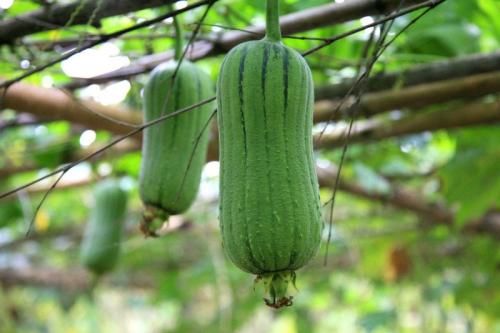
Cultivation Management
(1) Cultivation methods: There are usually 3 types: tunnel trellis, horizontal trellis, and trailing type. Each cultivation method has its advantages and disadvantages, and one should consider one's own land conditions and choose one method for cultivation. 1. The tunnel trellis can follow bitter gourd cultivation as a single bed to facilitate irrigation; usually a tunnel trellis is set up over the ditch spacing of two beds. 2. Although the horizontal trellis is easily damaged by wind, because of good ventilation and sufficient sunlight, it helps flowering and fruiting, the fruit shape is upright, and fewer diseases occur. 3. Although the trailing type does not require the cost of building a trellis, once pests and diseases occur it is very difficult to control effectively, and if the leaves are too luxuriant, they not only become a habitat for melon flies, but flowering and fruit setting are also poor.
(2) Land preparation: Prepare the land according to each cultivation method. The tunnel trellis type can follow bitter gourd, the trailing type can follow watermelon, and for the horizontal trellis type it depends on the previous crop, so it is not necessarily necessary to plow the whole field again; the planting-hole method can be used to apply base fertilizer and then transplant.
(3) Sowing: The most suitable sowing period is around early February. If sowing before early February, the temperature is cold and heat-preservation facilities should be used. The seedling raising period is generally 25~30 days.
(4) Planting density: Loofah has a long growth period and many secondary vines. To avoid stems and leaves being too luxuriant and making fruit setting difficult, the following row and plant spacings can be used. Cultivation method Row spacing (m) Plant spacing (m) Description Trailing type 3.0 1.0 Single-row planting along one side beside the bed ditch, leaving one plant per hole Horizontal trellis type 2.5 1.2 Single-row bed, leaving one plant per hole Tunnel trellis type 3.0 0.9 ~1.2 Double-row planting, leaving one plant per hole. At present, the main cultivation method used by farmers is tunnel trellis single-vine dense planting, with a bed width of 4 m and a plant spacing of 0.45 m. The main vine is allowed to grow and bear fruit, and all secondary vines (lateral buds) are removed. This not only lengthens the harvest period but can also increase yield.
(5) Fertilization: Loofah has a long growth period, so slow-release organic compost should be combined with an appropriate amount of quick-acting fertilizer. The fertilization amount per 10 ares is as follows: Fertilizer name Total amount Base fertilizer Topdressing I II III IV V Compost Ammonium sulfate Calcium superphosphate Potassium chloride 2,000 48 55 25 2,000 -- 55 -- -- 10 -- 5 -- 10 -- 5 -- 10 -- 5 -- 10 -- 5 -- 8 -- 5. The 1st topdressing is 7~10 days after transplanting, and the 2nd topdressing is applied in a band when vines begin to extend, along with hilling. The 3rd is when the vine is 60 cm long, the 4th is when the 1st female flower on a secondary vine opens, and after that the 5th topdressing is given according to growth and fruit-setting conditions.
(6) Pruning: In horizontal trellis cultivation, to promote elongation of the main vine, it is advisable to remove early the secondary vines from the root zone up to 1 m along the main vine. When the main vine grows above the horizontal trellis, pinch it at 1.3 m to facilitate growth of secondary vines on the horizontal trellis. At this time, the secondary vines can be trained in all directions so that they develop evenly, avoiding dense vines that obstruct ventilation and light, reducing disease occurrence, and increasing the fruit-setting rate. In single-vine dense planting cultivation, the main vine is allowed to grow and bear fruit, and all secondary vines (lateral buds) are removed.
(7) Irrigation: To promote growth and the development of tender fruit, appropriate irrigation is necessary. If water is lacking, not only is growth poor, but the development and quality of tender fruit are also poor. Generally, furrow irrigation is carried out, and the best time for irrigation is in the evening.