How to manage an osmanthus (sweet olive) bonsai? A detailed guide to care methods
How to manage an osmanthus (sweet olive) bonsai? What issues need attention? Zhongdiwang has compiled the management methods for osmanthus bonsai, listed in detail below for netizens' reference. Placement of the osmanthus bonsai: an osmanthus bonsai is best placed in a warm, sunny spot, with appropriate shading in summer to avoid direct intense sunlight. North of the Yangtze...
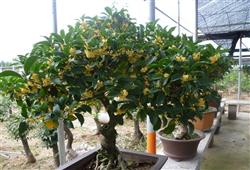 How to manage an osmanthus (sweet olive) bonsai? What issues need attention
Zhongdiwang has compiled the management methods for osmanthus bonsai, listed in detail below for netizens' reference.
Placement of the osmanthus bonsai:
An osmanthus bonsai is best placed in a warm, sunny spot, with appropriate shading in summer to avoid direct intense sunlight. In areas north of the Yangtze River, it must be brought indoors to overwinter in winter, and a room temperature kept at 0-5°C is relatively safe. It can be brought back outside around the time of Jingzhe (Awakening of Insects) in the following spring.
Watering method:
For osmanthus bonsai soil, follow the principle of not watering until dry, and watering thoroughly when you do. Generally, water once every 3-4 days in spring and autumn, once a day during high summer temperatures, and once every 7-10 days in winter. In summer, water in the early morning and evening, while in winter water around midday, so that the water temperature is close to the soil temperature and does not cause sudden cold or heat that damages the roots. In autumn, water moderately, and during the plum rain season prevent the potting soil from becoming too wet or waterlogged.
Fertilization method:
Osmanthus bonsai is grown mainly for its flowers, so it should be given sufficient fertilizer. When new shoots emerge, apply nitrogen fertilizer 1-2 times to promote the growth of branches and leaves; before flower bud differentiation and flowering, mainly apply phosphorus fertilizer. Before fertilizing, the potting soil should be slightly dry, and it is best to loosen the soil first to aid fertilizer absorption. On the second day after fertilizing, water once. If using compost or manure, it must be fully decomposed before use. When using the chemical fertilizer superphosphate, its concentration must not exceed 2%.
Pruning method for osmanthus bonsai:
Shaping and pruning of the osmanthus is best done after autumn, cutting off overly vigorous upper branches to balance the tree's vigor. Overly dense branches should be thinned out, and diseased and weak branches removed, so that nutrients are concentrated and flowering is promoted. Shaping and pruning combined with water and fertilizer management can improve the healthy growth of the osmanthus bonsai and maintain its graceful form.
Repotting the osmanthus:
An osmanthus bonsai can be repotted and given fresh soil once every 2-3 years. The new pot should be slightly larger to favor root growth. When repotting, cut off some of the old roots and dead roots, pick out some of the old soil with a bamboo stick, replace it with loose, fertile new potting mix, and place decomposed cake fertilizer at the bottom of the pot as a base fertilizer. Be sure to press the soil down firmly; this promotes abundant flowers and lush leaves on the osmanthus.
Pests and diseases to control in osmanthus bonsai:
Common diseases of osmanthus include leaf spot, sooty mold, algal leaf spot, root rot, and iron deficiency, and they should be controlled according to the specific disease situation.
1. Leaf spot, sooty mold, and algal leaf spot can be controlled by spraying 0.5 Bordeaux mixture or a 500-1000 times dilution of 5% carbendazim;
2. For root rot control, take care to keep the soil loose and well aerated, and avoid waterlogging; if root rot is caused by fungi, drench the roots with a 200-300 times dilution of amobam.
3. Common insect pests of osmanthus include sawflies, whiteflies, mites, long-scale insects (Lopholeucaspis japonica), and yellow stinging moths. Sawflies, whiteflies, and mites can be killed by spraying a 1500-3000 times dilution of 40% dimethoate, while for long-scale insects, besides manual brushing off, during the first and second instar nymph stages they can be killed by spraying a 1000 times dilution of 40% omethoate or a 500 times dilution of 40% fenitrothion.
Reasons why osmanthus does not bloom
When osmanthus blooms
Methods to make osmanthus bloom earlier