Correct Application Methods and Key Spraying Points for Foliar Fertilizers
1. Different foliar fertilizers have different application concentrations; higher is not always better. 2. Different crops and different growth stages respond differently to foliar fertilizers. 3. Different crops react differently to foliar fertilizers. 4. How well a foliar fertilizer dissolves and its dilution concentration greatly affect the spraying results...
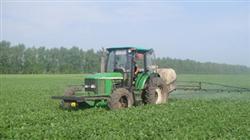 In addition to absorbing the nutrients they need mainly through the roots from the soil, crops can also absorb nutrients through their leaves.
The use of foliar fertilization is mainly to help crops supplement certain secondary and trace nutrient elements or growth regulators, which is also very important for increasing crop yield and improving quality. Under special circumstances, such as the reproductive growth stage in the later period of field crops, when above-ground parts such as fruits lack secondary and trace nutrient elements such as calcium and boron, and at this time root activity declines and nutrient absorption capacity weakens, supplementation through leaf fertilization is needed; or during a high-temperature dry season with no irrigation conditions, when the effective nutrients in the rhizosphere soil are not transported smoothly; or in waterlogged low-lying plots where crop roots lack oxygen, causing crops to be unable to absorb nutrients normally, foliar fertilization methods should be used.
Therefore, the main problems solved through foliar fertilization are, first, the supply of secondary and trace elements; second, alleviating the difficulty of roots being temporarily unable to absorb nutrients.
Leaf absorption is faster than root absorption and can quickly provide nutrients to the plant. It has the following advantages: it supplies nutrients directly and quickly, avoids the fixation and degradation of nutrients in the soil, and has higher nutrient use efficiency than soil fertilization.
Its disadvantages are: the fertilizer effect is short-lived and limited. It is an auxiliary fertilization method.
Techniques for foliar fertilization
1. Choose fertilizer components: foliar fertilization mainly supplies trace elements, and the combination of trace elements is beneficial to the absorption and utilization of nutrients. To determine the fertilizer variety, first look at the needs of the crop; second look at the types of limiting nutrients in the soil.
2. The concentration of the leaf fertilizer must be set accurately: too high a concentration will damage the leaves, while too low a concentration will have no effect.
3. The time of fertilizer spraying and climatic conditions must be chosen well: for example, avoid spraying fertilizer before rain; choose the key period of high nutrient efficiency during the growth stage. As for the number of sprayings, generally more than 2 sprayings are needed to be effective,