The Correct Method of Applying Potassium Fertilizer to Sunflowers
How Should Potassium Fertilizer Be Applied to Sunflowers? What Should Be Noted? As a food and oil crop, sunflowers are grown on an ever-expanding area in China and are widely distributed. Because sunflowers have a pronounced potassium-loving habit, in order to strive for high yields, besides applying a certain amount of nitrogen and phosphorus fertilizer, attention must also be paid to applying potassium fertilizer. But many farmer friends in actual...
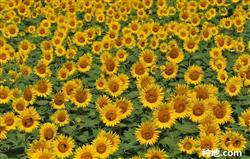
How Should Potassium Fertilizer Be Applied to Sunflowers? What Should Be Noted?
As a food and oil crop, sunflowers are grown on an ever-expanding area in China and are widely distributed. Because sunflowers have a pronounced potassium-loving habit, in order to strive for high yields, besides applying a certain amount of nitrogen and phosphorus fertilizer, attention must also be paid to applying potassium fertilizer. But many farmer friends in actual production often find that with the same potassium fertilizer application, sometimes it works and sometimes it does not. Why is that?
Sunflowers are indeed a potassium-loving crop. According to test data published in the "World Fertilizer Use Manual," at an average yield level of 200-250 kg, the amount of nitrogen absorbed by sunflowers per mu is 8.7 kg, phosphorus 5.8 kg, and potassium 25.6 kg. It can be seen that the ratio of nitrogen, phosphorus, and potassium required by sunflowers is 1.5:1.0:4.4. From the absorption ratio, sunflowers are a crop that requires a great deal of potassium. The root system of sunflowers can reach as deep as 2 m, and most of the nitrogen, phosphorus, and potassium required is supplied by the soil, with any shortfall regulated through fertilization. If too much nitrogen fertilizer is applied in a one-sided way, it will increase the risk of lodging and disease, and also lead to reduced oil content. Sunflowers must absorb large amounts of potassium from the soil, and the soil's potassium supply capacity can vary greatly depending on the soil parent material and ecological conditions. The amount of potassium required also differs with the yield level and variety of sunflowers. For example, high-yielding sunflower hybrid varieties will absorb even more potassium. Of the large amount of potassium absorbed by potassium-loving crops, part is luxury absorption, which may have no obvious effect on yield, especially under normal growth conditions. But under abnormal conditions such as drought, it plays a favorable role in improving the drought resistance and other stress resistance of sunflowers.
Sunflowers need to absorb large amounts of potassium, but increasing potassium fertilizer application is not always particularly effective. Why? How can the effectiveness of potassium fertilizer application to sunflowers be improved? In other words, what are the effective conditions for applying potassium fertilizer?
Experts believe:
The first is soil conditions: applying potassium fertilizer in soils with relatively low available potassium content has an obvious effect, and at this time applying potassium can increase the oil content and oil yield of sunflowers. The key lies in how to determine the critical level of soil potassium content. The level of soil available potassium content is the main factor determining whether potassium fertilizer application is effective or ineffective. Growing sunflowers on potassium-deficient soil definitely requires potassium fertilizer application to obtain a certain high yield. As for whether a specific farmland soil is deficient in potassium, it is necessary to use a "soil potassium supply critical value" level that has been verified through a large number of trials before a conclusion can be drawn. Generally, for soils with available potassium content above the critical value level, whether to apply potassium depends on what crop is being grown and what the target yield is set at. If a potassium-loving crop is grown and a high target yield is required, even if the soil is not potassium-deficient, choosing an appropriate method of potassium fertilizer application can still achieve results. At present in China, the critical value for farmland soil potassium supply status is not a fixed value or a single line, but a range value, that is, the critical soil potassium supply status is set within the range of 70-100 mg/kg. For another example, in North America the critical level of potassium available to crops in northern soils is agreed to be between 40-150 mg per kg; but some states in their fertilizer recommendation suggestions explicitly state that for new high-yielding hybrid sunflower varieties, the critical level of soil potassium must be higher than 105 mg per kg to obtain good yields. This shows that the effective application of potassium fertilizer also differs according to the requirements of the variety and the target yield level. In some cases, even if the soil is not potassium-deficient, applying potassium to crops is still effective. Of course, it should also be explained here why, both domestically and abroad, the critical value of soil potassium supply is only set as a range rather than a single number or a single line level. This is mainly because different soil types, especially different soil textures, differ greatly in the availability of the potassium they contain. The most prominent point is that sandy soils should use the low end of the range, while clayey soils should use the high end of the range.
The second is the target yield level and varietal differences: different crops grown in the same soil will have somewhat different requirements for the critical level of soil potassium supply. Sunflower seeds have a very high oil content, and sunflowers are a crop with high potassium uptake, so they have relatively high requirements for the critical level of soil available potassium. At the same time, the target yield level and differences among varieties must also be considered. For example, new high-yielding hybrid sunflower varieties require a soil potassium critical level higher than the general index level in order to obtain good yields and give full play to the variety's potential for high yield and high oil.
The third is that the presence or absence of irrigation conditions has a great influence on the effectiveness of potassium fertilizer. Especially during key growth stages, ensuring irrigation can enable crops to effectively utilize potassium fertilizer. If under drought conditions, when sunflowers are subjected to water stress, applying potassium fertilizer is more important than applying nitrogen fertilizer. Applying potassium can improve the utilization of limited water by sunflowers and reduce the transpiration coefficient of sunflowers. Therefore, under the same drought conditions, applying potassium fertilizer helps improve the drought resistance of sunflowers.
Click to get more sunflower cultivation techniques
Click to get more nitrogen, phosphorus, and potassium fertilizer application techniques
Click to get more fertilizer application techniques