How to Increase Yield by Applying Potassium Fertilizer Reasonably to Chinese Cabbage
How can Chinese cabbage increase yield by applying potassium fertilizer? The yield-increasing effect of applying potassium fertilizer to Chinese cabbage is obvious. Test results show that: under the same conditions of nitrogen and phosphorus fertilizer, adding potassium fertilizer (50% potassium sulfate) at 18 kg/mu to Chinese cabbage gave a yield increase rate as high as 33.2%, with an average increase of 159 kg of Chinese cabbage per kg of potassium sulfate. It enhances disease resistance. Applying potassium fertilizer can...
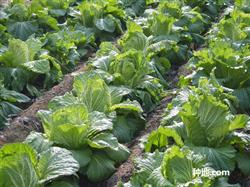
How can Chinese cabbage increase yield by applying potassium fertilizer?
The yield-increasing effect of applying potassium fertilizer to Chinese cabbage is obvious. Test results show that: under the same conditions of nitrogen and phosphorus fertilizer, adding potassium fertilizer (50% potassium sulfate) at 18 kg/mu to Chinese cabbage gave a yield increase rate as high as 33.2%, with an average increase of 159 kg of Chinese cabbage per kg of potassium sulfate.
Enhanced disease resistance. Applying potassium fertilizer can significantly improve the disease resistance of Chinese cabbage and reduce the disease incidence rate. According to statistics, the disease incidence rate of Chinese cabbage with potassium fertilizer applied was only 1.9%, while the incidence rate in the control plot was 11.4%, a reduction in incidence rate of 9.5%.
Improved marketable rate. Chinese cabbage with potassium fertilizer applied forms firm, compact heads with few loose leaves, while the cabbage in the control plot does not form firm heads, and the difference is obvious. For winter storage, the standard marketable cabbage is generally one with 3 tightly wrapped green leaves on the outside; the marketable rate of cabbage with potassium fertilizer applied reached 88.5%-91.2%, while the marketable rate in the control plot was 80%-83.1%. Adding potassium fertilizer improved the marketable rate of Chinese cabbage, thereby increasing economic returns.
Potassium application method - basal application: For Chinese cabbage to produce more than 10,000 kg, 300-500 kg of refined organic fertilizer per mu is needed, or 300 kg of dried chicken manure and 3 cubic meters of barnyard manure, plus compound fertilizer (with a nitrogen-phosphorus-potassium content above 35%), such as Sakafu potassium sulfate compound fertilizer at 30-40 kg per mu; the above two fertilizers can be applied alone or mixed. If compound fertilizer is not used, nitrogen fertilizer (15 kg of 46% urea), phosphorus fertilizer (30 kg of 14% superphosphate), and potassium fertilizer (12 kg of 50% potassium sulfate) can also be blended into a compound mixed fertilizer and broadcast before plowing, but it is best to apply it in concentrated bands in furrows, close the furrows with soil and form ridges, and sow cabbage seeds on the ridges.
Topdressing: The fertilizer requirement of Chinese cabbage during the head-forming stage accounts for more than 60% of the total fertilizer requirement of the entire growth period. During this period, in addition to topdressing nitrogen fertilizer (20-25 kg of urea) in two applications, also topdress 5-7 kg of potassium sulfate, applying it in furrows between the ridges and covering with soil and watering.
Foliar spraying: From the rosette stage to the head-forming stage, 0.2% monopotassium phosphate can be sprayed once every 7-10 days, for a total of 3 sprays; it can be sprayed in the morning, in the evening, or all day on cloudy days.
Click to get more nitrogen, phosphorus, and potassium fertilizer application techniques
Click to get more fertilizer application techniques
Click to get more Chinese cabbage planting techniques