Free-range chicken farming becomes a new hotspot, with a detailed explanation of the key points of scientific management techniques
Free-range chicken farming, scientific management is very important
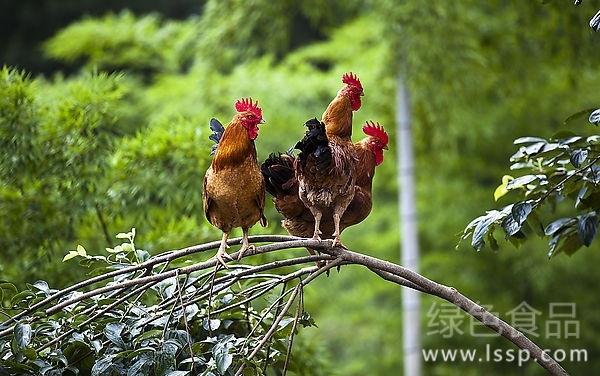
Free-range chicken, that is, local chicken, also called caoji, differs from caged broiler chickens and laying hens; it refers to meat chickens raised freely in mountain forests and orchards. Free-range chickens raised in rural areas have better meat quality and a fresher taste than ordinary broiler chickens, and are deeply loved by consumers. A few years ago, because free-range chickens had shortcomings such as slow growth, small body size, and low egg production, they were gradually replaced by superior foreign chicken breeds, and the number raised dropped greatly. But as consumers' requirements for food taste and quality gradually rise, "free-range chicken" farming has once again become a new hotspot in the breeding industry.
I. Selection of the rearing site
Woodland for free-range chicken farming
Site selection should take comprehensive factors into consideration, such as area, terrain, soil, orientation, transportation, water source, power source, epidemic prevention conditions, natural disasters, and the economic environment. In general, site selection should follow the principles below.
(1) It should be conducive to epidemic prevention. The chicken farm site should not be chosen in densely populated residential areas or factory concentration areas, should not be chosen in places with frequent traffic, and should not be chosen near livestock and poultry trading venues; it should be chosen in a relatively remote place that vehicles can still reach. Such a place is not easily affected by infectious diseases and is conducive to epidemic prevention.
(2) The site should be in a high, dry, and well-drained place. If in a plain area, choose a place with high, dry terrain that slopes slightly to the south or southeast; if in a mountainous or hilly area, it is advisable to choose a south-facing slope with an incline below 20 degrees. Such a place is convenient for drainage and receiving sunlight, warm in winter and cool in summer. It is best if there is a fish pond within the site, to facilitate waste discharge and to make use of waste for comprehensive operation.
(3) There should be shade within the site. It is advisable to have green bamboo, green trees for shade, and grassland within the site, to facilitate the chickens' activity.
(4) The site must have a water source and a power source. A chicken farm needs water and electricity, so there must be a water source and a power source. The water source is best if it is tap water; if there is no tap water, then choose a place with abundant groundwater resources suitable for digging a well, and the water quality must meet hygiene requirements.
(5) The site must be able to be enclosed within its boundaries. The site should be an independent, self-contained closed system (enclosed with bamboo or brick walls), to prevent outsiders from entering at will and to prevent outside livestock, poultry, and wild animals from entering at will.
II. Management of chicks
Chick rearing
1. Prepare the chicken house. Do the preparatory work before the chicks arrive. For a chicken house converted from an old building, brush the four walls and ceiling inside with thick limewater 1-2 times. Whether it is a converted or newly built chicken house, it must be strictly disinfected, hygiene must be done well, and the temperature regulation and ventilation facilities in the house must be verified. Install elastic plastic netting or bamboo-woven netting in the chick house, with a mesh diameter of 1 cm and the net about 1 m above the ground. If it is converted from an old building, light windows and ground windows should be opened at the front and back. The light windows are 1.5 m above the ground, and the ground windows are 20 cm above the ground.
2. Source of chicks. To reduce germs brought by outside chickens and to ensure breed purity, it is best to keep breeder chickens and breed chicks oneself.
Select pure free-range chickens with glossy feathers, strong health, and fast growth for breeders. The weight of a hen is about 1.6 kg, and the weight of a rooster is suitably 1.6-2.25 kg, with a male-to-female ratio of 1:10. Breeder roosters and hens should not be brother-and-sister chickens.
When farmers use the method of having hens hatch chicks, in order to make the chicks' age uniform, in addition to feeding evenly and on time with guaranteed quality, hens that hatch earlier should be made to sit empty (no eggs placed in the nest), but the empty sitting time should not exceed 7 days. For medium- and large-scale rearing, it is advisable to use an incubator to hatch chicks.
3. Scientific management. When chicks enter the brooding room, in the first week there are 50 per sq m, and they are separated into groups; fresh, clean dry rice straw is spread on the elastic plastic netting or bamboo-woven netting, with a straw thickness such that chick droppings can fall through the gaps to the ground. In the second week there are 40 per sq m, and the straw is removed so that chicken droppings fall directly through the mesh to the ground. In the third week there are 30 per sq m, and afterward 10. Chicks are raised in groups according to age, strength, size, and sex.
The temperature of the chicken house is 32°C in the first week, then decreases by 2.5°C each week, and heating is stopped when it reaches the natural temperature of 21°C. Use intermittent lighting of 1 hour of light and 3 hours of darkness in a 4-hour period as 1 cycle, so that the chickens' activity and rest are moderate, promoting the growth of free-range chickens and improving feed utilization, while also saving electricity costs. The light intensity should refer to the light intensity of the daylight windows during the day. Chicks can only be put out to pasture at 25 days of age; this is one of the important factors for ensuring a high survival rate.
III. The free-range rearing process
Free-range rearing of chickens
1. Free-range scale. It is advisable to raise 2000 chickens per woodland area; a large scale is inconvenient to manage, and a small scale has low benefits. Free-range rearing can be done from late spring to mid-autumn; in winter, when temperatures are low and insects and grass decrease, free-range rearing should be stopped.
2. Free-range method. For free-range chickens, choose improved breeds with strong disease resistance. Before 3-4 weeks of age, follow the same practice as ordinary brooding, choosing a room with good insulation for artificial brooding, and after heating is stopped, transfer them to the mountain for free-range rearing. When chicks first begin free-range rearing, they do not have the habit of going up the mountain to forage, so they must be trained. Generally, two people need to cooperate: one person in front whistles and scatters pelleted feed to let the chickens scramble for it and follow, while the other person drives them from behind with a tree branch, until all the chickens go up the mountain. At noon each day, whistling and supplementary feeding should also be done once on the mountain to strengthen the training, and in the evening the same method is used to guide the chickens back to the house. After about 10 days of training, the flock establishes a conditioned reflex.
3. Precautions. In the first few days of free-range rearing, to prevent stress, a certain amount of vitamin C or multivitamins can be added to the feed or drinking water; do not use antibiotics or deworming drugs for 3 months before release from the coop.
IV. Disease prevention
Sick chickens must be isolated promptly
Disease prevention measures should focus on prevention, and the feeding and drinking conditions of the flock should be observed every day. Sick chickens found should be isolated immediately. Manure cleaning should be done once a week. In rainy and snowy weather, grazing is strictly prohibited, to avoid wetting the feathers and causing the chickens to catch a chill and cold.
The most harmful to free-range chickens and also the most easily epidemic is fowl plague. Fowl plague is a highly contagious and devastating infectious disease caused by the Newcastle disease virus, with a mortality rate of almost 100%. This disease can occur in all four seasons and is more common in hot summers. Free-range chicken farming emphasizes natural, ecological methods and avoids the use of chemical agents and other hormonal substances, so simple and easy traditional methods should be adopted to effectively prevent and treat fowl plague.
(1) Mung beans: Grind mung beans with alum into powder, mix with water into a paste, and feed to the chickens. 3 times a day, 2-3 tablespoons each time, for 7 consecutive days.
(2) Baijiu: Soak granular grain in baijiu for 2 hours, then feed the chickens once in the morning and once in the evening, 2-3 grams per chicken each time, for 5-7 consecutive days.
(3) Ginger: Take 10 grams of ginger, chop it, add 50 grams of alum powder, mix well, and feed to the chickens, 1-2 times a week.
(4) Garlic: 2 heads of purple-skinned garlic, peeled and pounded into garlic paste, soaked in boiled water for 1 hour, then filtered and given to the chickens as drinking water, once a day.
(5) Sophora flavescens: 50 grams of Sophora flavescens, add 1 kg of water and decoct into a soup, give as drink once in the morning and once in the evening.
(6) Wheat: 500 grams of wheat, mix evenly with 0.5% potassium permanganate solution, and feed to the chickens, 2 times a day, for 3-4 consecutive days.
(7) Salt: Soak granular grain in 5% salt water for 2 hours, then add it to other feed at 10% of the daily feed amount and feed to the chickens, for 3-5 consecutive days.