Scientific Pairing and Breed Preservation Methods for Pigeons to Prevent Inbreeding
Pigeons
In recent years, meat pigeon production has developed rapidly. However, because insufficient attention has been paid to the preservation, purification and rejuvenation of quality breeding pigeons, and measures have been ineffective, inbreeding has become serious in the core flock, germplasm has clearly degraded, and product quality has declined. This is mainly shown in: first, decreased productivity; second, dead embryos in the late incubation stage; third, reduced disease resistance. Therefore, after selecting and establishing a certain excellent breed as the core flock of breeding pigeons, on the basis of using artificial incubation technology, work on breed preservation, purification and rejuvenation must be done well.
I. Methods for Breed Preservation and Purification
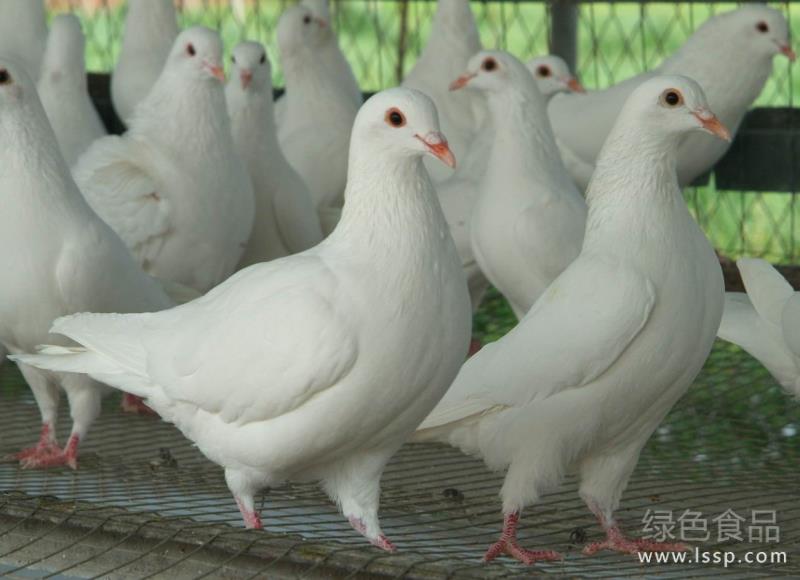
Taking the American White King pigeon as an example, the measures include the following aspects:
1. The offspring of high-yielding parent pigeons that lay 3 pairs of eggs per month, with each clutch cycle under 35 days, are retained for breeding;
2. For reserve breeding pigeons, select those whose body weight at 30 days of age reaches more than 550 grams for females and more than 600 grams for males, and retain them for breeding;
3. The core flock of the whole farm is divided into two groups, A and B. Male pigeons from the offspring of group A are paired with female pigeons from the offspring of group B, and male pigeons from the offspring of group B are paired with female pigeons from the offspring of group A, to prevent inbreeding;
4. Records must be kept properly for the above work, and cage numbers must be established
Pigeons
II. Scientific Pairing Methods
(1) The estrus period of pigeons
When pigeons grow to 3 to 4 months of age, secondary sexual characteristics begin to appear, which is called the estrus period of pigeons. They appear unusually lively, emotionally very unstable, chase and fight each other, and make a louder "coo-coo" call than usual. After entering the estrus period, pigeons will choose their own mates, mate and reproduce, which is the natural reproduction method (also called the natural pairing method). For artificially raised pigeons, the natural reproduction method is not advocated for breeding. (Because it can lead to early pairing, inbreeding, and mismatched pairing, causing breed degeneration in pigeons.) Instead, artificial pairing methods should be used.
(2) Separate management of males and females
After pigeons mature, secondary sexual characteristics appear and they have reproductive capacity. In order to prevent early pairing and do a good job in selection, male and female pigeons should be raised and managed separately.
Separate flock management of males and females means separating male and female pigeons at 3-4 months of age and raising them in two different pigeon pens. After separation, the pigeon pens should not be too large; it is appropriate to raise 50-100 pairs of pigeons per pen, among which the male pigeon pen can be larger and the female pigeon pen can be smaller. Because male pigeons will chase and fight each other after entering estrus; if the pen is too small (that is, the stocking density is too high), pigeons may be pecked and injured or pecked to death.
When separating groups, whether in the male pigeon pen or the female pigeon pen, attention should be paid to ensuring that the age difference is not too great, that is, pigeons of the same month age should be placed in the same pen as much as possible, to prevent the big from bullying the small and the strong from bullying the weak, causing injury or disability to weak and small pigeons. In addition, uneven sizes also make management inconvenient. When distinguishing male and female pigeons, it is impossible to be 100 percent accurate, and it is unavoidable that a few pigeons of the opposite sex are mixed into the separated pens. Therefore, during daily feeding and management, observe at any time and anywhere. Once discovered, immediately take them out and put them into a pen with pigeons of the same sex. The behavior of opposite-sex pigeons in separated pens is as follows: a small number of male pigeons in the female pigeon pen will appear especially active and constantly chase female pigeons; while a small number of female pigeons in the male pigeon pen are often chased by several male pigeons, compete for, and run everywhere, or have the feathers on the head and neck pecked off, or the skin pecked and injured. In addition, unfamiliar pigeons will also be attacked by the flock. Therefore, in the first few days of separate management, especially when the pigeons were not originally in the same pen, observe frequently. If attacking behavior is found, immediately remove the attacked pigeon or scatter the attacking pigeons. After they become familiar with each other, this phenomenon will naturally disappear.
After male and female pigeons are separated into pens, establish retention standards and select pigeons one by one according to the standards, culling those that are injured, disabled, or poorly developed.
Pigeon farming
(3) Preparatory work before pairing
After male and female pigeons are separated into pens, feeding and management should be strengthened, and the following points should be noted:
First, prevent them from becoming too fat or too thin. As the saying goes, "A fat chicken does not lay eggs." The same is true for pigeons. If raised too fat, reproductive capacity after pairing is affected. If male pigeons are too fat, semen quality is poor, sperm count is low, or there are many deformed sperm; if female pigeons are too fat, they lay few or no eggs. If raised too thin, then there is malnutrition, which not only hinders growth and development, but also easily causes nutritional diseases and is unfavorable to the production and formation of sperm and eggs. Generally, feed twice a day, with feed intake at about 80 to 90 percent full as appropriate. The feed formula should be reasonable, drinking water should not be restricted, and they should bathe once a week.
Second, enhance the disease resistance of pigeons. Half a month before pairing, feed pigeons antibiotic drugs such as erythromycin, chloramphenicol, tetracycline, etc., to prevent infectious diseases, and deworm internal and external parasites, such as using levamisole or piperazine to expel roundworms. During the last bath, add an appropriate amount of trichlorfon to the water to kill external parasites such as pigeon lice, pigeon flies, and fleas.
Third, disinfect the pigeon house and cages. Regardless of what kind of pigeon house is used, whether newly built, converted from an old house, or enclosed in a courtyard or on a balcony, etc., one week before introducing pigeons, thoroughly clean the shed, arrange all tools such as pigeon cages, feed troughs, water troughs, and health sand cups, and carry out comprehensive disinfection by methods such as fumigation with potassium permanganate plus formalin or spraying with caustic soda solution.
Pigeon pairing
(4) Pairing methods
When young pigeons are raised to 6 months of age, all tissues, organs, and reproductive organs of the body have fully developed and matured, and they can be paired and placed in cages. Male and female pigeons develop affection, and after about 10 days they can lay eggs. There are two methods of pairing pigeons: one is natural pairing. That is, pigeons raised in groups are allowed to freely seek partners and form pairs.
The advantage of this pairing method is that it is simple and convenient and requires no manpower. But it also has many disadvantages:
First, pigeons lay two eggs each time, and the squabs hatched are mostly one male and one female. After they mature, a brother and sister may pair with each other, causing inbreeding.
Second, early pairing easily occurs. Especially in some small pigeon farms, where the number of squabs is not large, retained breeding squabs separated from their parent pigeons are raised together, and their ages are uneven. Some pigeons have already matured, while others have not yet matured, leading to premature mating.
Third, it causes differences in breed, body type, body weight, feathers, etc., which is unfavorable for obtaining excellent offspring.
The second is artificial pairing. That is, using artificial methods to deliberately pair pigeons. It can overcome all the disadvantages of natural pairing, but it requires a certain amount of manpower and time. Before pairing and placing in cages, check body weight, age in months, and health status. Meat pigeons meeting the standard requirements can be placed in cages and recorded, while culling those that do not meet the standards. The method of placing in cages is to first put male pigeons into the cage (they can be arranged regularly by breed, feathers, etc.). After two or three days, when the male pigeons are familiar with the environment, use the same method to send selected female pigeons into the cage. Pigeon farms or households practicing small-group free-range raising can use this method for pairing and placing in cages. After placing them in cages, the nest doors can be closed. After pairing is successful, open the nest doors and let the parent pigeons go out to move around, become familiar with the environment, and recognize their own nests, so as to avoid nest fighting and fighting.