How to raise chicks after hatching and select strong, healthy chicks
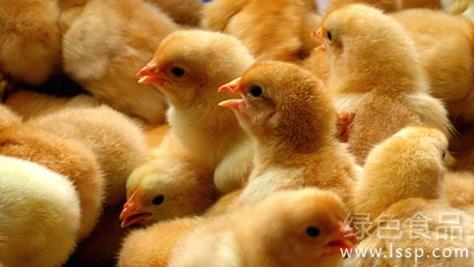
Chicks
When raising chicks, you should select strong and healthy ones, mainly through looking, touching, and listening. The so-called "looking" means observing the appearance: whether they are uniform in size and conform to breed standards, and whether the feathers are clean, neat, and glossy. "Touching" means feeling whether the body is plump and springy. "Listening" means hearing whether the chirping is clear and loud. Healthy chicks generally show: bright, expressive eyes; dry, firm legs; neat down; lively and active behavior; well-contracted abdomen; a soft, springy feel to the touch; no bleeding at the navel; and a full, warm feel when held in the hand, with strong struggling. Conversely, chicks that are listless, have messy down, or show bleeding traces at the navel are all weak chicks.
On the first day after the chicks arrive, the temperature should reach 37-38 degrees C, and the flock should be evenly distributed in the brooder cage, not crowded around the heat source or far away from it. After that, lower the temperature by 2 degrees C to 3 degrees C each week. In summer, lower it until it reaches room temperature; in winter, keep it stable at 20 degrees C to 22 degrees C, and never below 18 degrees C. Judge the temperature by observing the flock's behavior: if the temperature is too high, the chicks move away from the heat source, breathe with their mouths open, and press their wings to the ground. If the temperature is too low, the chicks huddle close to the heat source and crowd together. At a suitable temperature, the flock is evenly distributed, active and normal, and the chirping is clear and loud.
Once the chicks are brought back, start giving them water immediately. It is best to first give 5% glucose water, and at the same time provide electrolytes and multivitamins in a concentrated drinking-water treatment for 5-7 days, to ease the stress response caused by transport and improve the survival rate of the chicks. Fill the drinker to 1/3, keep the drinking water clean, and replace it 3-4 times a day. If conditions permit, use cooled boiled water, and never give raw water.
After the chicks drink water, begin feeding them. For the first 1-2 days, you can spread newspaper on the cage floor and scatter complete pellet feed onto the newspaper. As they get older, remove the newspaper and replace it with feed troughs. During the brooding period, feed in small amounts and add frequently, about once every 2 hours.
The stocking density of chicks should be adjusted according to their age, breed, rearing method, season, and ventilation conditions. For chicks 1-2 weeks old, the stocking density is 60 birds per sq m in cages and 30 birds per sq m on the floor; for 3-4 weeks old, it is 40 birds per sq m in cages and 25 birds per sq m on the floor. Whether the stocking density is appropriate is closely related to chick development and the full use of the chicken house. In winter and spring, keep it slightly denser; in summer, slightly sparser. Net rearing can be denser, while floor rearing should be sparser.
Within the first week, the relative humidity in the brooding room must be close to 75%. Generally, it should be 70-75% in the first week, and about 65% from the second week to the seventh week. This maintains normal metabolic activity, yolk absorption, avoids dehydration, and promotes feather growth in chicks. High humidity easily triggers airsacculitis, mold, mycoplasma, and other infections; low humidity is not conducive to yolk absorption and easily leads to poor growth in chicks.
⟧ In addition to affecting sexual maturity in chickens, light also has a sterilizing and disinfecting effect. For chicks 1-3 days old, artificial light can be supplied for up to 23 hours per day; for 4-14 days old, up to 18 hours per day; afterward, shorten it by 1-2 hours each week until it is reduced to natural light. The lighting intensity should be 5-15 W per sq m.
The brooding period is a time of high incidence of colibacillosis and respiratory diseases. In addition to doing routine work well, preventive medication should be given according to past disease occurrence. When adding medicine to drinking water or feed, the dosage must be accurate and mixed evenly.
In daily work, observe the flock's mental state, distribution, feed intake, water intake, and droppings, and check the temperature, humidity, and ventilation inside the house. Pick out the weaker chickens and raise them separately so they can recover as soon as possible. Those with no rearing value should be culled promptly.