Introduction to Understory Chicken Farming: How to Establish a Good Ecological Cycle
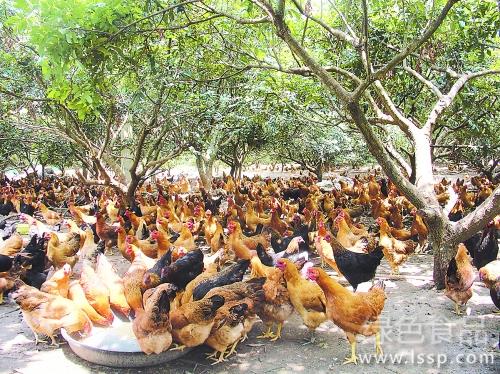
Understory Chicken Farming
Understory chicken farming makes use of the land resources and shade advantages beneath the trees, and is a new ecological farming model for raising free-range chickens. While increasing the added value of fruit trees and eggs, it also establishes a mutually beneficial cycle between laying hens and the fruit forest.
1. Woodland Selection
Generally, it is best to raise chickens in half-mature forests and woodlands with trees (or fruit trees) aged 3 to 5 years. Among these, half-mature forests with relatively sparse canopy, higher crowns, a shade density of 60% to 70%, and abundant understory weeds and insects are the most ideal for raising chickens. Woodlands with excessively dense branches and leaves and heavy shade have poor light penetration, which is not conducive to chicken growth.
Fruit tree woodlands such as peach and pear that have not yet fruited or bear few fruits are suitable for planting grass and raising chickens. Mulberry orchards, citrus orchards, and loquat groves are also good places for raising chickens. Peach, pear, and other fruit trees that have already set fruit will drop some fruit during the fruiting period, which then rots; chickens that eat the rotten fruit are prone to poisoning, so such woodlands are not suitable for raising chickens.
2. Breed Selection
Understory chicken farming has the characteristic of "free-range plus supplemental feeding." For understory chicken farming, breeds that have passed national and local variety certification, as well as crosses between local chicken breeds with more than 75% local chicken bloodline, should be selected for raising. Chickens of these breeds have strong adaptability, strong disease resistance, strong foraging ability, and tolerance for coarse feed. They are medium to slightly large in body size, with glossy feathers, tall and slender shanks, large combs, and red faces, and their meat is of good quality with good flavor.
3. Feed Selection
For understory chicken farming, feed and additives that meet green food standards can be selected for feeding. During the free-range period, plant protein feed can be supplemented. During the fattening period, chickens should be given little or no animal-based feed such as fishmeal, and the use of toxic and harmful additives and veterinary drugs with residues is prohibited. In addition, forage grass, tree leaves, seeds, insects, microbial fermentation feed, and agricultural by-products can be reasonably used to feed the chickens.
In understory chicken farming, the chickens can forage for the abundant insects, grass, minerals, and other substances in the woodland to meet their body's needs for these nutrients, while energy, protein, trace elements, and the like need to be obtained through supplemental feeding.
Free-range chickens like to eat legumes and tender forage grasses. When establishing forage grass pastures, in addition to considering the trampling tolerance of the forage, the feeding habits of the chickens should also be fully considered, and the proportion of legumes and tender forage grasses planted should be increased. Suitable grass species for feeding chickens include chicory, alfalfa, ryegrass, comfrey, Chinese milk vetch, red clover, white clover, and bitter lettuce.
4. Stocking Density
The stocking density for understory chicken farming can be determined based on the nitrogen, phosphorus, and other substances excreted by the chickens and the self-purification capacity of the woodland soil.
Under the premise of not damaging the soil environment and achieving a good ecological cycle, understory chicken farming should stock 5 chickens per 667 sq m of woodland. This is the stocking density determined based on the amount of nitrogen and phosphorus excreted in chicken manure.
5. Points to Note
In understory chicken farming, in addition to doing a good job in feeding and management, the relationship between farming and the ecological environment must also be well coordinated so that the farming industry can develop in a healthy and sustainable way. Understory chicken farming should use woodland resources scientifically and reasonably, and must not sacrifice ecological benefits in exchange for farming profits.
During understory free-range raising, the pecking and trampling of chickens can cause mechanical damage to the understory vegetation. When the understory chicken farming density is too high, chickens scratching and pecking at the roots of the trees can expose and damage the tree roots. Studies show that when the tree farming density is too high, the chickens' scratching and pecking behavior is highly destructive to understory resources, and in severe cases can leave the woodland with not a blade of grass growing and the understory land uneven.
Under high-density farming conditions, manure and sewage emissions will exceed the soil's own purification capacity. After the soil absorbs a large amount of chicken manure, nitrogen- and phosphorus-enriched zones will form. Excessive soil fertility will disrupt the ecological balance of understory farming, affect tree growth, and cause serious damage to the environment. In developing the understory chicken farming industry, great importance must be attached to the impact of farming on the woodland ecological environment.