Master Its Living Habits and Learn the Techniques for Breeding Large Icefish Fry and Fingerlings
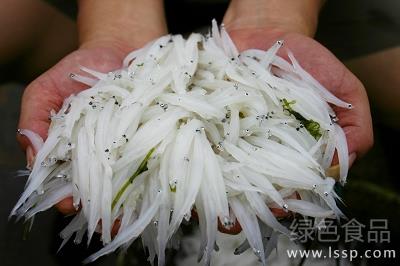
Large icefish
Icefish is one of China's prized aquatic products, hailed as a delicacy for the table, long renowned at home and abroad, and a hotspot of aquaculture in recent years. The techniques for farming large icefish in large open ponds are briefly introduced below.
I. Living Habits
Habitat habits. In ponds, icefish mostly live in the middle and lower layers; except when oxygen is lacking, they are rarely found active in the upper layers; when startled, they burrow into the bottom mud. Larvae and juveniles have a strong phototaxis, and at night they can be attracted into groups with light, which can be used to check their growth and feeding conditions; adult fish have no phototaxis.
Reproductive habits. In ponds, large icefish can develop to gonadal maturity and spawn on their own. The gonadal development and spawning characteristics of large icefish in ponds are basically the same as those of icefish in natural waters. In the middle and lower reaches of the Yangtze River, the spawning peak is from late December to early January. In hard-bottomed ponds with aquatic plants, spawning is relatively concentrated, and the fertilization rate can reach 80%-90%.
Feeding habits. Juveniles start feeding at 10 days after hatching, and their food is rotifers; afterward they gradually choose larger, easily obtained zooplankton as food, in the order of nauplii, copepodites, cladocerans, and adult copepods. Large icefish is carnivorous and feeds on small fish and shrimp.
II. Pond Conditions
Choose an old pond, requiring fresh water quality, no pollution, shelter from wind and sun exposure, and convenient water intake and drainage. The area of a monoculture pond is 3 mu to 4.5 mu, and the area of a polyculture pond is 4.5 mu to 9 mu, with a pond depth of more than 2 m, a moderate amount of aquatic plants around the pond, and a bottom mud thickness of 0.2 m. Do not polyculture with carnivorous and omnivorous fish.
III. Fry and Fingerling Stocking and Preparation for Breeding
Stocking pond for fry and fingerlings. In a fertile pond used for raising domestic fish, after several seine hauls to appropriately turn over the surface bottom mud, the pond water is filled into a stocking pond that has been desilted and cleared of pests. Because the air temperature is low when large icefish start feeding, pond water quality is difficult to cultivate, especially the low density of rotifers; using fertile water from a domestic fish pond and introducing resting eggs of rotifers can rapidly increase the food density in the stocking pond. This work should be completed two weeks before stocking, and the pond water depth before stocking should be 0.6 m. Source of fry and fingerlings. For the fry and fingerlings needed for first-time rearing, mature parent fish can be collected from natural waters and artificially fertilized on site to obtain fertilized eggs (fertilized eggs are sold at fish hatcheries). Fertilized eggs can be hatched indoors in still water; when the water temperature is maintained at 4°C-6°C, they hatch in 30 days to 40 days, with a relatively high hatching rate and relatively good stocking results. Controlling the hatching time is of important production significance. If eggs and larvae hatch after the end of February, it is easier to obtain starting food, which helps increase the survival rate of the seedlings.
Stocking method. Stocking during the embryonic stage of the eggs gives better results than stocking fry. One week before hatching, place the eggs in the pond to hatch, stocking 20,000 fertilized eggs per mu, and 30 kg of large icefish can be caught from September to October. If the stocking rate is too high, the larvae and juveniles will not have enough food. A pond water depth of 1 m to 1.5 m is suitable.
Breeding techniques. The larvae feed on rotifers and nauplii. They start feeding 10 days after hatching, and if there is no food 3 days after starting to feed, they die. Therefore, the stocking pond must be fully fertilized in advance to ensure sufficient food when they start feeding. Apply fully fermented manure and appropriately apply limewater; after 10 days to 15 days, the water color becomes denser, and rotifers can reach a considerable density.
Juveniles mainly feed on nauplii, cladocerans, copepods, and chironomid larvae. During this period, fertilizer can be applied frequently; the amount applied is controlled according to water color and water temperature, and the pond water transparency should be kept above 40 cm as much as possible, with the water depth maintained at 2 m.
IV. Adult Fish Farming
Supply sufficient food. During the adult stage (total length above 40 mm), food intake is large and growth accelerates significantly, so fertilizer must be applied frequently to maintain the density of plankton; apply decomposed fermented fertilizer, and a small amount of soybean milk can also be splashed on (250 g to 500 g of soybeans per mu per day), flexibly adjusted according to water quality conditions.
Pay attention to the shift in feeding habits. Large icefish has a transition period in feeding habits, gradually shifting from feeding on cladocerans and copepods to carnivory. If fish and shrimp are found in the intestinal tract of icefish with a body length close to 80 mm, it indicates that the feeding habit is shifting; small fish and shrimp should be introduced in time and a certain density maintained, which can greatly promote the growth rate of large icefish. In the Yangtze River basin, introducing an appropriate amount of egg-bearing freshwater shrimp in May means the hatched shrimp fry coincide exactly with the feeding transition period of large icefish.
Strictly prevent floating head. Large icefish has higher dissolved oxygen requirements than ordinary fish; in polyculture, it is always the first to gasp at the surface, and at a water temperature of 20°C, floating head occurs. If emergency measures are not taken immediately, mass mortality can occur. The way to prevent floating head is to reduce the amount of fertilizer applied and not allow the food organisms to reproduce excessively. If the water is too fertile, replace it with fresh water as soon as possible, and if necessary use an aerator or oxygen-increasing agent to increase oxygen.
V. Preventing High-Temperature Damage
In high-temperature seasons, the pond water depth should be kept above 2.5 m, and shading measures should be used when necessary to prevent high-temperature damage.