How can cage fish farming improve medication effectiveness, cure and eliminate fish diseases?
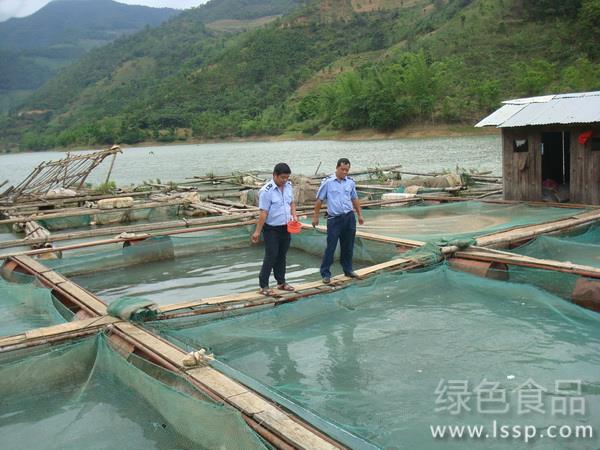
Cage fish farming
Cage fish farming has high stocking density, small space, high disease rate and rapid contagion. Using the ordinary method of directly splashing medicine into the cage often makes fish diseases persist despite treatment. The reason is that the water in the cage exchanges quickly, the effective time of the medicine is short, and the range of the medicine's potency is small (after application, most of the medicine dissolves in the surface layer of the water, while the concentration at the bottom is very low or even zero, and the fish, due to their reaction to the medicine, all move toward the bottom of the cage). Moreover, as cage farming increases in number, its impact on the water quality of large water bodies intensifies, pathogens continuously increase, leading to severe cross-infection. Adopting suitable methods can both effectively cure and eliminate fish diseases and save costs.
To facilitate medication, when setting up the cage, install one net rope at each of the four corners and at the midpoint of each of the four bottom edges, and fasten the other ends firmly to the cage frame. In addition, make a cloth bag slightly larger than half the size of the cage.
1. Preventive medication
For prevention, mainly use Chinese herbal medicines, adopting the methods of hanging bags and feeding medicated bait, supplemented by other medicines, adopting the methods of splashing and feeding medicated bait. Due to the influence of factors such as medicines, feed, water quality and density, hepatobiliary syndrome has been relatively common in recent years. Choosing Chinese herbal medicines is relatively safe, such as Humifuse Euphorbia Herb (Euphorbia humifusa), Chinese Tallowtree leaves (Triadica sebifera), Sweetflag Rhizome (Acorus calamus), pine needles, Chinaberry leaves (Melia azedarach), and Castor Bean leaves (Ricinus communis), etc. They can be used alone or several kinds can be used at the same time.
Hanging bags: Select four points in each cage, with one deep and one shallow hanging bag at each point, so that the entire cage body can reach a certain drug concentration.
Splashing: Lift the net ropes pre-installed at the four corners and four bottom edges of the cage, so that all the fish are in water more than 1 m deep at the surface, increase the concentration to 10 to 20 times and splash for more than half an hour.
2. Therapeutic medication
Fingerlings: Fingerlings have low activity intensity. Drive the fingerlings into one corner of the cage, put on the cloth bag, and adopt immersion treatment. The drug concentration is 10 to 20 times the normal dosage. Do not splash all at once; splash slowly. The medication time depends on the fish's reaction to the medicine, and generally stops when the sick fish show signs of poisoning.
Adult fish: Larger fish have greater activity intensity and should not be gathered too densely. The fish can be driven into 1/3 or 1/2 of the cage area (depending on the number of fish), in water less than 1 m deep, separated with bamboo poles, and then a cloth bag is put over them (putting a cloth bag over the entire cage is of course also possible, but the workload is relatively greater). After the fish calm down, begin splashing the medicine, increasing the concentration to 10 to 20 times. The medication time is the same as for the fingerling method.
Feeding medicated bait: Feed by hand. Sprinkle each handful of feed more widely and over a larger area, so that as far as possible fish with weak feeding ability can eat more.
3. Medication course
The biggest difference between medication in cages and in ponds is that the duration of drug action is short, so external medicines must be used at least twice a day. The number of medication days is determined according to the type of medicine and the severity of the disease. Bacterial diseases require at least two consecutive days, parasitic diseases at least one day, and on the second and third days, sterilization should be carried out once each.