Integrated Polyculture of Soft-Shelled Turtles with Silver Carp, Bighead Carp, Common Carp and Crucian Carp for Imitation-Wild High-Efficiency Farming
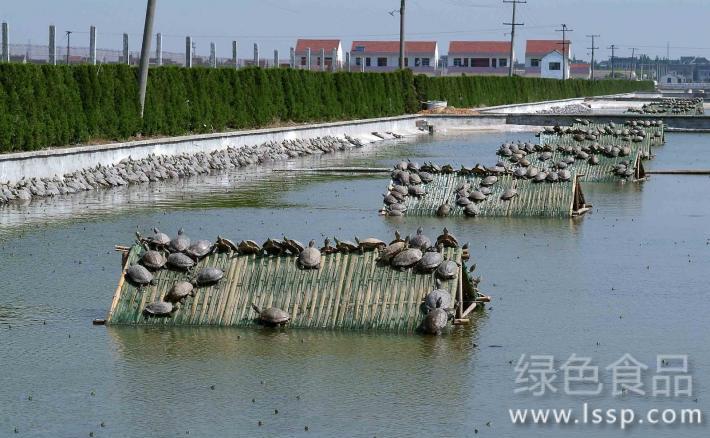
Soft-Shelled Turtle Farming
In recent years, fish farmers in Chentao Town, Binhai County, Jiangsu Province, have changed their pond soft-shelled turtle farming from the previous monoculture of soft-shelled turtles to a system based mainly on raising soft-shelled turtles with a moderate stocking of silver carp, bighead carp, common carp and crucian carp. This has not only made the quality of the soft-shelled turtles very close to that of wild ones, but also yielded harvests of the polycultured fish, significantly improving farming efficiency. Their imitation-wild high-efficiency polyculture technique for soft-shelled turtles with silver carp, bighead carp, common carp and crucian carp is introduced below for farmers' reference:
I. Basic Conditions
1. Pond conditions. Choose ponds with convenient transportation, a complete water inlet and drainage system, and a quiet ecological environment. The area is generally about 5 mu, the pond slope ratio is 1:2, the pond bottom is flat, the sludge thickness is about 25 cm, and the water depth is 1.8 m to 2.5 m.
2. Water source requirements. The water source must be sufficient, and the water quality must be good and free of pollution, meeting the water standards for fish farming, with a pH of 7 to 8.5 and dissolved oxygen above 5 mg/L.
3. Escape-prevention facilities. Build an escape-prevention wall around the pond, 40 cm high, with a 10 cm inward overhang at the top, and a smooth inner wall, to prevent soft-shelled turtles from escaping and enemies from intruding.
4. Building the "two platforms." These are the basking platform and the feeding platform. For every 2 to 3 mu, use cement slabs or wooden boards to build platforms in the pond for soft-shelled turtles to rest, bask their backs and feed. The platform surface is 15 to 25 cm above the water surface, and the sloping side extends to 20 to 30 cm below the water surface.
II. Fry and Seedling Stocking
1. Stocking preparation. In winter, drain the pond water and disinfect and tidy the pond, remove silt and dry the pond, and repair the pond embankments. Before stocking, apply 75 to 150 kg of quicklime per mu, slaked into slurry and splashed over the whole pond, for thorough pond clearing and disinfection. Seven days after pond clearing and disinfection, fill with water to 50 cm, and at the same time apply fermented organic fertilizer to fertilize the pond water.
2. Fry and seedling stocking. Fish fry are generally best stocked in winter, and at the latest stocking should be completed before the Beginning of Spring. Soft-shelled turtle seedlings are generally best stocked from late March to early April. When stocking soft-shelled turtle seedlings, choose individuals that hatched from eggs laid and reproduced under natural conditions, requiring uniform and neat specifications, no disease or injury, a robust physique, and strong activity, with an individual weight of 200 to 250 g each being optimal. The stocking size for silver carp and bighead carp is 150 to 300 g each, and for common carp and crucian carp 30 to 60 g each. At stocking, disinfect by soaking in 4% salt water. The stocking rate for soft-shelled turtle seedlings is 250 to 300 per mu, for silver carp and bighead carp (3:1) 200 to 250 per mu, and for common carp and crucian carp 150 to 200 per mu.
III. Feeding Management
1. Feeding of soft-shelled turtle bait
(1) Types of bait. The soft-shelled turtle is an omnivorous animal, mainly relying on animal protein, with plant protein as a supplement. Fresh live bait mainly includes small miscellaneous fish, animal viscera and trimmings, while green feed mainly includes fresh tender aquatic plants and melons, fruits, and vegetable stems and leaves. Wheat bran, cornmeal, bean dregs and the like can also be mixed and processed for feeding.
(2) Feeding time. When the water temperature rises to about 18°C, the soft-shelled turtles begin to feed. At this time, feed a small amount of bait for domestication, so that the soft-shelled turtles start eating earlier, thereby extending the growth period.
(3) Feeding amount. The feeding amount for soft-shelled turtles is generally calculated based on turtle weight. The daily feeding amount of fresh animal bait is 10% to 20% of the total soft-shelled turtle weight, while the daily feeding amount of compound feed is 5% of the total weight. In the morning, feed 40% to 50% of the total daily feed amount, and in the afternoon, feed 55% to 60% of the total daily feed amount. However, this should be flexibly controlled according to weather, water temperature and the growth of the soft-shelled turtles, with each feeding amount based on being consumed within 2 to 3 hours. According to many years of practical experience, the annual bait feeding amount for soft-shelled turtles distributed by month is 3% to 4% in March to April, 5% to 6% in May, 11% to 13% in June, 24% to 26% in July, 30% to 32% in August, 24% to 26% in September, and 2% to 3% in October.
2. Feeding of fish feed. Stocking silver carp and bighead carp in the pond can clean and regulate water quality, while stocking common carp and crucian carp can loosen the bottom mud, clean up residual bait, and make full use of the scattered soft-shelled turtle feed. Therefore, it is sufficient to increase the feed by about 10% on the basis of the soft-shelled turtle feeding amount to meet the nutritional needs of the polycultured fish.
3. Feeding method. Adhere to the "four fixed" and "four look" feeding method. Feeding is generally carried out by setting up 2 to 3 fixed feeding sites per mu on the two sides of the pond that are well ventilated and face the sun, which is conducive to observing the feeding, growth and activity of the soft-shelled turtles and fish, and convenient for adjusting the feeding amount. Feed twice a day, at 8 to 9 a.m. and at 5 p.m. The bait and feed should be fresh and palatable, and should be disinfected before feeding.
4. Water quality management. At the early stage of stocking, maintain the water level at 80 to 100 cm, and gradually raise the water level as the water temperature rises and the individuals grow. In spring and autumn, add new water once every half month; in summer, add new water once a week, adding 20 to 25 cm each time. In summer and early autumn during high-temperature seasons, the water level should be filled sufficiently. During high-temperature seasons and when the water quality is too dense, change the water in time, with each water change not exceeding 20%. Regularly splash 15 to 20 g/m3 of quicklime or 2 g/m3 of bleaching powder to ensure that the dissolved oxygen in the water is above 4 mg/L, the pH is between 7 and 8.5, ammonia nitrogen does not exceed 5 mg/L, and transparency is kept at 30 to 40 cm in spring and autumn and 40 to 50 cm in summer high temperatures. Equip one aerator for every 5 to 8 mu of water surface, and turn it on at appropriate times to increase the dissolved oxygen content of the water body.
5. Daily management. Insist on patrolling the pond twice a day in the morning and evening, checking the escape-prevention facilities and the water inlet and outlet, and repairing leaks in time. Observe the water quality, and if there are abnormal changes, promptly take adjustment and improvement measures. Observe the activity, feeding and growth of the soft-shelled turtles and fish, and adjust the feeding amount in time. Do a good job in cleaning and sanitation, promptly remove residual debris and bait in the pond, and ensure fresh water quality. According to water level changes, adjust the height of the basking platform and feeding platform in time.
IV. Disease Prevention and Control
1. Feed disinfection. Animal bait can simply be washed clean with clear water. Plant feed such as aquatic plants and duckweed should be soaked in a 20 g/m3 bleaching powder solution for 20 minutes before feeding.
2. Pond disinfection. Regularly splash the pond with medicine. Every half month, splash the whole pond once with 1 g/m3 or 15 to 20 g/m3 of quicklime dissolved in water to prevent bacterial diseases. Every month, splash the whole pond once with 0.7 g/m3 of a copper sulfate and ferrous sulfate mixture (5:2) to prevent parasitic diseases.