Common Problems and Solutions in Raising Free-Range Chickens Under Forest
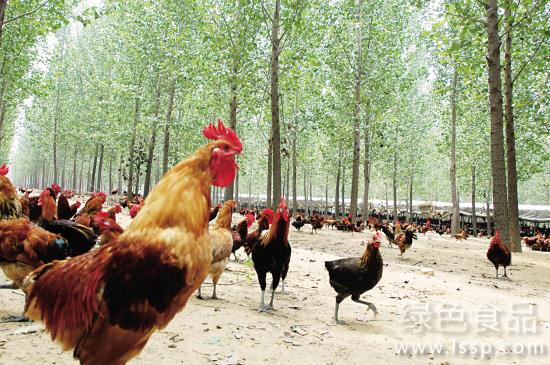
Raising Chickens Under Forest
Raising free-range chickens under forest is an ecological circular industry that has emerged in recent years, based on the principle of "protecting livestock with forest and promoting forest with livestock." It mainly uses natural ecological resources such as woodland and orchards to raise chickens through a combination of grazing and rearing. The trees provide a good and suitable environment for the growth of free-range chickens; in turn, the chickens peck at insect pests in the woodland, and their manure provides high-quality organic fertilizer for the trees. Raising free-range chickens under forest not only solves the employment problem of surplus rural labor, but also increases the income of local farmers, achieving a high degree of unity among economic, social and ecological benefits.
1 Problems in Raising Free-Range Chickens Under Forest
1.1 Neglect of environmental hygiene and non-standard site selection and layout
Judging from the actual situation of raising chickens under forest, a large proportion of farmers lack the corresponding awareness of hygiene and disease prevention, and the rearing areas are not cleaned and disinfected accordingly. Some farmers even pile up dead and diseased chickens directly in a corner without harmless deep burial, causing severe contamination of the rearing area and subsequently triggering various diseases. In addition, some farmers do not strictly follow the requirements in site selection and layout, mixing the living area with the rearing area, and fail to build corresponding chicken sheds or coops.
1.2 Abuse of drugs and inadequate disinfection
During medication, antibiotics are added arbitrarily to the water, and the same drug is used regardless of the cause of disease. At the same time, some farmers, in order to save money, stop medication as soon as the condition shows slight improvement, which ultimately leads to recurrence of the disease. As for disinfection, no disinfection plan has been formulated, the practices are highly arbitrary, the types of disinfectants used are limited to a single kind, and dead and diseased chickens are not handled in strict accordance with the requirements of harmless treatment.
1.3 Low level of breeding technology and unscientific immunization
In the process of production management, many farmers lack professional knowledge and simply leave the flock in the forest without proper care. At the same time, they do not attach importance to vaccine immunization, do not purchase vaccines through proper channels, and store and use vaccines improperly, resulting in low antibody levels or even no antibody production after vaccination of the flock.
2 Countermeasures
2.1 Scientific site selection and good environmental hygiene
For site selection, choose a location with sufficient water, dryness, a quiet environment, convenient power supply, shelter from the wind and facing the sun, and easy drainage, and an orchard or forest belt suitable for free-range rearing. Set up a disinfection room and disinfection pool at the entrance of the production area, and set up corresponding fences on the periphery. Build chicken sheds based on the principle of heat protection and warmth retention, clean the sheds every day, disinfect regularly, and ensure the environmental hygiene of the rearing area. In addition, carry out harmless treatment of dead and diseased chickens and promptly disinfect the contaminated environment.
2.2 Regularly carry out breeding technology training
In view of a common problem among farmers, namely weak awareness of disease risk and low professional quality and management level, training in feeding management, legal knowledge and disease prevention should be intensified to enhance farmers' disease prevention and control level and their awareness of epidemic prevention. At the same time, technical guidance on breeding should be strengthened, and various new breeding models, new technologies and new knowledge should be actively promoted. In addition, existing facilities and technical personnel should be fully utilized to actively carry out epidemic prevention and control guidance and testing work, and scientific and reasonable immunization procedures and epidemic prevention measures should be formulated according to the actual situation of farmers.
2.3 Improve the level of breeding management
In the production process of raising chickens under forest, corresponding systems should be formulated for harmless treatment, immunization and disinfection. At the same time, keep good breeding records, mainly including records of marketing, purchase of chicks, diagnosis and treatment, feeding and disinfection; the records must be detailed and complete. In addition, a corresponding incentive mechanism should be established to encourage farmers to take the lead in setting up professional cooperative organizations, and to promote the development of free-range chicken farming under forest through measures such as market development, local development, network building, development in other locations and brand building. For organizations with notable income-increasing benefits and demonstration effects, corresponding rewards may be given based on the actual number of users developed, thereby enhancing the initiative and enthusiasm of specialized cooperative organizations for development.