Good Feed Brings Good Returns: Four Clever Ways to Identify Fish Feed Quality
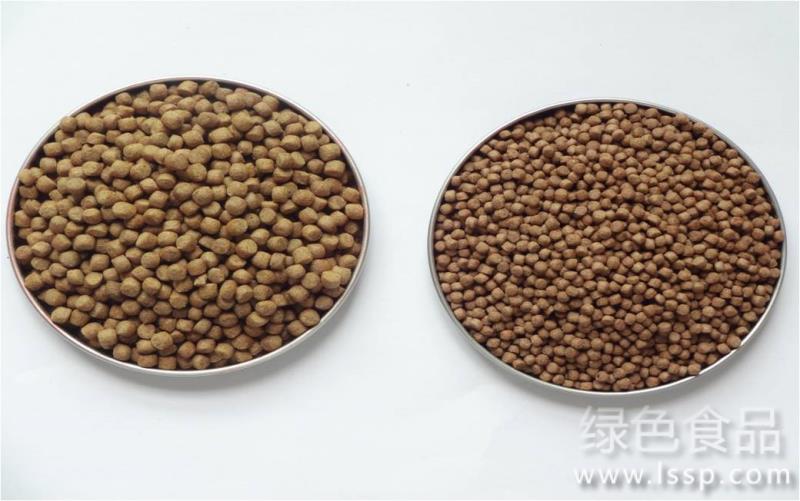
Fish Feed
Through many years of aquaculture practice, the four methods of "look, smell, soak, chew" have been summarized for cleverly identifying fish feed quality.
1. Look (examine the feed's color and the uniformity of the pellets): Complete compound feed for fish is made by uniformly mixing the main raw materials such as fishmeal, soybean meal, rapeseed meal, cottonseed meal, and premix (containing trace elements) in a certain proportion and then pelletizing them. The appearance color of the feed has the natural color of the raw materials, generally a dark yellowish-brown or brown. If there is more fishmeal and soybean meal, the feed color will be slightly yellow; when there is more miscellaneous meal, the feed color is dark red. Fish in different growth stages need pellet feed of different specifications. For a fish feed product of the same specification, the pellet size should be uniform and consistent, the surface should be glossy and bright, the cross-section cut should be smooth, and the pellet length is generally 1.5 to 2.5 times the particle diameter. If the ratio of fish feed length to particle diameter is imbalanced, it will seriously affect the palatability of the food to the fish and cause a large amount of feed loss.
2. Smell (smell the odor given off by the feed): Complete compound feed for fish is made by mixing various raw materials and then cooking them with steam, and generally has a faint meal fragrance and fishy smell. Feed with the antibacterial drug allicin added has a garlic smell; while feed with fish attractant and fish flavoring (used to pass off as genuine, replacing fishmeal) added has a pungent fishy smell, and after soaking it in water for a period of time, the fishy smell immediately becomes faint or disappears.
3. Soak (check the feed's fineness and water resistance): The method is to grab a handful of feed and put it into water, observe the time it takes for the feed to disperse, and check the feed's degree of coarseness and uniformity. The fish we generally culture (black carp, grass carp, bighead carp, crucian carp, common carp, etc.) all belong to the carp-type fish, and their digestion and absorption of food takes place in the intestinal tract, relying on intestinal peristalsis and digesting and absorbing under the action of digestive enzymes. This requires that the feed particle size be as fine as possible; the finer it is, the higher the utilization rate. The intestinal emptying time of fish is generally 1.5 to 2 hours, and the time for the feed to disperse in water should preferably be 3 to 5 minutes. Feeding once every 2 to 3 hours can achieve the goal of not wasting feed.
4. Chew (feel the feed's taste and impurity content): Although fish swallow feed when eating, the quality of the taste is the main factor affecting their feeding behavior. Through the touch and taste of our oral cavity, we can sense the hardness of the pellets, the degree of impurities (such as sand grains and soil) and whether there is any abnormal odor. If there is a gritty feeling or a soil taste, it proves that the feed contains impurities such as sand grains and soil; if there are abnormal tastes such as bitter, sour, or astringent, it indicates that the feed raw materials or finished feed have become moldy.
Overall, to judge whether a feed is of good or poor quality, one should consider both appearance quality and internal nutrition, and evaluate it from conditions such as enterprise scale, equipment, technology, and manpower. Only by choosing high-quality and efficient feed can high returns be obtained.