Breeding Technology for the Yellow-Throated Pond Turtle: An Excellent Dual-Purpose Food and Medicinal Species
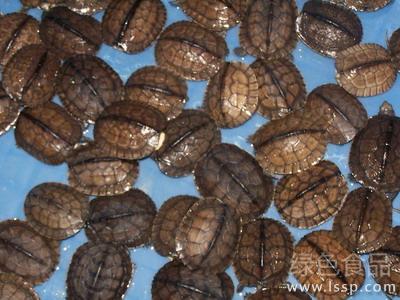
Yellow-Throated Pond Turtle
The yellow-throated pond turtle, also known as the yellow-throated water turtle or fragrant turtle, is a small to medium-sized freshwater turtle distributed in the freshwater waters of Anhui, Jiangsu, Zhejiang and parts of southern provinces and regions. Its body is flattened and oval, and the shell of an adult turtle is about 15cm long. The yellow-throated pond turtle has a gentle temperament and delicious flesh with no off-flavour. It is an excellent dual-purpose food and medicinal species, and at the same time the best turtle species for cultivating the high-grade ornamental turtle——the green-haired turtle. It is therefore deeply loved by consumers. A brief introduction to its ecological breeding technology is given below.
I. Turtle Pond Construction
To raise yellow-throated pond turtles, a site should be chosen that is open, sunny, sheltered from the wind, quiet, with abundant water and good water quality for building the pond. The size of the pond can be determined according to conditions and the scale of breeding; round, oval, rectangular or irregular shapes are all acceptable. The pond should be more than 1 m deep, and the pond embankment should connect with the surrounding ground at a gentle slope of 25~30 degrees. For a small courtyard pond, the bottom and four walls can be laid with bricks, then the joints pointed and smoothed with cement mortar, with a 20cm-thick layer of sand and mud spread on the pond bottom, and a feeding platform of 3~5 sq m and 70~100cm high built in the pond to serve also as a resting and basking place. On the bank facing the sun, a 5~8 sq m egg-laying site should be set up, covered with 40cm-thick sandy loam for the turtles to dig holes and lay eggs. A rain shelter should be built overhead, and several clumps of flowers, grass or vines planted around to provide a concealed and safe egg-laying environment for the turtles. A newly built turtle pond should first be disinfected by splashing the whole pond with quicklime water, and the pond bottom exposed to the sun for 5~7 days. After pest organisms have been eliminated, water is added, then a bleaching powder solution is splashed to sterilise, the water is drained and fresh water added, and hatchlings or breeding turtles are introduced.
II. Feeding Management
A newly hatched yellow-throated pond turtle hatchling weighs only 3~5g. For the first 3 days it relies on the nutrients stored in the yolk sac; after 3 days it can be fed cooked egg yolk or yellow mealworms; after 7 days it can be fed high-quality feed that is fine, tender, soft and easy to digest, such as minced fresh fish and shrimp, animal viscera, fruits and vegetables and tubers. The feeding amount is about 5% of the turtle's total body weight, with the criterion being that the feed is finished within 100min after feeding. In summer, feed twice a day; in spring and autumn, feed once a day; in late autumn, feed once every 2 days, but the feed should be high-quality with high protein and fat content, so that the turtles store as much energy as possible for overwintering and can safely pass the long cold winter.
Hatchlings are generally kept temporarily in indoor ponds or in basins or jars, with the container placed at a slant and the water depth at 10~15cm, allowing the turtles to choose a suitable water level or a dry spot for themselves. The stocking density is about 100 turtles per sq m. After 15~30 days of temporary rearing, or after waking from overwintering, the hatchlings are transferred to juvenile turtle ponds. If the juvenile turtle pond is indoors, the water depth should be increased to 30cm, and the top of the pond wall should have an overhanging lip to prevent escape. The ratio of water area to land area in the pond should be 2:1, and the pond bottom should be covered with a 20cm-thick layer of hard clay. The stocking density is 20~30 turtles per sq m. The feed for juvenile turtles can be based on the hatchling feed formula with the addition of plant-based feed such as duckweed or melon and vegetable matter. In the peak growing season from May to August, the feeding amount can be increased to 10% of the turtle's total body weight. One month before overwintering, high-quality fat-rich feed should also be given to help them overwinter safely. The juvenile turtle pond should have its water changed once every 3~5 days, changing about 1/3 of the water each time. After 2~3 months of careful rearing, juvenile turtles can reach a body weight of more than 50g, and when the air temperature stabilises above 20°C they can be transferred to outdoor turtle ponds. Entering the 3-year-old young turtle stage (that is, the spring after two overwinterings), body weight has reached more than 250g, and at this point inoculation of the turtle shell basic branch algae can begin to cultivate green-haired turtles.
III. Reproduction of the Yellow-Throated Pond Turtle
1. Parent selection. For males, healthy individuals should be selected weighing more than 300g, with a narrow and elongated body shape, a relatively large carapace, a centrally sunken round plastron, a relatively long tail, and the anal opening relatively far from the rear end of the plastron; for females, healthy individuals should be selected weighing more than 400g, with a round and thick body shape, a relatively short carapace, a flat plastron, a relatively short tail, and the anal opening relatively close to the rear end of the plastron. The overall requirements are individuals that are healthy, with complete limbs, an intact shell, smooth body surface, bright and spirited eyes, head, neck and limbs that can extend and retract freely, quick reactions, and the ability to turn over on flat ground. The female-to-male ratio should preferably be 2:1~2.5:1.
2. Management during the egg-laying period. The yellow-throated pond turtle reaches sexual maturity at the age of 5~6 years. Mating occurs in the evening or at dawn in May~June and August~September when the temperature is 20~25°C, and eggs are laid from June to September, with July being the peak egg-laying period. Turtle eggs are shaped like silkworm cocoons; fertilised eggs are round and smooth, with a reddish, glossy eggshell that does not stick to mud or sand. However, the embryo of a turtle egg only becomes fixed about 24 hours after laying, so turtle eggs should be collected in the afternoon of the second day after laying. During the egg-laying period, the site should be checked every morning, and labels with the date written on them should be placed next to eggs newly laid the previous night or early that morning, so that turtle eggs can be collected on time. When collecting turtle eggs, each should be examined individually, and fertilised eggs should be arranged with the end showing the air sac cavity facing up in a basin with sand at the bottom or a specially designed egg tray, and then placed separately in hatching boxes according to the order in which they were laid for constant-temperature incubation. If a particular turtle egg still has not shown a white semi-transparent air sac cavity after another 8 hours, it is an unfertilised egg and should be processed for food or other uses.
3. Incubation management. Hatchling incubation boxes are generally rectangular, measuring 60cm×40cm×12cm, mostly made of wood, with several drainage holes drilled in the bottom and a 6cm-thick layer of sand spread inside. Turtle eggs are arranged neatly with 1cm gaps, covered with a 3~4cm-thick layer of sand and soil, and a glass cover is placed on top. Labels indicating the egg-laying date and the number of turtle eggs and other relevant data are affixed, and a constant temperature of 28~30°C and humidity of about 85% are maintained. After 55~60 days of incubation, the hatchlings emerge, with a hatching rate generally of about 90%.