To increase the egg production rate of laying geese, master these five key points
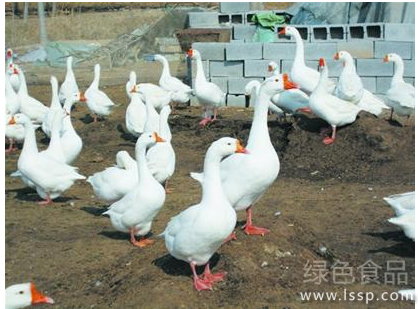
Laying goose farming
In the process of raising laying geese, the egg production rate depends mainly on the breed, followed by the formulation of protein feed, with the protein content guaranteed at 20% to 25%, soybean cake 15 to 20%, bone and shell meal 2 to 3%, salt 1%, trace elements and minerals about 1%; it is even better if carrots can be added. So, how do you increase the egg production rate of laying geese? Below, the editor introduces the five major aspects that must be handled well to increase the egg production rate of laying geese:
1. Provide enough feed: starting four weeks before laying, feed a mixed feed of 25-30% grain and 70% green grass and vegetable leaves, with soybean cake added, so that the crude protein level is 15-16%, feeding 250-300 grams per bird per day, and fully supply enough high-quality roughage, such as dried grass meal and blighted grain. If there are free-range conditions, give priority to grazing and supplement with a small amount of concentrate;
2. Do not graze too far: geese are herbivorous waterfowl, and even if free-range conditions are available, do not let the laying geese go too far, because geese have the habit of returning to the nest to lay eggs. If you see a mother goose not eating grass, stretching its head and neck, and calling, that is a sign of attachment to the nest, and it should be driven back into the shed to lay eggs;
3. Add night feeding: feeding at night is an important measure to increase the egg production rate. In particular, night feeding must be done in the early laying period and during the laying period, 1-2 times per night, which can produce 40-80 eggs per year;
4. Artificial assisted mating: geese like to mate on water, and the fertilization rate is high. Artificial assisted mating can also be adopted. Each time a mother goose lays an egg, artificial assisted mating should be carried out once to increase the fertilization rate of breeding geese;
5. Keep good ganders: generally a goose flock can be used for 3-4 years, and good ganders must be selected and retained. It is best to form the flock before laying (that is, in the breeding season) to avoid disturbance caused by forming the flock temporarily and affecting the conception rate of the laying geese. The male-to-female ratio of geese is 1:6.
The above content is a brief and detailed introduction to the five major aspects that must be handled well to increase the egg production rate of laying geese, for the reference of goose raisers only.