Broiler chickens are prone to diseases in winter, so scientific feeding and management measures should be adopted
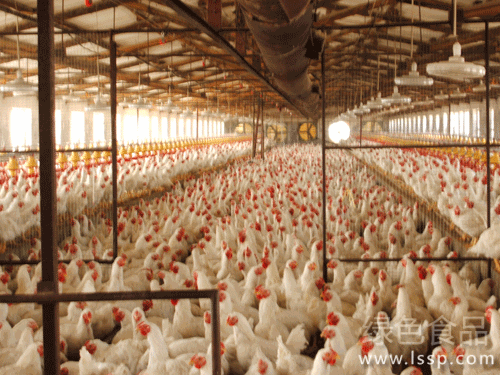
Broiler chicken rearing
Winter is the most difficult season for broiler chicken rearing, because ventilation and heat preservation conflict in winter. Due to high rearing density and excessive enclosure for warmth, there is too much CO2 in the house and a lack of fresh air, making the climate environment inside the chicken house very poor, thereby inducing a variety of diseases, such as colibacillosis, respiratory diseases, ascites, etc. Therefore, raising broiler chickens in winter should be managed from the following aspects.
1. Reduce rearing density: In a closed chicken house, the respiration of the flock causes the oxygen content in the house to decline and carbon dioxide to increase. In chicken houses where heating measures are taken, the humidity is high, the temperature is high, the immunity of the chickens declines, and the disease rate increases. Due to dense rearing, the chance of pathogens spreading through the air increases, and the chance of chickens suffering from infectious rhinitis, infectious laryngotracheitis, chronic respiratory disease, fowl cholera and other diseases will increase. If the rearing density is reduced, the number of chickens decreases, the oxygen demand decreases, and the exhaled carbon dioxide decreases, lowering the air pollution index and thereby reducing the disease incidence.
2. Strengthen ventilation of the chicken house: When the keeper entering the chicken house feels a pungent smell, eye irritation, or mild difficulty breathing, the house temperature must be raised and ventilation carried out slowly, avoiding excessive ventilation that causes the temperature of part or all of the chicken house to drop too quickly; cold wind should be prevented from blowing directly onto the chickens to prevent them from catching cold. When the outside atmospheric temperature is too low, ventilation of the chicken house can be carried out by pre-warming the air through a warm empty room before letting it into the chicken house, or by directing heated air into the chicken house through air ducts or long cloth bags. Under normal circumstances, windows should be opened for ventilation on sunny, windless days from 10:00 am to 3:00 pm, as ventilation at this time is less likely to cause too great a temperature drop and also helps save fuel. However, at any time, when there is a pungent or eye-irritating gas or breathing is difficult, ventilation must be carried out to keep the air in the house fresh and reduce the occurrence of chicken diseases.
3. Control the temperature of the chicken house: Temperature is the primary condition for the normal growth and development of broiler chicks, and is closely related to the body temperature regulation, activity, feed intake, drinking, digestion and absorption of feed, and disease resistance of broiler chickens. The optimum temperature differs at different growth stages. Under normal circumstances, the brooding temperature is 33-35°C, and thereafter the temperature can be reduced by 2-3°C each week until it reaches 18-21°C. During brooding, the temperature standard must be well controlled, neither too high nor too low; it should be balanced and steady, higher in the early growth stage and lower in the later stage, decreasing gradually, and must never fluctuate sharply or change too much. The basic principles of heating control are that the early stage is higher than the later stage, nighttime is slightly higher than daytime, weak chicks need higher temperatures than strong chicks, windy cooling and rainy or snowy days require higher temperatures than normal sunny days, brooding in winter and spring requires higher temperatures than brooding in summer and autumn, and the period before and after immunization and during illness of the chicks requires higher temperatures than usual, and so on.
4. Control the humidity of the chicken house: The most suitable humidity for a broiler chicken house is 60%-70%. If the humidity in the house is too low, broiler chickens appear dull, with ruffled feathers, dry skin, and dull-colored beaks and claws, and it is easy to cause dehydration of the chickens and induce respiratory diseases in the flock. If the humidity in the house is too high, it will increase the heat dissipated by the chickens and make them feel colder. In production, a water basin can be placed on the heat source to increase humidity, or a humidifier can be used for humidification; measures such as strengthening ventilation and placing quicklime blocks indoors can be taken to reduce the humidity in the house. At a dry-bulb temperature of 33 degrees, the wet-bulb temperature should be 28-29 degrees, that is, a dry-wet bulb temperature difference of 4-5 degrees, which can ensure a relative humidity of 65%-70% in the chicken house.
5. Do a good job in hygiene and disinfection: The chicken house should be cleaned every day, and manure and bedding should be removed in time to prevent feces and urine from being stored in the house for too long and producing large amounts of ammonia gas, causing ammonia poisoning. After the broiler chickens are sent to market, the chicken house should be thoroughly disinfected, and the house should be left empty for 10 days before the chicks are brought in. The environment around the chicken house should be disinfected once a week, and spray disinfection with chickens inside the house should be carried out 1-2 times a week, with regular disinfection of utensils such as feed troughs and drinkers.
In short, reasonably arranging the daily life of the chickens, strengthening feeding management, resolutely not using moldy feed, and improving the resistance of the chickens; while ensuring the temperature of the chicken house, using sufficient sunlight hours for appropriate ventilation to increase fresh air in the house; paying attention to environmental hygiene, doing a good job in disinfection, and reducing rearing density are all of great benefit to ensuring the health of the chickens.