Proper methods for applying foliar fertilizer in grape cultivation
How should foliar fertilizer be applied in grape cultivation? Please introduce the methods. The main advantages of foliar fertilization are: rapid fertilizer effect, remarkable results, labor and fertilizer savings, and it is not affected by soil fixation or root absorption function. The disadvantages are: it is greatly affected by wind, air humidity, and temperature. Foliar fertilization can not only promptly treat fruit trees'...
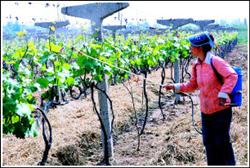
How should foliar fertilizer be applied in grape cultivation? Please introduce the methods
The main advantages of foliar fertilization are: rapid fertilizer effect, remarkable results, labor and fertilizer savings, and it is not affected by soil fixation or root absorption function. The disadvantages are: it is greatly affected by wind, air humidity, and temperature. Foliar fertilization can not only promptly treat nutrient deficiency symptoms in fruit trees, but also has a remarkable effect on promoting leaf growth, extending the functional period of leaves, and improving photosynthetic efficiency.
I. Fertilization period, fertilizer types, and concentrations. 1. After sprouting and before flowering: mainly to promote leaf and new shoot growth, with nitrogen fertilizer as the main spray. For example: 0.3%-0.5% urea solution, 0.3%-0.5% ammonium sulfate solution, 0.3%-0.5% ammonium nitrate solution, 0.3% urea + 0.3% potassium dihydrogen phosphate nitrogen-phosphorus-potassium compound liquid fertilizer.
2. Flowering and fruit-setting period: mainly to promote flowering and increase the fruit-setting rate. 5-7 days before flowering, spray 0.1%-0.3% borax solution or 0.05%-0.15% boric acid solution; one week before flowering and one week after flowering, spray 0.05%-0.2% zinc sulfate solution once each; during the flowering period and after flower drop, spray 0.03%-0.07% rare earth micro-fertilizer once each.
3. After fruit setting and before ripening, and during branch maturation: mainly to promote fruit growth, increase fruit sugar content, prevent fruit "water injection", promote photosynthesis, extend leaf lifespan, promote branch maturation, and improve plant disease resistance. During this period, root-external topdressing should mainly use phosphorus and potassium fertilizers, with nitrogen fertilizer applied together.
II. Preparation of extract solutions. 1. Superphosphate extract solution: take 1 kg of superphosphate, add 5 kg of clean water, soak for 12 hours, and filter to obtain the liquid. When using, add 50 kg of water to each kg of filtrate to obtain a 2% extract solution.
2. Plant ash extract solution: take 1 kg of plant ash, add 5 kg of clean water, soak for 24 hours, and filter to obtain the liquid. When using, add 50 kg of water to each kg of filtrate to obtain a 2% extract solution.
3. Potassium dihydrogen phosphate extract solution: mix 5.5 kg of fresh plant ash with 2.5 kg of superphosphate, add 45 kg of water, soak for about 24 hours, and filter to obtain the liquid; add another 25 kg of water to the residue, soak for 10 hours, and filter to obtain the liquid. Mix the two filtrates and add 100 kg of water before spraying on the leaves.
4. Nitrogen-phosphorus mixed solution: One method is to take 1 kg of superphosphate, add 5 kg of clean water, soak for 12 hours, and filter to obtain the liquid; add 2 kg of urea to the filtrate to make a stock solution. When using, add 50 kg of water to each kg of stock solution for spraying. Another method is to take 1 kg of the supernatant liquid of fully decomposed human manure and urine, add 50 kg of water, and spray.
III. Timing of foliar fertilization. Foliar fertilization should be chosen on a windless cloudy day or a sunny day; on sunny days, it is best to do it before 10 a.m. or after 5 p.m. The interval between two foliar topdressings is generally about 15 days.
IV. Precautions. 1. Because within a certain range, the higher the temperature, the greater the humidity, and the lower the wind speed, the faster and more the leaves absorb, so when there is heavy fog or dew, the spray concentration should be reduced accordingly. It should not be carried out in windy or high-temperature weather. 2. Focus on spraying tender leaves, young shoots, and the underside of leaves. 3. When spraying, the droplets should be fine and uniform, and the fertilizer solution should be about to drip but not fall. 4. When mixing multiple fertilizers for spraying, pay attention to the properties of the fertilizers and do not mix them blindly. 5. If rain occurs within 12 hours after spraying, spray again.
Click to get more foliar fertilizer application methods
Click to get more fertilizer application methods
Click to get more grape cultivation techniques