How to raise and fatten meat donkeys? Detailed explanation of four technical key points
In the process of raising meat donkeys, fattening is very difficult, because meat donkeys are herbivorous animals. In fact, fattening meat donkeys is the scientific application of feed and management techniques to obtain higher-quality meat donkey output at a lower breeding cost in a short period of time, thereby enabling the price of meat donkeys to increase and raising breeding income. So this article will give farmers a detailed introduction to the four issues that need attention in meat donkey fattening.
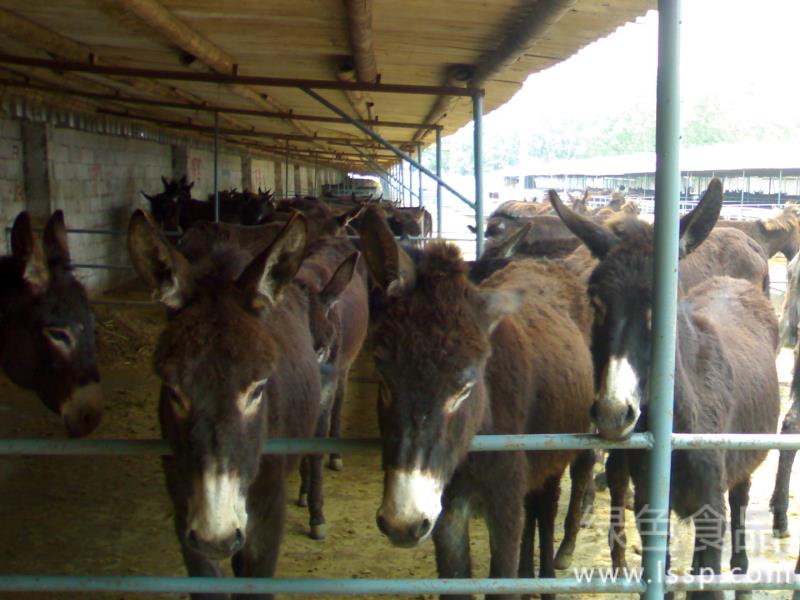
Donkey
1. Selection of superior breeds. To improve the economic benefits of raising meat donkeys, the first step is to select offspring from crossbreeding superior breeds with local breeds. Second, do a good job in the scientific feeding and management of meat donkeys. China's superior donkey breeds mainly include the dual-purpose draft-and-meat type. Among them, the Guanzhong donkey and Dezhou donkey, which are larger in body size and suitable for pure breeding as meat donkeys, can be used to crossbreed and improve local breed donkeys; medium-sized ones such as the Biyang donkey and Jiami donkey can not only bear various types of labor but can also serve as excellent breeds for crossbreeding and improving local breed donkeys; small local superior breeds include the Hexi donkey.
2. Feeding principles. Feed in separate troughs according to the donkey's sex, age, strength, and body condition, tie them with short halters, and fix their trough positions. Feed 4 times a day in the morning, noon, evening, and at night (dual-purpose meat and draft use). In summer, feed 1 more time, and in winter, feed 1 less time. Coarse feed should be chopped short and fine, achieving "an inch of grass in three cuts." Concentrate feed should be ground, or soaked, fermented, roasted, and otherwise processed to improve the meat donkey's palatability and digestibility of the concentrate. Because the donkey's stomach is small, feed less but more frequently, and provide supplementary feeding at night. At the same time, ensure that the donkey is provided with sufficient drinking water and an appropriate amount of salt. Feed at fixed times every day, rest and exercise at fixed times, and brush the skin on schedule.
3. Feeding of foals. In addition to normal management, newborn donkeys usually begin training to eat concentrate at 15 days of age. Corn, barley, millet, oats, and other grains can be ground into flour, boiled into thin porridge, and then a little sugar added to entice the foal to eat it. At first, 10-20 grams per day, after several days 80-100 grams, after 1 month 100-200 grams, after 2 months 500-1000 grams, and then gradually increase. After 9 months, the daily concentrate feed should reach 3.5 kilograms. During the entire fattening period, a meat donkey will use up a total of 500 kilograms of concentrate.
4. Fattening methods for adult donkeys. Donkeys prepared for fattening can first be fed some easily digestible feed such as green grass and bran, also feeding less but more frequently, and each feeding should reach only 70 to 80 percent full. After observing for a few days, once the donkey's eating is normal, it can enter the regular feeding period. At this time, the mixed concentrate fed to the donkeys should be based mainly on cottonseed hulls (in cotton-producing areas). The mixed concentrate includes 30% cornmeal, 50% cottonseed kernel cake, and 20% bran. Feed 2 times a day for 2 consecutive months (coarse feed provided at night), and then they can be sold.