When do geese need supplemental feeding? Master the three-observation method
Besides being affected by age, breed and feeding management, the egg production of female geese is also influenced by reasonable supplemental feeding, which is a key part of increasing egg production. So when is the most suitable time to give geese supplemental feed? Let the editor of Green Food Network introduce it to you:
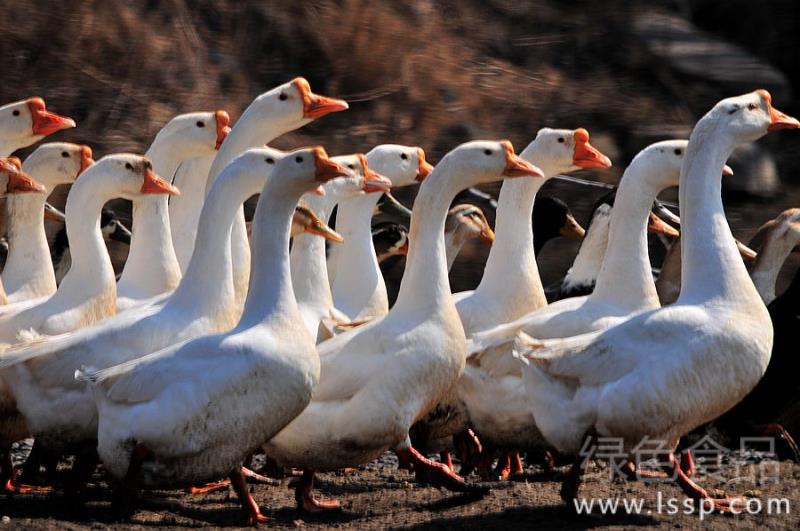
Geese
1. Supplemental feeding based on body condition
In overfat female geese, a large amount of fat is deposited around the ovaries and oviducts, which throws the endocrine function within the goose's body out of balance, hindering the formation and movement of egg cells, so the laying rate of female geese drops greatly, or they even stop laying. If female geese are too thin and lack nutrition, the laying rate drops significantly or they even stop laying. For overfat geese, concentrate feed should be appropriately reduced or stopped, and the exercise or grazing time of overfat confined female geese should be appropriately increased. For too-thin female geese, the amount of concentrate feed should be increased in time, the protein content in the geese's daily ration should be increased, and in the evening the laying geese should also be given 1 to 2 supplemental feedings of concentrate.
2. Supplemental feeding based on the state of the droppings
If the droppings passed by the geese are thick, loose, strip-shaped, glossy on the surface, and can be broken into several sections with a light prod, this indicates moderate nutrition and normal digestion. If the droppings passed are firm and small, black in color, and after a light prod the cross-section is granular, this indicates that the geese have been fed too much concentrate and too little green feed; the nutrient level of the feed is relatively high and hard for the geese to absorb, causing indigestion, so the proportion of concentrate should be reduced and the proportion of green feed increased. If the droppings passed are light in color and unformed, scattering as soon as they are passed, this indicates that the amount of concentrate is insufficient and too much green feed has been fed, so the nutrition in the feed is not enough, and supplemental concentrate should be fed.
3. Supplemental feeding based on the shape and weight of the eggs
Laying geese need twice as much carbohydrates, fat and protein as non-laying geese, and their need for minerals and vitamins is even greater.
Generally speaking, the total daily ration for laying geese is 150 to 300 grams. If the feed nutrients taken in by laying geese are insufficient, the eggshells will become thin, the egg shape will change, and the eggs will also be smaller. When this situation is found, feeds rich in protein such as fish meal, peanut cake and soybean cake must be added, the crude protein content in the daily ration of laying geese should be raised to 22%, the daily feeding amount for the geese should be increased to 300 grams, and at the same time mineral feed should be appropriately added to the daily ration.