Raising chickens on the mountain brings good returns, and these four points need attention
Raising chickens on the mountain does not disturb residents, and the chickens have a larger range of activity and a richer food supply. Moreover, chickens raised free-range on the mountain have firm, flavorful meat and are in high demand in the market. Although raising chickens on the mountain has many advantages, four points still need attention:
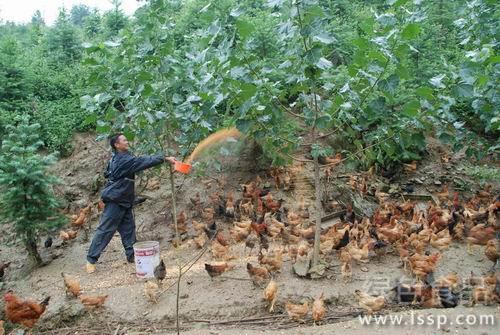
Raising chickens on the mountain
1. Site selection. The chicken farm should be located in a mountain hollow sheltered from the wind and facing the sun, with grass and trees; the trees provide shade and coolness, and the grass can be eaten. Build a simple chicken coop that is warm in winter and cool in summer in a dry place.
2. Feeding. Raise them at home for 30 to 45 days, then move them to the mountain to raise them, for a higher survival rate. During the day, let the chickens out to move around, bask in the sun, and forage for food. In the morning and at noon, feed them until half full so they stay active and forage on their own; at dinner, feed them until full. The feed trough should have a wide bottom and a small opening, with an inward-curled rim nailed on the opening, which can both prevent the chickens from scratching out the feed or hooking it out with their beaks, and prevent them from defecating into the trough. In summer, from dark until 10 o'clock at night, hang an electric light 1 m above the flat ground away from the chicken coop to attract insects to feed the chickens. If there is no electricity, hang a kerosene lamp. Provide enough clean drinking water.
3. Management. The chicken coop should be warm in winter and cool in summer. Pay special attention to the invasion of late-spring cold spells. At night, let the chickens return to the coop to spend the night; a dog can be kept to guard against wild animals. Every morning, clean out the chicken droppings.
4. Disease prevention. When the chicks are 7 days out of the shell, vaccinate each chicken against Newcastle disease with 1 drop of Newcastle disease vaccine strain II by nasal drip; at 60 days of raising, vaccinate by injection with Newcastle disease vaccine strain I and fowl cholera vaccine, 1 ml per chicken, to prevent Newcastle disease and fowl cholera.