How to Raise Laying Ducks for More Eggs? A Full Guide to the Four-Season Breeding Tips
In recent years, duck farmers have summed up "four sayings" in the breeding process for saving feed and increasing egg production. Each laying duck produces 250-300-plus eggs per year, each egg weighs 60 grams, and more than 20% of feed is saved. The four-season verse for breeding is:
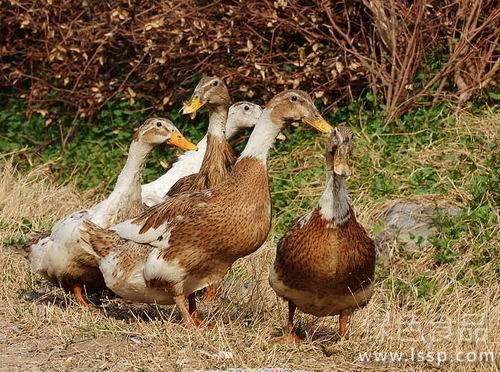
Laying duck
(1) In spring, fatten the duck with a single spray of flowers.Experience has shown that feeding laying ducks earlier in spring means the ducks lay earlier, more, and larger eggs. Therefore, in spring the laying ducks must be carefully fed. The commonly used laying duck feed formula is: 30% corn, 20% broken rice, 15% wheat, 5% bran, 14% rice bran, 8% rapeseed cake, 8% fish meal. Feed each laying duck 100-125 grams of compound feed per day, plus 150-200 grams of green feed. In this way, the female ducks become fat and plump and lay many large eggs.
(2) In summer, stop feeding and pluck the feathers.After entering summer, especially on very hot days, the female ducks have poor appetites and are rather thin because they have laid eggs continuously for several months in spring. If they continue laying, it will inevitably affect the autumn eggs. At this time, the laying ducks should be shut up, and a few tube feathers (large feathers) on the wings and tail should be plucked out. For three consecutive days, give only water and no feed, forcing them to stop laying. In this way, the laying ducks shed their old feathers. Then feed them concentrated feed. After about 20 days, the laying ducks regain their strength and grow new feathers, and after about 30 days the laying ducks can continue high production.
(3) In autumn, control the ducks from fattening up.In autumn, grazing food is abundant, such as various seed-bearing forage grasses and fallen rice grains. At this time, the laying ducks must be controlled from fattening up. The method of driving the laying ducks to make them move can be adopted, keeping the laying ducks' body weight at 1.5-2 kg. Because when body weight increases, fat accumulation inevitably rises, and the laying ducks' egg-laying capacity will decline. If the female ducks maintain a medium-to-upper degree of fatness, they will certainly have high and stable production throughout autumn. Autumn is the best season for processing century eggs; egg prices are high and the returns are good.
(4) In winter, stir the ducks and make them splash in the water.The winter climate is relatively cold, the duck flock's activity decreases, fatness increases, and egg production decreases. To make laying ducks produce more eggs, in addition to reducing concentrated feed and increasing green feed and coarse feed, the ducks must also be driven (that is, stirring the ducks), gently shouting to make the flock stand up, and then slowly driving the flock to walk in circles inside the duck shed, 5-10 circles each time, at least 5 times a day. Duck farms with a water pool, ditch, pond, or reservoir can also arrange one water activity, but before entering the water the laying ducks must be made to move, to make the ducks' whole bodies warm up and improve their cold resistance. After splashing in the water for more than one hour, the ducks must be driven ashore.