Survival rate is key in turkey farming, and brooding work must be done well in spring
Turkeys have the advantages of fast growth, high meat yield, good meat quality, rich nutrition, delicious flavor, ease of raising, tolerance of coarse feed, and strong disease resistance. The key to raising turkeys lies in improving the survival rate of spring brooding.
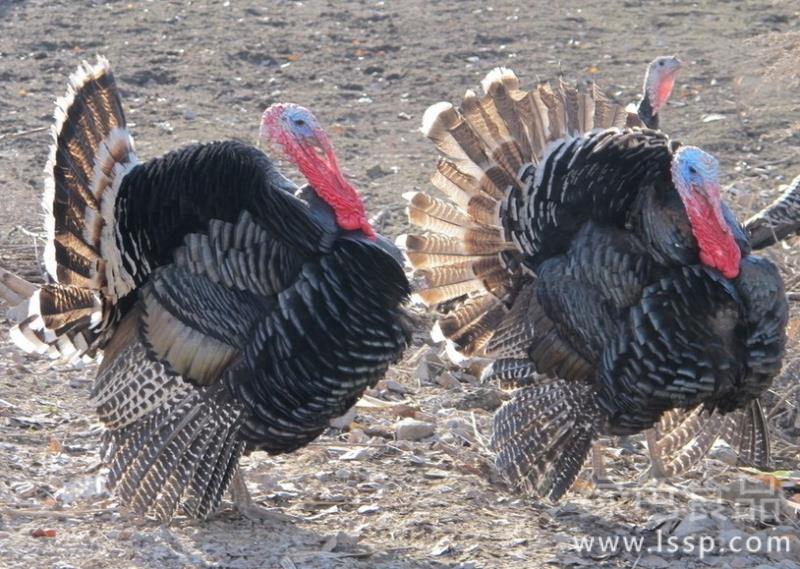
Turkey
I. Early-stage feeding and management
After the chicks hatch, if a brooding room is available, turkey chicks can be raised on multi-tier wire flooring inside it. If there is no brooding room, a 40-60 watt bulb can be used to illuminate separate boxes. For chicks 1-2 weeks old, the temperature should be controlled at 32-35°C. Place the chicks in a cardboard box about 60 cm long and about 45 cm wide; generally one cardboard box holds 20 chicks. Cover the top of the box with cloth or newspaper with ventilation holes made in it. Line the box with clean straw cut into 5 cm lengths or other softer dry grass to a thickness of 6 cm, and provide water and complete chick feed. In summer and autumn, the feed can be given dry; in spring and winter, the feed should be mixed with warm water before feeding. If the chicks in the brooder box keep opening their beaks, the temperature in the box is too high, so move the bulb a little upward; if the chicks huddle together and keep chirping, the temperature is too low, so move the bulb a little downward. At the same time, there are also four taboos.
1. Prevent sudden power outages. In winter or early spring, a sudden power outage of 1-2 hours will cause the chicks to freeze to death. For this reason, a generator must be kept on the farm.
2. In summer and autumn, when the temperature is relatively high, never leave the chicks exposed to the sun.
3. Never allow the box to be damp. Replace the straw in the box frequently, rotate the use of cardboard boxes, and dry the boxes that have been taken out of use in the sun.
4. Do not let mother turkeys take care of young poults. After hatching, the young poults should be raised in brooder boxes to avoid attacks by cold wind.
II. Mid-stage feeding and management
For chicks 3-4 weeks old in the mid stage, the temperature in the box should be controlled at 25-30°C. In the mid stage, the chicks' feed intake increases, so feed and water must be supplied sufficiently, but they must still be raised in boxes and must not be raised loose. Chopped scallions, garlic, and the like can be added to the feed to provide titanium for the turkeys. Feed with added vegetable leaves should not be fed too much, to prevent diarrhea.
Turkey
III. Late-stage feeding and management
For chicks 5-6 weeks old in the late stage, in summer and autumn they can be placed in the brooding room during the day, but at night they must still be put into brooder boxes to prevent a sudden drop in temperature at night. Cover the top of the box with mosquito-proof gauze to avoid fowl pox caused by mosquito bites. If a sudden storm occurs during the day and the temperature drops sharply, the chicks should immediately be caught and placed in brooder boxes for temporary rearing, and at night precautions must be taken against house rats and yellow weasels. Turkeys within 2 months of age should mainly be kept in pens, and as far as possible not released loose, so as to avoid accidental sudden attacks that reduce the survival rate. After that, grazing begins. Daily grazing should also be controlled to within 4 hours; after they become young adult chickens, they can be released loose all day. At the same time, when farmers raise turkeys, the feed should be adapted to local conditions, and attention must also be paid to complete nutrition, adding a small amount of fish meal, soybean meal, salt, amino acids, and bone meal.
IV. Disease prevention and control
1. Chicken house hygiene: When turkeys are raised in a chicken house, sand, sawdust, or cut straw 2 cun thick should be spread on the ground and replaced regularly, and disinfection of the chicken house must be institutionalized.
2. Vaccine disease prevention: At 7 days of age, use Newcastle disease virus strain I to administer nasal drops to turkeys, 2-3 drops per chick; at 30 days of age, use Newcastle disease virus strain II vaccine to administer nasal drops or chest intramuscular injection to turkeys; at 60 days of age, inject turkeys once more with strain I vaccine. Ordinarily, regularly feed turkeys some rice soaked in white liquor, and afterward they will not contract fowl plague.
3. Deworming disease prevention: After turkeys enter the site for pen raising or loose raising, feed them for 3 days each month with feed mixed with metronidazole and santonin, 2 times a day, 2 pills of each per turkey each time, crushed and mixed into the feed for feeding. An appropriate amount of expired penicillin and streptomycin can also be placed in a water basin for the turkeys to drink, to prevent the occurrence of turkey cecal hepatitis and intestinal parasitic diseases.