Snakehead Takes Over the Market as Carp Slumps: How to Solve Four Technical Problems in Snakehead Farming
The snakehead has a cylindrical body that can reach 0.6 m in length, a long head with a flat front end, a black body with a greyish-white belly and irregular spots. The dorsal and anal fins are very long and lack hard spines, the pelvic fins are very small, and the caudal fin is rounded. In recent years, the snakehead market has been strong, and snakehead farming has gradually emerged. To farm snakehead, the following four technical problems must be solved:
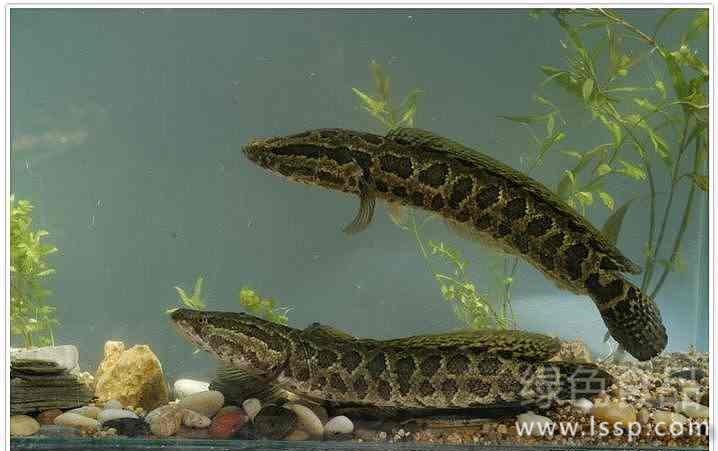
Snakehead
I. Pond selection.The pond for farming snakehead does not need to be very large; generally 3 mu to 5 mu is enough. The pond water depth is 1.5 m to 2.0 m, the bottom mud is 15-20 cm thick, and there is an ample water source with convenient drainage and filling.
II. Stocking of fingerlings.The size of the snakehead fingerlings stocked depends on the size of the commercial snakehead on the market. At present, snakehead with an individual weight of 0.7 kg to 2.0 kg sells well, so the stocked snakehead fingerlings should be 75-100 g each. The stocking density should be determined based on factors such as feed sources and rearing techniques; generally, 2000-2500 snakehead fingerlings are stocked per mu. At the same time, 400-500 bighead carp fingerlings of 100 g to 150 g each can be polycultured.
III. Feed feeding.The snakehead is a ferocious carnivorous fish that eats both live and dead food, feeding on wild trash fish such as small crucian carp. Artificial rearing uses timed and fixed-point feeding for taming. Feed twice a day, at 10 a.m. and 3 p.m. Generally, after 5-7 days of stocking, all the snakehead fingerlings can float to the surface to compete for food. While feeding, carefully observe the feeding situation of the snakehead near the feeding platform. If there are few snakehead around the feeding platform and the competition for food is not intense, it indicates that the fish are already full and feeding can be stopped.
IV. Rearing management.The snakehead has a large appetite and produces a lot of excrement, so the pond water easily becomes fertile. Plankton will multiply in large numbers in fertile water, causing oxygen depletion; therefore, special attention must be paid to changes in dissolved oxygen in the rearing pond. Once oxygen depletion occurs, turn on the aerator in time. If the oxygen depletion is severe, a method of killing part of the plankton at the water surface can be adopted, that is, splashing trichlorfon at a concentration of 0.5 ppm to 1.0 ppm on the water surface 2-3 m from the pond bank. The snakehead has strong disease resistance and rarely gets sick, but in the late autumn, if management is poor, feed is insufficient, or the water environment is poor, the snakehead can also get sick. Therefore, in the late autumn, the snakehead must be carefully observed, and once disease occurs, treat it promptly.