Eight Measures for Managing Breeding Pigeons to Improve Production Levels
To improve the productivity of breeding pigeons, that is, to achieve a high egg production rate, high fertilization rate, high hatchability, and a high survival rate for squabs and young pigeons, the feeding and management of breeding pigeons must be done well. In the feeding and management of breeding pigeons, eight key points require attention:
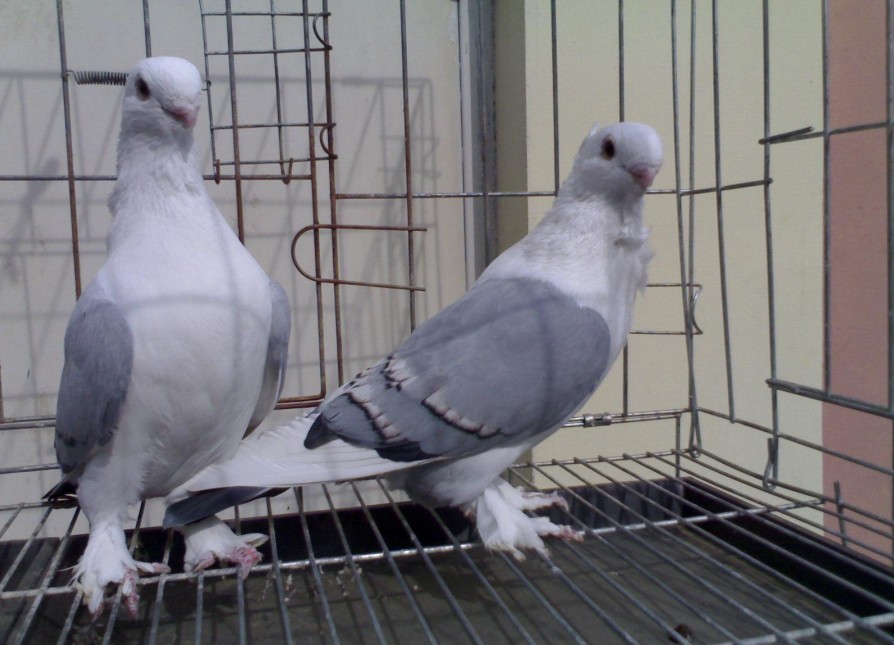
Pigeons
1. Reasonable pairing. Whether free pairing or artificial pairing is used, production records should be kept when breeding pigeons are placed in cages, and observation should be strengthened. Pay attention to whether the pairing is reasonable. If they still often fight 4-5 days after pairing, or if they still lay infertile eggs after pairing, they should be separated and re-paired. Generally, pairing a first-time laying hen pigeon with a male pigeon half a year to 1 year older than her can increase the fertilization rate. When a male pigeon has weak libido, it can be given an intramuscular injection of 5 mg of testosterone propionate once, and then another injection two or three days later. In addition, older male and female pigeons with declining libido should be culled in time.
2. Promoting incubation. Shortly after mating, the female pigeon will lay eggs. The nest should be prepared in advance so that the breeding pigeons can enter the nest to lay and incubate. After paired parent pigeons lay eggs, some will actively incubate the eggs, while some rarely or even do not incubate them. The solution is to confine the parent pigeons in the nest and cover it with black cloth to let them incubate. If the parent pigeons are still not enthusiastic about incubating after various measures are taken, they should be culled early, but if they are breeding pigeons of an excellent breed, foster pigeons can be used to hatch for them. An incubator can also be used for incubation, with the incubation temperature controlled at 39.5°C and the humidity at about 65%. After 10 hours of incubation, the eggs should be turned, 5-6 times a day, and cooled once for about 20 minutes. After 17-18 days of incubation, the chicks can hatch.
3. Use of foster pigeons.Foster pigeons are also called nurse pigeons. When parent pigeons become ill, or when excellent breeding pigeons are to lay more eggs and are unwilling to incubate, foster pigeons can be used to nurse and raise the young. Foster pigeons should be healthy, 3-5 years old, experienced in incubation and brooding, strongly broody, and their laying period should differ from that of the parent pigeons by no more than 5 days.
Breeding pigeons
4. Checking embryonic eggs.In order to improve the hatchability and hatching rate of pigeons, the pigeon eggs should be checked. The first check is on days 4-5, after candling, remove the infertile eggs; the second is on days 10-13, after candling, remove the dead embryo eggs, and let the remaining fertilized eggs continue to be incubated by breeding pigeons that laid eggs in the same period, that is, combined-egg incubation. When combining eggs, note that the incubation time of the pigeon eggs should be the same or similar. While combining eggs for incubation, the pigeons whose incubation is terminated early should be allowed to lay eggs as soon as possible. In addition, the incubation environment should be quiet. If pigeon eggs are contaminated, they should be carefully cleaned in time.
5. Assisting hatching.For young pigeons that have pecked the shell but are unable to hatch, manual assistance should be given, that is, use a needle to gently pick open the hard shell at the broken opening of the pigeon egg and extend it by half a circle or 1 circle, until the young pigeon can push the shell open.
6. Strengthening feeding and management during the pigeon molting period.Breeding pigeons begin molting in late spring and early summer each year, once a year, about 1-2 months each time. The feed amount for molting pigeons should be reduced, and the feed quality should be lowered, so that the pigeons shed feathers early and molt early due to insufficient nutrition, thereby shortening the molting period. After molting, the feed amount for the pigeons should be increased in time to supplement nutrition and strengthen the physique of the breeding pigeons.
7. Feeding and management of pigeons during the brooding period.Two hours after hatching, the breeding pigeons feed pigeon milk to the young pigeons. If after 5-6 hours the breeding pigeons still do not feed them, the cause should be checked. If the breeding pigeons are sick, they should be isolated and treated in time, and foster pigeons should be used to nurse them. If it is their first time hatching young, and they have no experience, then training should be carried out by carefully placing the beak of the young pigeon into the beak of the breeding pigeon, and after repeating several times they can learn.
8. Management in other aspects.In the management of breeding pigeons, attention should be paid to epidemic prevention work, and flying birds and other poultry should be prevented from entering the pigeon house to eliminate the occurrence of epidemics. Breeding pigeons with low production performance should be culled. In addition, the pigeon house should be cleaned and disinfected regularly, and the nutrition of the pigeons should be properly formulated.