River snails fear heat but not cold; how should artificial breeding be done?
River snails are nutritious, rich in protein, vitamins and amino acids. They are a typical high-protein, low-fat food. Wild river snails begin natural mating and egg-laying every year in April to May, when the water temperature stabilizes above 16 °C. Varieties such as the Chinese river snail, Beijing river snail and Chinese round snail are suitable for artificial breeding.
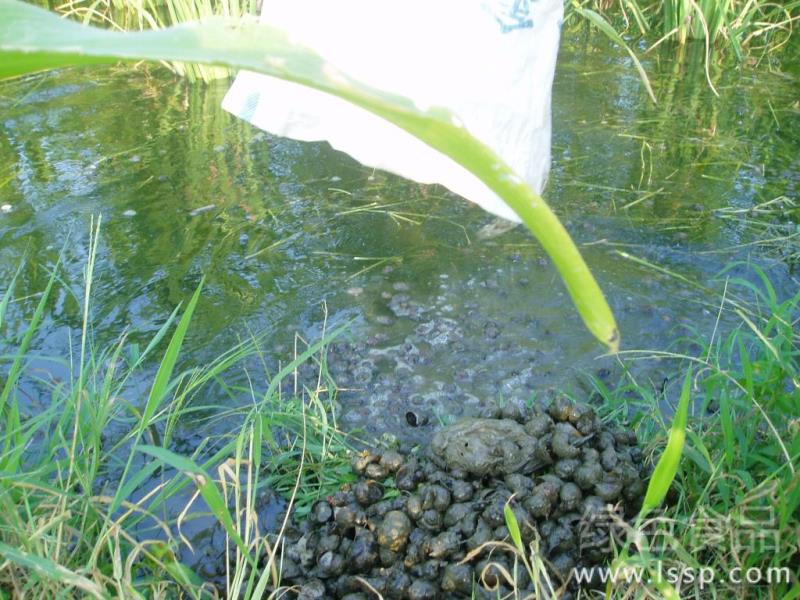
River snail breeding
I. Feeding and management of brood snails
Female snails lay eggs once every 25 to 30 days until October. They lay as few as a few dozen eggs, or as many as 2000. The brood river snail pond should be chosen in a place with a convenient water source, bottom substrate rich in humus and unpolluted water; the water depth should preferably be 30 to 80 cm, and the area can be large or small, with about 100 brood river snails stocked per square meter. Thicker bamboo stakes and wooden sticks should be inserted in the pond and along its edges for the brood snails to lay eggs on. Artificial feeding is mainly duckweed, human excrement and urine, rice bran and wheat bran, applied twice a week, with each feeding amount about 30% of the river snails' weight.
II. Feeding and management of young snails
River snails are not strict about their environment; ponds, canals, rice fields, wooden barrels and large basins can all serve as stocking ponds for river snails, and the scale can be large or small, generally stocking 1000 young river snails per square meter. The main food of young river snails is microorganisms in the water or the tender stems and leaves of aquatic plants. Artificial rearing of river snails requires applying a certain amount of farmyard manure to cultivate and breed plankton. In addition, organic fertilizer made by composting weeds from the pond edges is also a good feed for raising river snails. Various bran from grain processing and discarded vegetables can also be fed. Each application of manure should be 30% of the river snails' weight, and the feeding amount of concentrated feed such as rice bran and wheat bran should be 10% of the snail body weight, applied twice a week.
III. Issues to note in river snail rearing
River snails in water breathe through gills, so attention should be paid to the dissolved oxygen content in the water, new water should be added frequently, and excess aquatic plants should be removed. River snails fear heat but not cold; they will not die after being out of water for several days in winter, but they die after only a few hours out of water in the intense summer heat. In high temperatures, the water level should be deepened or more shade provided to cool the river snails and reduce heat stress. Attention should also be paid to preventing river snail eggs from being harmed by ants, spiders, cockroaches and the like. In addition, work should be done well to prevent river snails from escaping; although river snails are not agile, they are also prone to escaping, so in particular the escape-prevention facilities at the water outlet of the breeding pond should be strengthened.