Artificial farming of snakehead fish in wild rice stem fields to maximize resource utilization
Farming snakehead fish in wild rice stem fields makes full use of the ecological environment and biological resources in the field, so that the wild rice stem and the snakehead fish each get what they need, with good economic returns. The techniques for farming snakehead fish in wild rice stem fields are introduced below.
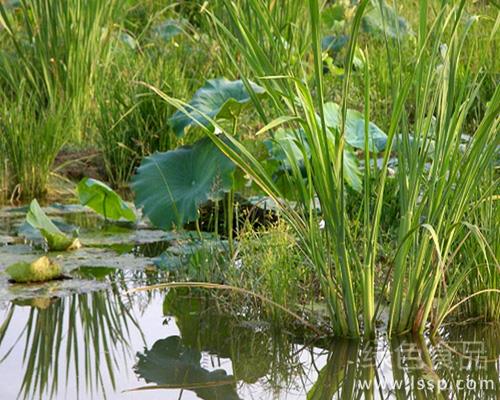
Wild rice stem field
1. Selection and preparation of the wild rice stem field
Choose a field that is well ventilated and sunny, with sufficient water sources, good water quality and convenient drainage and irrigation. The snakehead fish pit should account for 8-10% of the wild rice stem field area, with a depth of 1.2-1.5 m; where conditions permit, the snakehead fish pit can be built with materials such as brick and stone. The main ditch should connect with the fish pit, with a width of 1-1.2 m and a depth of 0.5 m, accounting for 3-5% of the wild rice stem field area; its shape depends on the field and can be dug into a “T”, “+”, “#” and other shapes, thus forming a complete system of fish pit, main ditch and branch ditches to ensure that the snakehead fish can move freely and smoothly in the wild rice stem field.
Reinforce the field ridges to a height of 0.8-1 m, or enclose them with old netting, and firmly block the water inlet and outlet with two layers of fish-blocking facilities to prevent the snakehead fish from jumping and burrowing to escape; the aquatic vegetable wild rice stem transplanted in the main field provides hiding places for the snakehead fish.
2. Planting of wild rice stem
1. Apply sufficient base fertilizer. Before planting the wild rice stem, plow the field and expose it to the sun, then irrigate and soak it; afterwards, apply 500-800 kg of decomposed organic fertilizer such as pig and cattle manure per mu of wild rice stem field, and 40 kg of calcium superphosphate as base fertilizer (evenly broadcast on the soil surface).
2. Selection of wild rice stem varieties. There are many wild rice stem varieties; adapt to local conditions and choose improved wild rice stem varieties that are high-yielding, strongly stress-resistant, early-maturing and suitable for planting in paddy fields with a deep plough layer.
3. Transplanting of wild rice stem. Transplant the wild rice stem in early to mid-April, with a row spacing of 1 m and a plant spacing of 0.6 m, transplanting more than 1000-1200 plants per mu of wild rice stem.
Snakehead fish
3. Stocking of fingerlings
Choose snakehead fish fingerlings of uniform size, free of disease and injury, robust in constitution, and trained to feed on artificial compound feed, either overwintered or of the current year. Overwintered snakehead fish fingerlings are 50-150 g in size, while current-year snakehead fish fingerlings are about 10 cm. In February-March, when the temperature is around 15°C, stock the overwintered fingerlings; for main-culture fields, stock 250-300 fish per mu, and for supplemental-culture fields, stock 20-30 fish per mu. Before transplanting the wild rice stem, first keep the overwintered snakehead fish fingerlings enclosed in the fish pit; when the wild rice stem seedlings have firm stems, release them into the main field for rearing. Alternatively, stock the snakehead fish fingerlings after the transplanted wild rice stem has taken root and revived, adapting to local conditions. Current-year snakehead fish fingerlings about 10 cm long are stocked after mid-May; main-culture fields stock 400-500 fish, and supplemental-culture fields stock 30-50 fish.
4. Field management
Fertilization, pesticide use and harvesting in the wild rice stem field still follow conventional practices, while feeding management for the snakehead fish should be especially strengthened. After feed training, the snakehead fish also feed well on artificial compound feed. For rural farming, feed sources are limited; a small meat grinder can be used to grind animal feed into minced meat at a ratio of 60%, plant feed ground into powder at a ratio of 35%, with 3% vegetable oil, 2% fish trace-element premix and a small amount of cooked starch paste added, then kneaded into ball-shaped feed for feeding; alternatively, only animal feed can be fed, with good results as well. Set up a feeding platform with fine mesh or bamboo mat 30-50 cm below the water surface of the fish pit, with an area of 1-2 sq m; feed at a daily feeding rate of 6%-10% of fish body weight, feeding 2-3 times a day, and flexibly decide the number of feedings and the amount of feed according to air temperature, water temperature, weather and the feeding conditions of the snakehead fish. In the three months of July, August and September, when the weather is good, the water temperature is high and the fish feed vigorously, feed at a daily feeding rate of 10%, 3 times a day.
For supplemental culture of snakehead fish, there is no need to feed bait; putting highly reproductive carp, crucian carp, tilapia, etc. into the field can provide bait for the snakehead fish.
Patrol the field every morning and evening; especially on thunderstorm and flood days, since snakehead fish have strong jumping and burrowing abilities, check the field ridges and fish-blocking facilities for leaks, and deal with problems promptly to prevent the snakehead fish from escaping.