Crucian carp has few diseases and high benefits: management points for efficient crucian carp farming
Crucian carp has tender, delicious meat and is rich in amino acids. It is both a fine dish and a medicinal food, with good effects in treating edema, cold-deficiency of the spleen and stomach, postpartum weakness in women, and promoting lactation. Crucian carp has strong adaptability, omnivorous feeding habits, few diseases, and good farming characteristics. Practice shows that paying attention to mastering the following techniques during farming helps achieve high yield and high benefits in crucian carp.
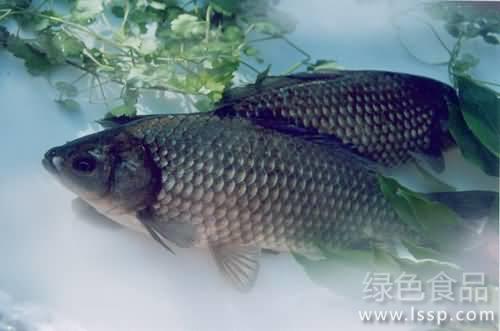
Crucian carp
I. Pond conditions
Crucian carp are accustomed to gathering in groups, burrowing into silt, and jumping against the current to escape. Ponds for mainly farming crucian carp are generally about 2 mu, with a maximum of no more than 4 mu. The pond bottom should be hard, with silt thickness allowed within 10cm; if it exceeds 10cm, the silt must be cleared to facilitate catching crucian carp. The pond embankment should be solid and not leak water, and fish-blocking screens should be installed at the inlet and outlet, firmly and reliably, and 50cm above the pond's highest water level.
II. Variety selection
The crucian carp currently sold on the market varies in quality. Practice has shown that allogynogenetic silver crucian carp and high-back allogynogenetic silver crucian carp (abbreviated as high-back crucian carp), which are suitable for main farming, grow 2 times and 3 times faster than ordinary crucian carp respectively. Allogynogenetic silver crucian carp and high-back allogynogenetic silver crucian carp are similar; the difference between allogynogenetic silver crucian carp and ordinary crucian carp is that allogynogenetic silver crucian carp has 31-32 scales along the lateral line, while ordinary crucian carp has 28-29; the number of lateral line scales of allogynogenetic silver crucian carp is the same as that of high-back crucian carp, but high-back crucian carp has a short head, high back, thick body, and round abdomen.
III. Stocking density
If the stocking number of crucian carp exceeds 2000 fish/mu, although the yield is high, the individual market-sized crucian carp are small, the selling price is low, and the benefit is not ideal; if the stocking number is less than 1000 fish/mu, although the individual market-sized crucian carp are large, the yield is not high and sales income is low. Stocking 1400 crucian carp fingerlings of 30 grams per mu or 1200 crucian carp fingerlings of 50 grams, together with no more than 600 total silver carp, bighead carp, and summer grass carp, can yield a net production of more than 500 kg of crucian carp and about 200 kg of other fish, with ideal results.
IV. Water quality management
The calcium and phosphorus content in crucian carp is more than 2 times that of other fish, so the pond water for farming crucian carp needs to be rich in calcium and phosphorus to meet the needs of crucian carp. Use 60 kg of quicklime solution per mu each time, applied once about every 20 days; use 15-2 0 kg of superphosphate per mu each time, applied once every 15 days. Superphosphate can only be applied 3-5 days after quicklime is applied, to prevent the water from becoming too alkaline and reducing the effectiveness of phosphate fertilizer.