How to manage meat geese when summer heat affects their vitality?
In summer heat, meat geese have low appetite and insufficient vitality, and raising goslings in hot weather is relatively difficult. So how can summer management of meat geese be done well?
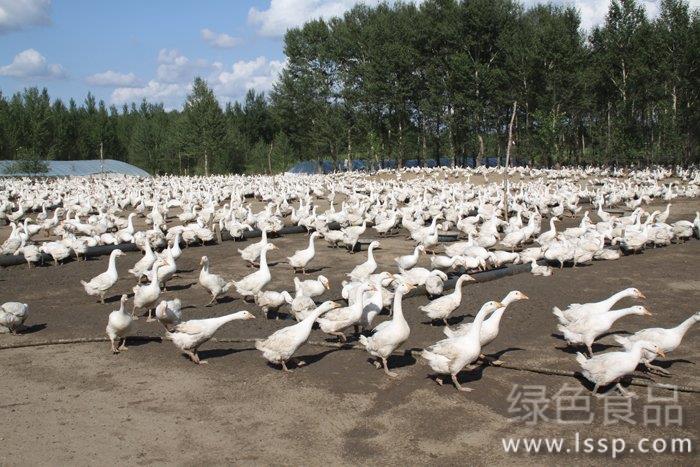
Meat goose farming
Cooling and heat prevention
Stocking density: it is suitable to raise 6-7 meat geese per sq m. In summer, the temperature of the goose house should be kept below 26°C. Maintain ventilation and air permeability, and spread fine sand 1 cm thick on the ground. Set up a shade shelter over the geese's activity area to block the sun. When the weather is hot, spray cold water around the goose house, or spray a fine mist of cold water onto the geese.
Intensive rearing of goslings
One day after the goslings hatch, place finely cut fresh tender vegetable leaves in the hand to lure them to eat; if most goslings compete for the food, they can be started on feed. After starting feed, first train them to drink water, then evenly scatter the chopped vegetable leaves in batches on a plastic sheet for the goslings to eat, feeding once every 2 hours. After 1.5-2 days, when the geese can eat until 70% full, then scatter-feed an appropriate amount of cooked rice or soaked crushed rice. From the 3rd day, switch to feeding from troughs, 4-5 times a day, with the last feeding at around 10 p.m.
For goslings aged 6-10 days, feed 6-8 times a day, including 2 feedings at night. In the daily ration, rice accounts for 20%-30%; green feed accounts for 70%-80%.
At 11-20 days of age, gradually change the rice to crushed rice, feed 6 times a day, including 2 feedings at night, and carry out appropriate grazing during the day.
At 21-30 days of age, transition from additionally feeding boiled cracked wheat grains to feeding soaked wheat grains; when approaching 30 days of age, dry grains can be fed, and the grazing time should be extended. Each feeding amount should be based on eating until 90% full, and at the same time let the goslings drink as much water as possible.
Combination of confinement and grazing
After meat geese reach 30 days of age and before the wing feathers grow out, make full use of the lower summer temperatures to graze them in places with good grass quality and sufficient grass quantity; at other times, keep them confined and appropriately supplement with concentrated feed such as bran, rice grain and corn. Especially when the down on the back and abdomen of the meat geese is being replaced by new feathers, even more attention should be paid to supplementing with high-quality concentrated feed such as barley, wheat and corn, so as to avoid uneven molting in the meat geese and affecting growth and development. Supplement-feed 2-3 times a day, with each feeding at 80%-90% full.
Timely fattening
After the meat geese grow their main wing feathers, begin fattening. During the fattening period, confinement rearing is suitable, and the feed is mainly corn, rice grain, wheat, bran and so on, matched with an appropriate amount of protein feed and roughage.
Reference formula for fattening
Corn 40%, rice grain 15%, wheat bran 19%, rice bran 10%, rapeseed meal 11%, fish meal 3.7%, bone meal 1%, salt 0.3%. The feed should be crushed, add water, and mix into a dry-wet state; feed 4-5 times a day, including 1 feeding at night, let the geese eat their fill, and provide enough drinking water. Clean the pen every day, wash the feed troughs and water troughs, and let the meat geese enter the water once every other day for about half an hour. After 15-20 days of fattening, when the breast muscles feel plump to the touch and the back fat has thickened, they can be sold.
Epidemic prevention and disease elimination
Each newly hatched gosling is injected intramuscularly with 0.02 milliliters of antiserum vaccine to prevent goose plague. At around 30 days of age, each is injected intramuscularly with 1.5 milliliters of fowl cholera vaccine. Rearing utensils should be disinfected with 5% fresh limewater once every 3-5 days. The goose house and activity area should be disinfected with 1% bleaching powder solution once every 7-10 days.