How to artificially fatten pheasants to advance their market time
From the beginning of the week age to 16-18 weeks of age is the fattening stage of pheasants, and the body weight of pheasants in the fattening stage shows a straight-line upward trend.
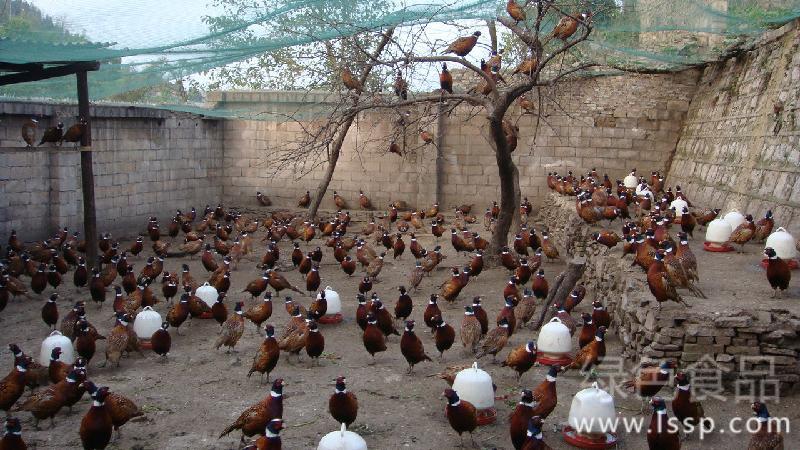
Pheasant farming
1. Reasonable feeding
For pheasants fed on raw grain, the proportion of energy feed such as corn and sorghum can be appropriately increased (recommended formula: corn 40%, wheat 15%, roasted peas 20%, rapeseed cake 15%, wheat bran 5%, rice bran 4%, bone meal 1%, plus 2.5kg of salt and an appropriate amount of trace elements per ton of pheasant feed); for those fed on domestic chicken feed, broiler growth feed can be used for fattening. Ensure sufficient drinking water, and in addition 10%—20% green feed can be added. Ensure that pheasants can take a sand bath at least once a week, spraying a 2% trichlorfon solution into river sand to kill external parasites on the pheasants' bodies.
2. Control density
In the early stage (5—11 weeks of age), raise 10-2 pheasants per square meter, then raise them in groups according to male and female, strength and weakness, and size, with the breeding density gradually reduced to 6-8 per square meter. At the same time, enough feed troughs should be set up so that pheasants can feed evenly and grow uniformly.
3. Set up perches, prevent pecking vice
Perches for pheasants to rest on should be placed inside and outside the chicken house, which not only makes full use of the breeding space but also helps reduce pecking vice in pheasants. Under high-density breeding, pheasants are prone to pecking feathers, pecking the cloaca, and so on. For pheasants that have been pecked and injured, they should be taken out, and the wounds coated with gentian violet or camphor ointment, and raised in isolation. Or regulate the pheasant flock: (1) hang green grass or green vegetables in the chicken house to lure pheasants into pecking at the vegetables, which both distracts the pheasants and supplements vitamins and cellulose; (2) 1% feather meal can be added to the feed of pheasants at 9-11 weeks of age; (3) increase the salt content in the feed to 2.5%, or add salt to the drinking water, and ensure sufficient water supply. Of course, to avoid pecking injuries, debeak the pheasants at the appropriate time during the chick stage.
4. Prevent startling and flying
Keep the pheasant farm quiet, decline visitors, and reduce external influences on the pheasants. To prevent pheasants from being injured or killed by collision when startled into flight, cut off the primary flight feathers on one side of the pheasants; the netting of the chicken house should not be built too high.
5. Do a good job in epidemic prevention
Clean the chicken house every day, and disinfect once a week with disinfectants such as Baidusha. Pheasants at 8—9 weeks of age are vaccinated via drinking water (the drinking water vaccination dose is 2 times the injection dose) with Newcastle disease strain II vaccine. During the fattening period, if there is continuous rainy weather, 0.04% terramycin or other antibiotics should be added to the pheasant feed to prevent fowl cholera or coccidiosis; generally administer the drug for 1 week, stop for 1 week, then administer for another 1 week.